
[Paper Review] Two Anderson impurities coupled through a superconducting island: charge stability diagrams and double impurity qubit
This paper proposes a double impurity qubit (DIQ) based on two quantum dots coupled via a superconducting island, leveraging electron-hole symmetry and parity protection to achieve extreme charge noise insensitivity. The key result is a tunable qubit with a nearly zero transition dipole moment, enabling high inhomogeneous dephasing times and suggesting a novel platform for multi-photon driven and strongly nonlinearly coupled qubit operations.
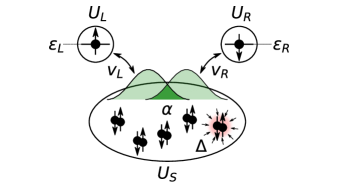
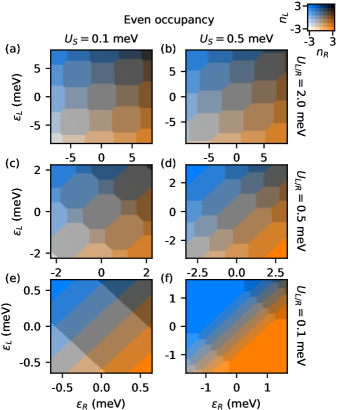
We present a model of two Anderson impurities coupled to and through a superconducting island. The model parametrizes the strength of the coupling between impurity sites, allowing it to represent a variable distance between the impurities. We systematically explore the effect of the model parameters in the subspaces with total even and odd occupancy, identifying unique features of the charge stability diagrams that distinguish the two parities. For total odd electron parity, we identify a device tuning, in which the splitting between the two lowest energy states is highly insensitive to changes of the chemical potentials. We investigate the degree to which a qubit based on such two states is tunable and discuss an optimal choice of parameters to maximize inhomogeneous dephasing time. Finally, we point out that the proposed qubit lacks a transition dipole moment, and outline some of the consequences on viable driving and readout mechanisms. The prototype qubits could be realized with the existing capabilities of coupling quantum dots to hard-gapped superconductors.
Motivation & Objective
- To design a qubit architecture that is highly insensitive to charge noise by exploiting superconducting screening and electron-hole symmetry.
- To identify a device tuning regime where the energy splitting between the two lowest states is robust against chemical potential fluctuations.
- To explore the feasibility of using the double impurity system as a topologically inspired qubit with minimal charge susceptibility.
- To analyze the implications of a vanishing transition dipole moment for qubit driving and readout, proposing alternative mechanisms.
- To demonstrate that the proposed qubit can be realized with existing quantum dot–superconductor coupling technology.
Proposed method
- Formulates a two-impurity Anderson model coupled to a superconducting island using the BCS zero-bandwidth approximation.
- Parametrizes the inter-impurity coupling strength via a mixing angle α, allowing control over effective distance and hybridization.
- Analyzes the system in subspaces of even and odd total electron occupancy, focusing on charge stability diagrams and energy level splitting.
- Identifies a 'sweet spot' in parameter space where the qubit splitting is insensitive to chemical potential variations due to symmetry and parity protection.
- Evaluates the qubit's tunability and dephasing time by optimizing parameters such as tunneling strength and asymmetry.
- Proposes alternative qubit control and readout schemes, including parametric driving via quantum capacitance and resonator coupling, due to the absence of a dipole moment.
Experimental results
Research questions
- RQ1Can a double impurity qubit coupled through a superconducting island achieve high charge noise insensitivity through symmetry and parity protection?
- RQ2What parameter regimes yield a qubit splitting that is robust against chemical potential fluctuations?
- RQ3How does the absence of a transition dipole moment affect qubit driving and readout, and what alternative mechanisms are viable?
- RQ4To what extent can the qubit's inhomogeneous dephasing time be maximized through optimal parameter tuning?
- RQ5Can the system be realized with current quantum dot–superconductor integration capabilities?
Key findings
- The double impurity qubit exhibits a highly insensitive energy splitting to chemical potential variations when tuned to the electron-hole symmetric point with odd total electron parity.
- The qubit's ground state superpositions are charge-neutral, with equal population on both impurities, resulting in zero electric dipole and transition dipole moment.
- The inhomogeneous dephasing time can be maximized by tuning the system to the sweet spot, where the energy splitting is least sensitive to charge noise.
- Conventional single-photon driving is ineffective due to the vanishing dipole moment, necessitating strong two-photon Rabi driving with quadratic drive dependence.
- Readout can be achieved via parametric coupling to a resonator using quantum capacitance differences between qubit states, or via baseband pulse-induced detuning.
- The system realizes the minimal fermionic qubit as defined by Bravyi and Kitaev, and offers a platform for studying strongly nonlinear coupling and multi-photon processes.
Read this paper
Open the full text in the Nubint reader and ask about any passage as you read.
Read this paper on NubintThis review was generated by AI from the original paper. Please check the paper before citing it.