
[Paper Review] Unconventional crystal structure of the high-pressure superconductor La$_3$Ni$_2$O$_7$
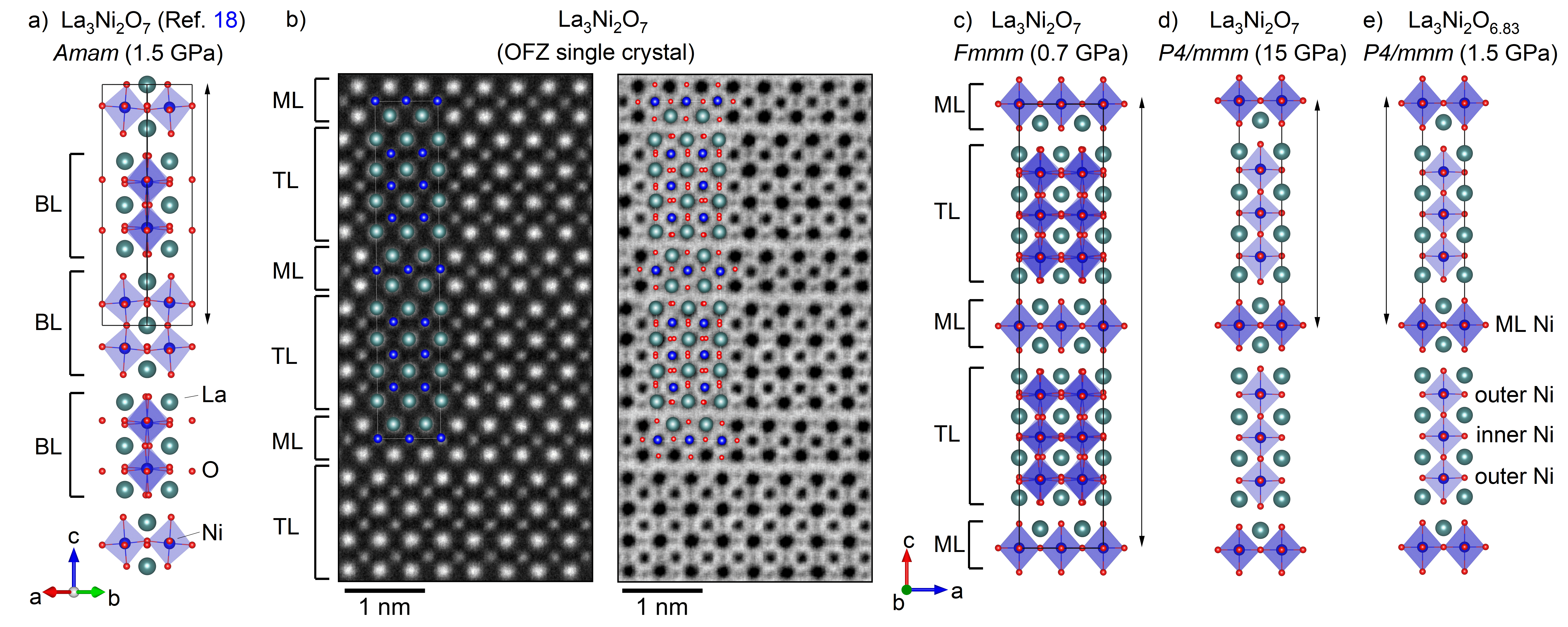
The paper reveals that La3Ni2O7 single crystals under high pressure host a monolayer–trilayer (ML–TL) alternating stacking, not the previously assumed bilayer RP structure, and links this structure to superconductivity observed under pressure.
The discovery of high-temperature superconductivity in La$_3$Ni$_2$O$_7$ at pressures above 14 GPa has spurred extensive research efforts. Yet, fundamental aspects of the superconducting phase, including the possibility of a filamentary character, are currently subjects of controversial debates. Conversely, a crystal structure with NiO$_6$ octahedral bilayers stacked along the $c$-axis direction was consistently posited in initial studies on La$_3$Ni$_2$O$_7$. Here we reassess this structure in optical floating zone-grown La$_3$Ni$_2$O$_7$ single crystals that show signs of filamentary superconductivity. Employing scanning transmission electron microscopy and single-crystal x-ray diffraction under high pressures, we observe multiple crystallographic phases in these crystals, with the majority phase exhibiting alternating monolayers and trilayers of NiO$_6$ octahedra, signifying a profound deviation from the previously suggested bilayer structure. Using density functional theory, we disentangle the individual contributions of the monolayer and trilayer structural units to the electronic band structure of La$_3$Ni$_2$O$_7$, providing a firm basis for advanced theoretical modeling and future evaluations of the potential of the monolayer-trilayer structure for hosting superconductivity.
Motivation & Objective
- Identify the actual crystal structure of La3Ni2O7 single crystals under high pressure and assess deviations from the previously proposed bilayer model.
- Determine how high-pressure structural phases correlate with superconductivity and transport properties.
- Convert structural findings into a coherent electronic structure picture to guide theoretical modeling.
Proposed method
- Synthesize La3Ni2O7 single crystals using optical floating zone under high oxygen pressure.
- Use scanning transmission electron microscopy (STEM) to resolve local stacking sequences (ML and TL units).
- Perform high-resolution single-crystal X-ray diffraction (XRD) under pressure to refine unit cells and symmetry.
- Conduct density functional theory (DFT) calculations for ML–TL stacking to analyze band structure and Fermi surface.
- Compare high-pressure structural refinements with RP-phase stacking and assess bond angles/distances including Ni–O–Ni bonds.
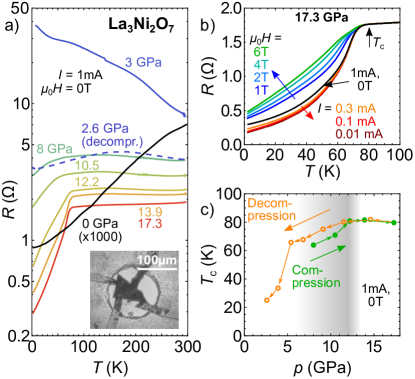
- Examine transport under pressure to correlate Tc with structural parameters and hysteresis behavior.
Experimental results
Research questions
- RQ1What is the actual stacking sequence of NiO6 octahedra in La3Ni2O7 under high pressure?
- RQ2How does the ML–TL stacking differ from the conventional RP bilayer structure both structurally and electronically?
- RQ3How do structural transitions correlate with the emergence and evolution of superconductivity under pressure?
- RQ4What does the electronic structure and Fermi surface look like for the ML–TL phase, and how does it compare with RP nickelates?
- RQ5Can observed superconductivity be reconciled with filamentary behavior and phase purity/mixtures in the crystals?
Key findings
- La3Ni2O7 single crystals under high pressure predominantly exhibit a alternating monolayer and trilayer NiO6 octahedral stacking (ML–TL), not the bilayer stacking previously assumed.
- STEM imaging shows ML–TL order across investigated regions, with occasional interruptions by TL-rich or BL-like regions; extended pure BL stacking is not detected.
- XRD refinements indicate an orthorhombic Fmmm structure at low/moderate pressure and a transition to tetragonal P4/mmm symmetry above ~12.3 GPa; Tc increases with pressure and shows hysteresis correlating with structural changes.
- DFT for the ML–TL phase reveals multiple Ni 3d-derived bands near the Fermi level, with distinct contributions from ML and TL units, including an almost pure d_z^2-derived Fermi-surface feature (epsilon sheet).
- The Fermi surface comprises four sheets in the k_z = 0 plane (alpha, beta, gamma, epsilon) and their duplicates, with orbital and unit-cell disentanglement showing ML-localized and TL-delocalized contributions.
- The observed superconductivity appears filamentary, with non-Ohmic transport below Tc and field-current dependence suggesting inhomogeneous superconducting regions within ML–TL bulk.
Read this paper
Open the full text in the Nubint reader and ask about any passage as you read.
Read this paper on NubintThis review was generated by AI from the original paper. Please check the paper before citing it.