
[Paper Review] X-ray Polarization of the Black Hole X-ray Binary 4U 1630-47 Challenges Standard Thin Accretion Disk Scenario
IXPE detects energy-dependent high X-ray polarization in 4U 1630–47 that cannot be explained by standard thin disc models; a partially ionised, outflowing disc atmosphere provides an explanation.
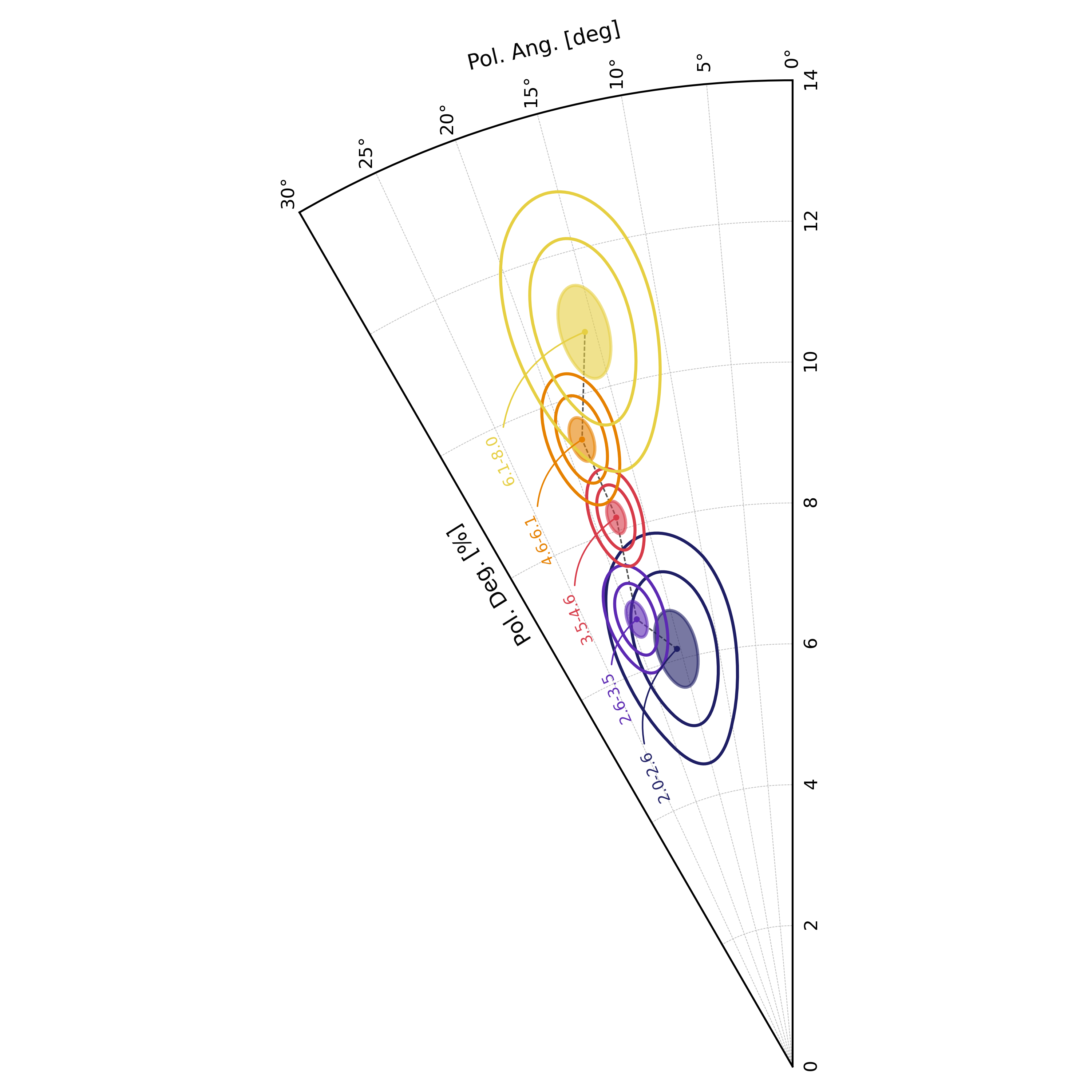
Large energy-dependent X-ray polarization degree is detected by the Imaging X-ray Polarimetry Explorer ({IXPE}) in the high-soft emission state of the black hole X-ray binary 4U 1630--47. The highly significant detection (at $\approx50σ$ confidence level) of an unexpectedly high polarization, rising from $\sim6\%$ at $2$ keV to $\sim10\%$ at $8$ keV, cannot be easily reconciled with standard models of thin accretion discs. In this work we compare the predictions of different theoretical models with the {IXPE} data and conclude that the observed polarization properties are compatible with a scenario in which matter accretes onto the black hole through a thin disc, covered by a partially-ionized atmosphere flowing away at mildly relativistic velocities.
Motivation & Objective
- Assess the energy-dependent X-ray polarization in 4U 1630–47 during the high-soft state.
- Test standard thin accretion disc predictions against IXPE polarimetry data.
- Explore whether disc atmosphere outflows and absorption can reproduce observed polarization.
- Constrain disc geometry parameters (spin, inclination) through combined IXPE/NICER/NuSTAR analysis.
Proposed method
- Use IXPE to measure polarization degree (PD) and angle (PA) in 2–8 keV with energy resolution (PD 6% at 2 keV to 10% at 8 keV; PA 17.8°).
- Perform quasi-simultaneous spectral fits to NICER and NuSTAR with models including thin/slimb disc emission, Comptonisation, and ionised absorption.
- Compare observed PD/PA with predictions from standard Chandrasekhar scattering in a thin disc and with models including a partially ionised, outflowing disc atmosphere.
- Incorporate relativistic effects and potential wind scattering to assess impact on observed PD.
- Constrain black hole mass, spin, and inclination via Kerr-based and slim-disc spectral models (kerrbb, slimbh).
- Explore parameter space (a, i, Mbh) to reproduce the IXPE polarisation measurements.
Experimental results
Research questions
- RQ1Can standard thin accretion disc models reproduce the observed energy-dependent polarization degree and angle?
- RQ2Does including a partially ionised, outflowing disc atmosphere reconcile the IXPE polarimetry with the NICER/NuSTAR spectra?
- RQ3What disc geometry and black hole parameters (spin, inclination, mass) are required to fit both spectroscopic and polarimetric data?
- RQ4Is there evidence for winds or outflows influencing the X-ray polarization signature in 4U 1630–47?
Key findings
- The 2–8 keV polarization degree rises from ~6% at 2 keV to ~10% at 8 keV, with a PA ~17.8°, inconsistent with standard thin disc predictions.
- Pure Thomson scattering in a semi-infinite, flat disc under GR effects cannot reproduce the observed high PDs.
- A model with a geometrically thinner disc plus a highly ionised, optically thick atmosphere outflowing at v ~ 0.5 c perpendicular to the disc can explain the PD/PA, especially for low spin (a ≲ 0.5) and i ≈ 70–75° (or higher if certain conditions hold).
- Relativistic beaming from an outflowing atmosphere increases PD for higher inclinations, aiding agreement with observations.
- Strong equatorial wind absorption lines (v ~ 0.003 c) are present and may be connected to the same material that forms the rapidly outflowing atmosphere.
- A slim-disc or puffed-disc geometry can yield higher PDs and energy-dependent PDs, but even at optimistic parameters they do not fully match the observed levels; best-fit slim-disc results imply high spin and high mass unless the distance is adjusted.
Read this paper
Open the full text in the Nubint reader and ask about any passage as you read.
Read this paper on NubintThis review was generated by AI from the original paper. Please check the paper before citing it.