
[Paper Review] Cygnus X-3 revealed as a Galactic ultraluminous X-ray source by IXPE
IXPE detects high, nearly energy-independent X-ray polarization from Cygnus X-3, revealing a narrow optically thick funnel and super-Eddington beaming, reclassifying it as a Galactic ULX analogue.
The accretion of matter by compact objects can be inhibited by radiation pressure if the luminosity exceeds the critical value, known as the Eddington limit. Discovery of ultraluminous X-ray sources has shown that accretion can proceed even when the apparent luminosity significantly exceeds this limit. High apparent luminosity might be produced thanks to geometric beaming of the radiation by an outflow. The outflow half-opening angle, which determines the amplification due to beaming, has never been robustly constrained. Using the Imaging X-ray Polarimetry Explorer, we made the measurement of X-ray polarization in the Galactic X-ray binary Cyg X-3. We find high, over 20%, nearly energy-independent linear polarization, orthogonal to the direction of the radio ejections. These properties unambiguously indicate the presence of a collimating outflow in the X-ray binary Cyg~X-3 and constrain its half-opening angle, <15 degrees. Thus, the source can be used as a laboratory for studying the super-critical accretion regime. This finding underscores the importance of X-ray polarimetry in advancing our understanding of accreting sources.
Motivation & Objective
- Investigate the accretion-ejection geometry of Cygnus X-3 using X-ray polarization.
- Determine whether the primary X-ray emission is obscured and reflection-dominated.
- Constrain the funnel geometry and opening angle to assess beamed luminosity relative to Eddington.
- Compare main and ToO states to understand changes in the accretion flow during state transitions.
Proposed method
- Perform X-ray spectropolarimetric analysis of IXPE data (2–8 keV) using a phenomenological model with absorbed broken power law, a thermal component, and Gaussian lines for the iron complex.
- Model polarization for each spectral component with a constant polarization and include cross-calibration with a Multiplicative Power Law across IXPE detectors.
- Use orbital-phase-resolved analysis with recent ephemeris to examine polarization variations across the binary orbit.
- Infer geometry by relating observed polarization to reflection from an optically thick funnel and compute intrinsic luminosity and beaming implications.
- Compare Main and ToO observations to assess changes in funnel properties during state transitions.
Experimental results
Research questions
- RQ1Is the primary X-ray source in Cygnus X-3 obscured, with observed emission dominated by reflection?
- RQ2What is the geometry and opening angle of the funnel around the X-ray source, and how does it affect beamed luminosity?
- RQ3Does the polarization pattern indicate reflection-dominated emission vs. scatter in the WR wind or other media?
- RQ4How does the accretion geometry change between hard (quiescent) and ultrasoft states, and what is the effect on observed polarization?
- RQ5Can the intrinsic luminosity exceed the Eddington limit given the inferred funnel geometry?
Key findings
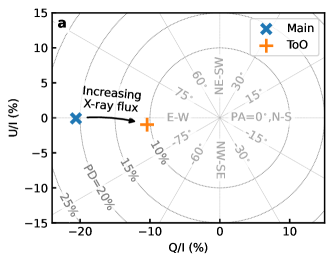
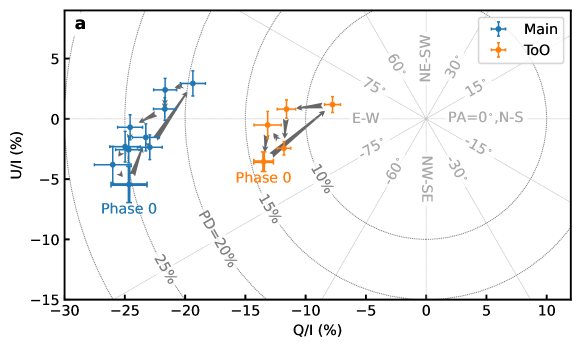
- A high polarization degree of 20.6% ± 0.3% (Main) with PA 90.1° ± 0.4° is observed in 2–8 keV, indicating reflection-dominated emission.
- The polarization is largely energy-independent, supporting a reflection-dominated scenario over a primary-continuum scenario.
- Modelling implies an optically thick envelope with a narrow funnel around the primary X-ray source, with a half-opening angle Δα ≲ 16°.
- Intrinsic luminosity in 2–8 keV exceeds the Eddington limit for a neutron star for α ≈ 8°, and may exceed it for a 20 M☉ black hole at α ≈ 16°.
- The observed apparent luminosity for an observer down the funnel is L ≳ 5×10^39 erg s^-1 in 2–8 keV, placing Cygnus X-3 in the ULX class for such viewing angles.
- A second ToO observation during a soft state shows PD ≈ 10.4% with PA ≈ 92.6°, suggesting reflection persists with altered funnel conditions as accretion changes.
Read this paper
Open the full text in the Nubint reader and ask about any passage as you read.
Read this paper on NubintThis review was generated by AI from the original paper. Please check the paper before citing it.