
[论文解读] Flavor mixing and CP violation from the interplay of $S_4$ modular group and gCP
本文提出了一种基于 $S_4$ 模形式对称性与广义 CP(gCP)对称性的统一味物理模型,用于解释轻子与夸克的质量及混合模式。通过将物质场分配至 $S_4$ 的不可约表示,并利用模参数 $\tau$ 的模形式,该框架以最少的自由参数生成了层级式质量与混合角。关键成果是识别出九种可行的轻子模型,包含七个实自由参数(含 $\text{Re}\tau$、$\text{Im}\tau$),以及十种夸克模型,包含七个耦合常数,成功拟合了实验数据,包括 CP 破坏与重子生成机制。
We have performed a systematical analysis of lepton and quark masses models based on $Γ_4\cong S_4$ modular symmetry with gCP symmetry. We have considered both cases that neutrinos are Majorana particles and Dirac particles. All possible nontrivial representation assignments of matter fields are considered, and the most general form of fermion mass matrices are given. The phenomenologically viable models with the lowest number of free parameters together with the results of fit are presented. We find out nine lepton models with seven real free parameters including the real and imaginary parts of modulus for Majorana neutrinos, which can accommodate the lepton masses and neutrino oscillation data. The prediction for leptogenesis is studied in an example lepton model. The observed baryon asymmetry as well as lepton masses and mixing angles can be explained. For Dirac neutrinos, four lepton models with five real free couplings are compatible with experimental data. Ten quark models containing seven couplings are found to be able to accommodate the hierarchical quark masses and mixing angles and CP violation phase. Furthermore, the $S_4$ modular symmetry can provide a unified description of lepton and quark flavor structure, and a benchmark model is presented.
研究动机与目标
- 构建一个基于 $S_4$ 模形式对称性与 gCP 对称性的最小化且可预测的轻子与夸克质量及混合味物理模型。
- 系统分类 $S_4$ 下物质场所有可能的非平凡表示分配,并推导最一般的费米子质量矩阵。
- 识别出自由参数最少的物理上可行模型,以重现中微子振荡、夸克质量及混合角的实验数据。
- 研究在 $S_4$-模形式框架下,重子生成与 CP 破坏的物理含义。
- 证明 $S_4$ 模形式对称性结合 gCP 能够统一描述轻子与夸克的味结构。
提出的方法
- 利用 $S_4$ 模形式对称性,将模参数 $\tau$ 视为自由参数,生成作为超势中 Yukawa 耦合的模形式。
- 引入广义 CP(gCP)对称性以约束复相位,减少自由参数数量,确保当 Clebsch-Gordan 系数为实数时所有耦合均为实数。
- 系统分析 $S_4$ 的所有不可约表示(1, 1', 2, 3, 3')在左手中微子、右手中微子及夸克场中的分配,推导最一般的质量矩阵。
- 利用模形式的权 $k$ 及其变换性质,构建中微子与带电费米子的 Dirac 与 Majorana 质量矩阵。
- 对生成的模型进行数值拟合,以匹配实验数据,包括中微子质量、混合角、夸克质量及 CKM 混合参数。
- 在基准轻子模型中研究重子生成机制,评估模型生成观测到的重子不对称性的能力。
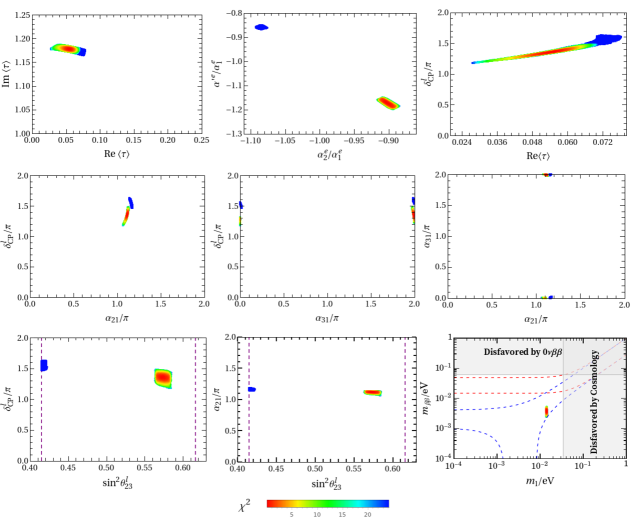
![Figure 1: The correlations among the input parameters, lepton mixing angles, CP violation phases and neutrino masses in the model L1. The lepton masses and mixing angles are required to lie in the experimentally preferred $3\sigma$ regions [ 76 ] . Notice that the transformation $\tau\rightarrow-\ta](https://ar5iv.labs.arxiv.org/html/2106.11659/assets/x1.png)
实验结果
研究问题
- RQ1结合 $S_4$ 模形式对称性与 gCP 对称性,能否构建一个仅含少数自由参数的最小化且可预测的轻子质量与混合模型?
- RQ2存在多少种可行的轻子模型(含 Majorana 中微子)可同时拟合中微子振荡数据、CP 破坏与重子生成?
- RQ3在 $S_4$-模形式框架下结合 gCP 对称性,描述夸克质量与混合角所需的最少自由参数数量是多少?
- RQ4相同的 $S_4$-模形式与 gCP 框架能否一致地描述轻子与夸克的味结构?
- RQ5模参数 $\tau$ 在此框架中如何实现质量的层级结构与 CP 破坏?
主要发现
- 识别出九种具有 Majorana 中微子的物理上可行的轻子模型,每种模型包含七个实自由参数(含 $\text{Re}\tau$ 与 $\text{Im}\tau$),成功拟合中微子质量、混合角与 CP 破坏。
- 四种具有 Dirac 中微子的轻子模型与五个实耦合常数被发现与实验数据兼容,包括中微子振荡参数。
- 构建了十种夸克模型,包含七个实耦合常数,成功重现了夸克的层级质量、混合角及 CKM 矩阵中的观测 CP 破坏相位。
- 该模型在基准轻子模型中成功通过重子生成机制解释了观测到的重子-熵比数量级。
- 引入 gCP 对称性显著减少了自由参数数量,当 Clebsch-Gordan 系数为实数时强制耦合为实数,从而增强了模型的可预测性。
- $S_4$ 模形式对称性结合 gCP 提供了一个统一框架,通过单一的群论与模形式构造,同时描述了轻子与夸克的味结构。
更好的研究,从现在开始
从阅读论文到最终审阅,大幅缩短您的研究时间。
无需绑定信用卡
本解读由 AI 生成,并经人工编辑审核。