
[论文解读] Fractionalization of Coset Non-Invertible Symmetry and Exotic Hall Conductance
本论文提出了一种在 (2+1)D 拓扑序中对非可逆共轭对称性 $G/K$ 进行分数化的框架,其中 $K$ 是 $G$ 的非正规子群。研究表明,通过缺陷的“夹心”构造及显式晶格模型,即使对称性本身是非可逆的,此类对称性仍可导致奇异的霍尔电导率。关键示例包括 $O(2)$ 和 $S_3$ gauge 理论,展示了分数化任意子和混合异常现象。
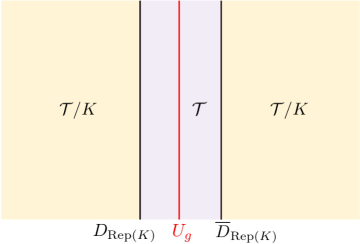
We investigate fractionalization of non-invertible symmetry in (2+1)D topological orders. We focus on coset non-invertible symmetries obtained by gauging non-normal subgroups of invertible $0$-form symmetries. These symmetries can arise as global symmetries in quantum spin liquids, given by the quotient of the projective symmetry group by a non-normal subgroup as invariant gauge group. We point out that such coset non-invertible symmetries in topological orders can exhibit symmetry fractionalization: each anyon can carry a "fractional charge" under the coset non-invertible symmetry given by a gauge invariant superposition of fractional quantum numbers. We present various examples using field theories and quantum double lattice models, such as fractional quantum Hall systems with charge conjugation symmetry gauged and finite group gauge theory from gauging a non-normal subgroup. They include symmetry enriched $S_3$ and $O(2)$ gauge theories. We show that such systems have a fractionalized continuous non-invertible coset symmetry and a well-defined electric Hall conductance. The coset symmetry enforces a gapless edge state if the boundary preserves the continuous non-invertible symmetry. We propose a general approach for constructing coset symmetry defects using a "sandwich" construction: non-invertible symmetry defects can generally be constructed from an invertible defect sandwiched by condensation defects. The anomaly free condition for finite coset symmetry is also identified.
研究动机与目标
- 将对称性分数化从可逆对称性扩展至非可逆对称性,特别是当 $K$ 在 $G$ 中非正规时的共轭对称性 $G/K$。
- 理解在自旋液体和规范化的分数量霍尔(FQH)态中出现的此类非可逆对称性如何在拓扑序中实现分数化。
- 建立在 (2+1)D 中系统化构造和分类共轭非可逆对称性分数化模式的方法。
- 证明即使对称性是非可逆的,这些对称性仍可支持定义良好的电霍尔电导率。
- 探讨异常与脱禁临界点在实现分数化非可逆对称性的系统中的作用。
提出的方法
- 通过‘夹心’机制构建非可逆缺陷:将可逆对称性缺陷与凝聚缺陷(凝聚子群 $K$)结合。
- 使用陈-西蒙斯场论描述体态拓扑序,以 $O(2)_{2k}$ 和 $S_3$ 量子双模型作为关键示例。
- 通过将 $G$ 的表示分解为 $K$ 的表示来分析对称性分数化,展示共轭对称性如何作用于威尔逊线。
- 通过研究任意子与对称性缺陷的统计交换行为以及威尔逊线在共轭对称性下的变换,推导晶格上的分数化数据。
- 应用异常流入与一致性条件,对有限共轭对称性的可能分数化模式进行分类。
- 通过规范 $G$ 的离散子群 $K$,研究脱禁临界点,导致 1-形式对称性与共轭对称性之间的混合异常。
实验结果
研究问题
- RQ1在 (2+1)D 拓扑序中,如何对形式为 $G/K$ 的非可逆对称性(其中 $K$ 在 $G$ 中非正规)实现分数化?
- RQ2此类非可逆对称性中的分数化具有何种物理意义与可观测后果,特别是在输运响应方面?
- RQ3在非可逆对称性系统中,是否可以定义良好的霍尔电导率?其与标准 $U(1)$ 霍尔电导率有何不同?
- RQ4任意子的统计交换与耦合性质在共轭非可逆对称性作用下如何变化?
- RQ51-形式对称性与共轭对称性之间的混合异常对脱禁量子临界性有何影响?
主要发现
- 通过规范 $U(1)_{2k}$ 分数量霍尔(FQH)态的 $\bZ_2$ 电荷共轭对称性,得到的 $O(2)_{2k}$ 陈-西蒙斯理论表现出连续的非可逆对称性 $(U(1)\rtimes\bbZ_2)/\bbZ_2$,称为余弦对称性。
- 该余弦对称性被实现为分数化:$O(2)_{2k}$ 理论中的任意子在该对称性下携带分数电荷,形成由电荷共轭关联的相反分数电荷的叠加态。
- 尽管该对称性是非可逆的,电霍尔电导率仍保持良好定义,且在电荷共轭下为偶函数,从而支持一致的响应函数。
- 在 $S_3$ 量子双模型中,共轭对称性 $S_3/\bbZ_2$ 非平凡地作用于 $\bbZ_2$ 威尔逊线,将其映射至真空线,这种变换对可逆对称性而言是不可能的。
- $S_3/\bbZ_2$ 对称性的分数化导致 $\bbZ_2$ 1-形式对称性与共轭对称性之间的混合异常,从而在临界点处阻止了禁闭。
- 缺陷夹心构造提供了一种通用机制,可从可逆对称性与凝聚缺陷构建非可逆缺陷,从而实现对分数化模式的系统分类。
![Figure 2: (a): The junction of the cosine symmetry defects that corresponds to the fusion channel $\tilde{U}_{[g]}\times\tilde{U}_{[g^{\prime}]}\to\tilde{U}_{[gkg^{\prime}k^{-1}]}$ . (b): Conjugating the invertible defects by $k\in K$ in the network of coset symmetry defects leads to an another expr](https://ar5iv.labs.arxiv.org/html/2405.20401/assets/x2.png)
更好的研究,从现在开始
从阅读论文到最终审阅,大幅缩短您的研究时间。
无需绑定信用卡
本解读由 AI 生成,并经人工编辑审核。