
[论文解读] Wigner Analysis of Particle Dynamics and Decoherence in Wide Nonharmonic Potentials
本文为宽广、非谐振势中具有退相干效应的粒子动力学发展了一种解析的Wigner函数形式体系,结合坐标系变换与两项关键近似——恒定角度近似与线性化退相干近似,实现了对非线性、开放量子系统中宏观量子叠加态的精确建模。该方法在非线性与退相干可忽略的极限下可恢复高斯波包动力学。
We derive an analytical expression of a Wigner function that approximately describes the time evolution of the one-dimensional motion of a particle in a nonharmonic potential. Our method involves two exact frame transformations, accounting for both the classical dynamics of the centroid of the initial state and the rotation and squeezing about that trajectory. Subsequently, we employ two crucial approximations, namely the constant-angle and linearized-decoherence approximations. These approximations are effective in the regime of wide potentials and small fluctuations, namely potentials that enable spatial expansions orders of magnitude larger than the one of the initial state but that remain smaller compared to the relevant dynamical length scale (e.g., distance between turning points). Our analytical result elucidates the interplay between classical and quantum physics and the impact of decoherence during nonlinear dynamics. This analytical result is instrumental to design, optimize and understand proposals using nonlinear dynamics to generate macroscopic quantum states of massive particles.
研究动机与目标
- 对宽广、非谐振势中具有退相干效应的粒子的Wigner函数时间演化进行建模。
- 处理相空间展开远大于初始态的尺度时的大规模量子动力学情形。
- 构建一个能够捕捉经典动力学、量子非线性与退相干之间相互作用的解析框架。
- 提供一种工具,用于设计和优化生成大质量粒子宏观量子叠加态的协议。
- 将半经典方法扩展至与高温热库弱耦合、且具有白噪声势涨落的开放量子系统。
提出的方法
- 应用两个精确的坐标系变换:一个用于经典质心轨迹,另一个用于围绕该轨迹的旋转与压缩。
- 引入恒定角度近似,以简化在旋转参考系中对非线性动力学的积分。
- 实施线性化退相干近似,以模拟与高温热库的弱耦合及白噪声势涨落。
- 推导出在变换参考系中时间演化后的Wigner函数表达式,再映射回原始参考系。
- 利用Airy函数形式描述双势阱势中经典转折点处的干涉图案。
- 在非线性与退相干可忽略的极限下,恢复标准的高斯波包动力学。
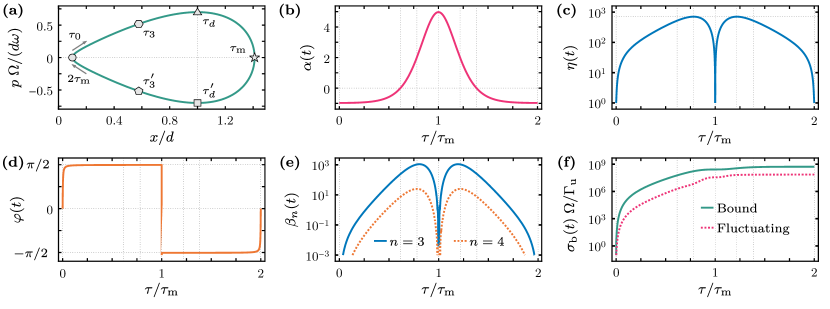
实验结果
研究问题
- RQ1如何对宽广、非谐振势中具有退相干效应的粒子的Wigner函数进行解析近似?
- RQ2在大相干扩展与小涨落的区域中,哪些近似是有效的?
- RQ3退相干如何影响非线性动力学过程中干涉图案的条纹间距?
- RQ4在何种极限下,该方法可恢复标准的高斯波包动力学?
- RQ5该解析框架能否预测干涉条纹间距随系统参数(如质量、势阱深度与控制参数)的标度关系?
主要发现
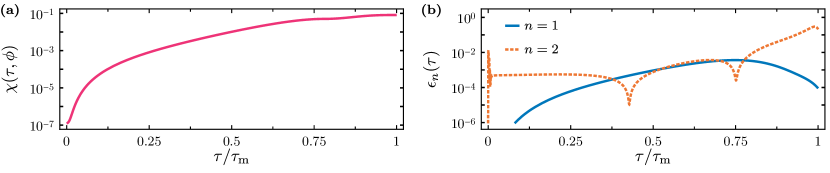
- 该解析Wigner函数在势能长度尺度远大于初始态尺寸时,对宽广、非谐振势中具有弱退相干的粒子动力学提供了极佳的近似。
- 在转折点处的干涉条纹间距满足 $ x_{\textrm{f}} \sim \left(\frac{\Omega}{\omega}\right)^{2/3} \left(\frac{1}{d}\right)^{1/3} f(x_{\textrm{s}}/d) $,其中 $ f $ 仅依赖于归一化的初始位移 $ x_{\textrm{s}}/d $。
- 该方法在非线性与退相干可忽略的极限下,可恢复Heller及其合作者所研究的高斯波包动力学。
- 恒定角度近似与线性化退相干近似在宽势阱与小涨落区域中均有效,从而实现了分析上的可处理性。
- 干涉图案由Airy函数的乘积描述,概率分布通过涉及质心参考系中Wigner函数的积分变换导出。
- 该解析结果可实现对大质量粒子中宏观量子叠加态生成协议的设计与优化。
更好的研究,从现在开始
从阅读论文到最终审阅,大幅缩短您的研究时间。
无需绑定信用卡
本解读由 AI 生成,并经人工编辑审核。