
[論文レビュー] 5G MEC Computation Handoff for Mobile Augmented Reality
本稿では、モバイル拡張現実(MAR)アプリケーション向けに、信号強度とMECサーバーの計算負荷を統合最適化する低複雑度の5Gマルチアクセスエッジコンピューティング(MEC)ハンドオーバー手法Comp-HOを提案する。ネットワークと計算メトリクスのバランスを取ることで、MECの混雑状態に起因する大きな遅延を低減し、送信オーバーヘッドを最小限に抑えつつ、ユーザー体験を向上させる。本手法は標準5G/LTEベースステーションと互換性を保ち、実環境のテストベッド測定およびカスタムNS-3シミュレーションにより検証済みである。
The combination of 5G and Multi-access Edge Computing (MEC) can significantly reduce application delay by lowering transmission delay and bringing computational capabilities closer to the end user. Therefore, 5G MEC could enable excellent user experience in applications like Mobile Augmented Reality (MAR), which are computation-intensive, and delay and jitter-sensitive. However, existing 5G handoff algorithms often do not consider the computational load of MEC servers, are too complex for real-time execution, or do not integrate easily with the standard protocol stack. Thus they can impair the performance of 5G MEC. To address this gap, we propose Comp-HO, a handoff algorithm that finds a local solution to the joint problem of optimizing signal strength and computational load. Additionally, Comp-HO can easily be integrated into current LTE and 5G base stations thanks to its simplicity and standard-friendly deployability. Specifically, we evaluate Comp-HO through a custom NS-3 simulator which we calibrate via MAR prototype measurements from a real-world 5G testbed. We simulate both Comp-HO and several classic handoff algorithms. The results show that, even without a global optimum, the proposed algorithm still significantly reduces the number of large delays, caused by congestion at MECs, at the expense of a small increase in transmission delay.
研究の動機と目的
- MECサーバーの過負荷が原因で発生する5G MEC対応モバイル拡張現実(MAR)アプリケーションにおける性能劣化を解消すること。
- 既存のハンドオーバー手法が無線信号メトリクスのみを重視し、MECサーバー負荷を無視するというギャップを特定すること。
- 信号品質とMEC計算負荷の両方を統合的に考慮する、シンプルで標準プロトコルに準拠したハンドオーバー手法の設計。
- 測定駆動型のMEC対応NS-3ネットワークシミュレータを用いて、スケールを考慮したアルゴリズムの性能評価。
- 従来のハンドオーバー手法と比較して、Comp-HOがMARアプリケーションにおけるエンドツーエンド遅延とユーザーQoEを向上させることの実証。
提案手法
- 信号品質が低下した場合、またはMECサーバー負荷がしきい値を超えた場合にハンドオーバーをトリガーするComp-HOというハンドオーバー手法を提案。
- 共存するサーバーからのMEC負荷情報をハンドオーバー意思決定プロセスに統合し、RSRP/RSRQとサーバー負荷メトリクスの重み付き組み合わせを用いる。
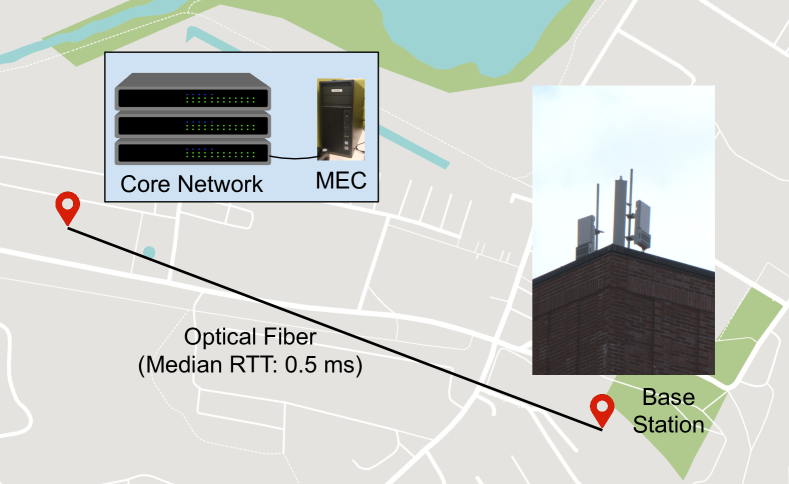
- 商用ベースステーションを搭載した5G MECテストベッドから得た実環境のMARプロトタイプ測定値を用いて、カスタムNS-3シミュレータをキャリブレーション。
- ユーザー密度と移動パターンを変化させた条件下で、Comp-HOを古典的手法(例:A2-A4-RSRQ、A3-RSRP、NoHO)と比較してシミュレーション。
- アプリケーションレベルの性能劣化を定量化するためのインパワーメントスコア指標を用い、リアルタイムのMAR品質体験(QoE)を反映。
- 異なるフレームレート(FPS)、ユーザー速度、ネットワーク負荷分布(均質的および非均質的状況を含む)における性能評価。
実験結果
リサーチクエスチョン
- RQ15G MEC対応MARアプリケーションにおけるエンドツーエンド遅延に、信号強度とMECサーバー負荷の統合最適化がどのように影響するか?
- RQ2従来のハンドオーバー手法と比較して、Comp-HOはMECサーバー混雑状態に起因する大きな遅延スパイクをどの程度低減できるか?
- RQ3異なるユーザー移動パターンおよびネットワーク負荷分布下でのComp-HOの性能はどのように変化するか?
- RQ4MEC負荷を考慮するハンドオーバー手法は、実際の5G/LTEベースステーションで低複雑度かつ標準プロTOCOL互換性を保って実装可能か?
- RQ5信号強度のみを基準とする手法と比較して、Comp-HOではアプリケーション遅延の低減と送信遅延の増加のトレードオフはどのようなものか?
主な発見
- Comp-HOは、グローバル最適解に到達しなくても、MECサーバー混雑状態に起因する大きな遅延の発生回数を顕著に低減する。
- 完全に障害が発生したパケット(最悪の性能レベル)の割合が減少しており、これはMARタスクにおける明確なQoE向上を示している。
- YOLOを用いたオブジェクト検出デモでは、ベースライン手法で26~39ピクセルのバウンディングボックスのずれが生じるのに対し、Comp-HOでは13ピクセルにまで低減され、安定性の向上が実証された。
- 均質的および非均質的ユーザー密度およびMEC負荷状況の両方で、Comp-HOはベンチマーク手法を上回る性能を示し、特に非均質的状況下で顕著な向上が得られた。
- ユーザー体験の向上は、わずかな送信遅延の増加を伴うが、計算要因に起因する遅延の大幅な低減によって相殺される。
- 異なるユーザー速度およびフレームレート下でもComp-HOは頑健性を保ち、多様な移動状況において一貫した性能向上を示した。
![Figure 2 : High-level Comp-HO flow diagram using 3GPP 5G and ETSI MEC [ 30 ] terminology. Comp-HO specific flows are marked in blue.](https://ar5iv.labs.arxiv.org/html/2101.00256/assets/pics/handover_procedure.png)
より良い研究を、今すぐ始めましょう
論文の読解から最終レビューまで、研究時間を劇的に削減しましょう。
クレジットカード登録不要
このレビューはAIが作成し、人間の編集者が確認しました。