
[論文レビュー] A Dual-Augmentor Framework for Domain Generalization in 3D Human Pose Estimation
本稿では、3次元人体ポーズ推定におけるドメイン一般化のためのデュアルオーガニゼータフレームワークを提案する。弱いオーガニゼータはソースドメインの知識を保持し、強いオーガニゼータは分布外のポーズを探索する。メタ最適化によりトレーニング中にドメインシフトをシミュレートする。本手法は最先端の性能を達成し、3DHPではMPJPEが2.4mm改善され、AUCが0.8%向上し、複数のベンチマークで先行手法を上回る。
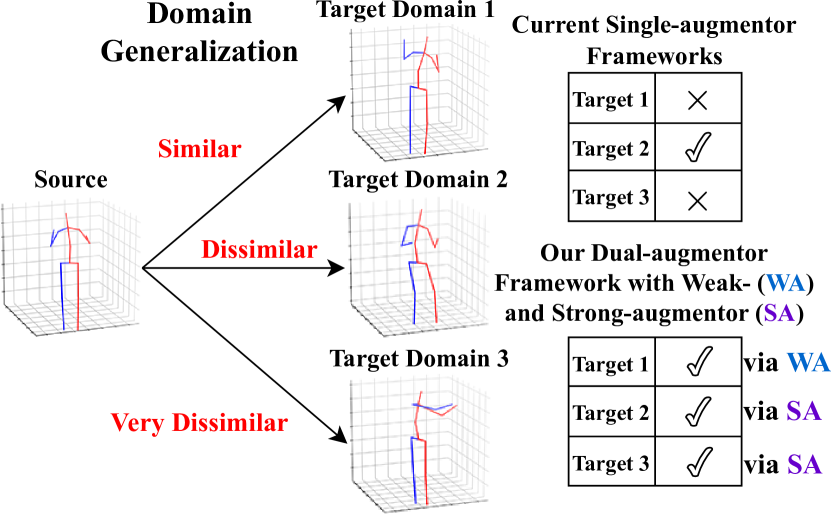
3D human pose data collected in controlled laboratory settings present challenges for pose estimators that generalize across diverse scenarios. To address this, domain generalization is employed. Current methodologies in domain generalization for 3D human pose estimation typically utilize adversarial training to generate synthetic poses for training. Nonetheless, these approaches exhibit several limitations. First, the lack of prior information about the target domain complicates the application of suitable augmentation through a single pose augmentor, affecting generalization on target domains. Moreover, adversarial training's discriminator tends to enforce similarity between source and synthesized poses, impeding the exploration of out-of-source distributions. Furthermore, the pose estimator's optimization is not exposed to domain shifts, limiting its overall generalization ability. To address these limitations, we propose a novel framework featuring two pose augmentors: the weak and the strong augmentors. Our framework employs differential strategies for generation and discrimination processes, facilitating the preservation of knowledge related to source poses and the exploration of out-of-source distributions without prior information about target poses. Besides, we leverage meta-optimization to simulate domain shifts in the optimization process of the pose estimator, thereby improving its generalization ability. Our proposed approach significantly outperforms existing methods, as demonstrated through comprehensive experiments on various benchmark datasets.Our code will be released at \url{https://github.com/davidpengucf/DAF-DG}.
研究の動機と目的
- ラベル付きデータが制御されたラボ環境に限定される3次元人体ポーズ推定におけるドメイン一般化を解決すること。
- 1つのオーガニゼータに依存する手法が、ソースドメインの知識保持と分布外ポーズの探索の両立に失敗するという限界を克服すること。
- ソースと合成ポーズの類似性を強制する敵対的トレーニングに依存することを減らし、多様性を制限する要因を軽減すること。
- メタ最適化により最適化中にドメインシフトをシミュレートすることで、ポーズ推定器の一般化性能を向上させること。
- ターゲットドメインデータに依存せず、ソースデータのみで有効なトレーニングを可能にすること。
提案手法
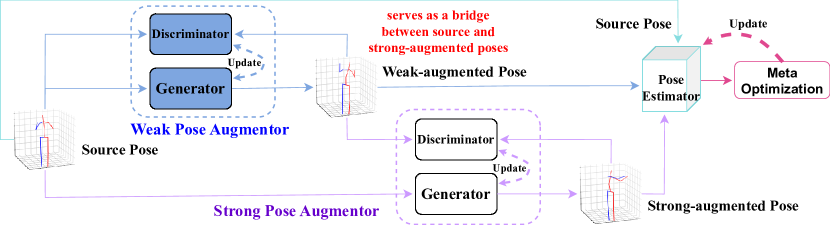
- ソースに類似するポーズを保持する弱いオーガニゼータと、ソース外の分布を探索する強いオーガニゼータの2つの異なるポーズオーガニゼータを導入する。
- 生成と識別において差別化された戦略を採用する:弱いオーガニゼータで生成されたポーズをブリッジとして用い、識別器が強いオーガニゼータと弱いオーガニゼータの出力を区別できるようにする。
- 局所的ポーズの一貫性を維持するための近接ペア(W-PP, S-PP)と、弱い生成器と強い生成器の出力間に構造的差を強制する1ステートギャップペア(W-OG, S-OG)を用いる。
- ソース、弱いオーガニゼータ、強いオーガニゼータの各データに対してメタ最適化を適用し、トレーニング中にドメインシフトをシミュレートし、ドメイン不変特徴の学習を促進する。
- 敵対的トレーニングを採用するが、識別器の構成を変更し、ソースとすべてのオーガニゼータ出力の類似性を強制しない。
- バックボーンネットワークにVPoseを採用し、PCK、AUC、MPJPEといった標準指標を用いて3DHPおよび3DPWデータセットで評価する。
実験結果
リサーチクエスチョン
- RQ11つのオーガニゼータ手法と比較して、デュアルオーガニゼータフレームワークは、ソースドメインの知識保持と分布外ポーズの探索の両立をより効果的に行えるか?
- RQ2弱いオーガニゼータと強いオーガニゼータの識別プロセスを分離することで、敵対的類似性の強制に依存せずに一般化性能が向上するか?
- RQ3ソース、弱いオーガニゼータ、強いオーガニゼータのデータ間でメタ最適化を適用することで、ポーズ推定器のドメインシフトに対するロバストネスがどの程度向上するか?
- RQ4近接ペアと1ステートギャップペアのコンponentsは、合成ポーズの品質と多様性にどのように寄与するか?
- RQ5デュアルオーガニゼータフレームワークは、最先端のドメイン一般化手法と比較して、標準的な3次元HPEベンチマークで優れた性能を達成できるか?
主な発見
- 提案されたデュアルオーガニゼータフレームワークは、先行SOTA手法と比較して、3DHPでPCKが1.2%向上、AUCが0.8%向上し、MPJPEが2.4mm改善された。
- 3DPWではPA-MPJPEが1.3mm、MPJPEが1.8mm改善され、複数のデータセットで一貫した向上が確認された。
- アブレーションスタディでは、弱いオーガニゼータの近接ペア(W-PP)を削除すると、3DHPでPCKが4.6%低下し、MPJPEが9.5mm上昇するなど、ポーズの一貫性を維持する上で極めて重要な役割を果たしていることが示された。
- 強いオーガニゼータにおける1ステートギャップペア(S-OG)を除外すると、PCKが1.5%低下し、MPJPEが3.4mm上昇するなど、生成器出力の構造的差を強制する上で重要であることが明らかになった。
- 1つのオーガニゼータベースライン(WAとSA)と比較して、デュアルオーガニゼータフレームワークは優れた性能を示し、WAは3DHPでPCKが87.3%、SAは89.8%であったのに対し、本手法は92.9%に達した。
- アブレーションスタディにより、差別化された生成、差別化された識別、およびメタ最適化の各コンponentsがすべて不可欠であることが確認され、いずれかを削除すると顕著な性能低下が生じた。
この論文を読む
Nubintのビューアで原文を開き、読みながら気になる箇所をすぐに質問できます。
Nubintでこの論文を読むこのレビューはAIが論文の原文をもとに作成しました。引用する前に原文をご確認ください。