
[論文レビュー] A Leptonic Model for Neutrino Emission From Active Galactic Nuclei
本論文は、活性銀河核(AGN)におけるテルバールスケールニュートリノ放射の完全にレプトン的メカニズムを提案する。このメカニズムでは、相対論的電子が生成する高エネルギーシンクロtron光子がkeV帯X線と散乱し、ミューオン-反ミューオン対を生成する。その後、ミューオンの崩壊によってニュートリノが生成され、陽子の関与は一切ない。モデルは、合理的な物理的パラメータのもとで、IceCubeが観測したNGC 1068からのニュートリノスペクトルをうまく再現でき、核子的パイオン崩壊シナリオの代替案を提供する。
It is often stated that the observation of high-energy neutrinos from an astrophysical source would constitute a smoking gun for the acceleration of hadronic cosmic rays. Here, we point out that there exists a purely leptonic mechanism to produce TeV-scale neutrinos in astrophysical environments. In particular, very high-energy synchrotron photons can scatter with X-rays, exceeding the threshold for muon-antimuon pair production. When these muons decay, they produce neutrinos without any cosmic-ray protons or nuclei being involved. In order for this mechanism to be efficient, the source in question must produce very high-energy photons which interact in an environment that is dominated by keV-scale radiation. As an example, we consider the active galaxy NGC 1068, which IceCube has recently detected as a source of TeV-scale neutrinos. We find that the neutrino emission observed from this source could potentially be generated through muon pair production for reasonable choices of physical parameters.
研究の動機と目的
- AGNにおける高エネルギーニュートリノの存在が、常に核子的宇宙線加速を示すという従来の仮定に挑戦すること。
- 天体的環境におけるTeVニュートリノ生成の完全にレプトン的代替メカニズムを提案すること。
- NGC 1068からの観測ニュートリノフラックスが、高エネルギー光子とX線放射場からのミューオン対生成によって説明可能かどうかを検証すること。
- 光度が厚いAGNコアにおいて、核子的モデルがガンマ線フラックス制約に直面する中で、このメカニズムの妥当性を評価すること。
提案手法
- 強い磁場(B ~ 0.03–2000 G)における相対論的電子からのシンクロtron放射を用いて高エネルギー光子生成をモデル化する。
- 非常に高エネルギー光子(Eγ ~ 1–100 TeV)とkeV帯X線との光子-光子衝突におけるミューオン対生成の閾値を計算する。
- ミューオン崩壊の相対論的運動論を用いてニュートリノエネルギースペクトルを予測し、Eν ≈ Eγ/6とする。
- 観測された1 TeV以上のエネルギーで約1042–1043 erg/sのエネルギー注入に一致するように、電子注入スペクトルをdNe/dEe ∝ Ee−2 exp(−Ee/300 TeV)として正規化する。
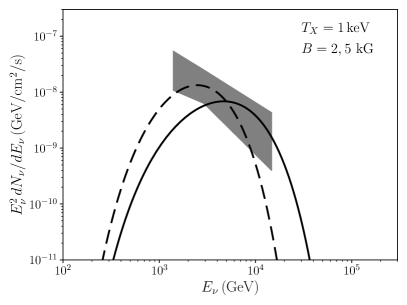
- 磁場強度とコロナ温度の変動に応じたニュートリノフラックスを計算し、NGC 1068(14.4 Mpc)からのIceCube観測フラックスと比較する。
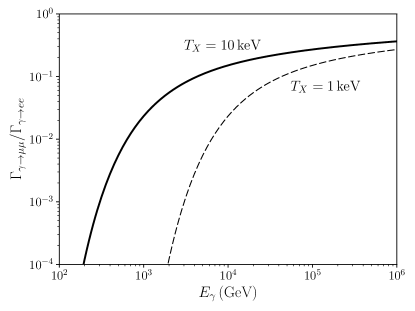
- eV–keV光子が支配的となる環境では、keV X線よりも電子-陽電子対生成が優勢であるため、この過程による抑制を評価する。
実験結果
リサーチクエスチョン
- RQ1AGNコアで陽子加速を伴わず、完全にレプトン的メカニズムによってTeVスケールニュートリノが生成可能か?
- RQ2高エネルギー光子–X線散乱によるミューオン対生成は、IceCubeのNGC 1068ニュートリノ過剰を説明するパイオン崩壊シナリオの有効な代替案となり得るか?
- RQ3このメカニズムが検出可能なニュートリノフラックスを生成するための物理的条件(例えば、磁場強度、X線放射密度)は何か?
- RQ4ミューオン崩壊からのニュートリノのフレーバー比はパイオン崩壊とどのように異なり、生成メカニズムの区別に利用可能か?
- RQ5このメカニズムの効率を制限するエネルギー閾値は何か?また、これはニュートリノスペクトルの低エネルギー尾にどのように影響するか?
主な発見
- モデルは、NGC 1068からのIceCube観測(約1–10 TeV、79イベント、4.2σの有意性)と整合するニュートリノスペクトルを生成する。
- 磁場強度が0.03–2000 G、コロナ温度が10–100 keVの範囲で、電子注入出力が約2–12×1042 erg/s(1 TeV以上)のとき、予測フラックスは観測フラックスと一致する。
- eV–keV光子が支配的となる環境では、電子-陽電子対生成がミューオン対生成を上回るため、このメカニズムは抑制を受ける。
- ニュートリノ生成は、~0.3 TeV × (10 keV/T) の閾値エネルギー以上でのみ効率的であり、X線温度が高い場合にはスペクトルの低エネルギー領域にカットオフが予想される。
- ミューオン崩壊からのフレーバー比(νe:νμ:ντ ≈ 1.2:0.9:0.9、摂動後)はパイオン崩壊(≈1:1:1)と異なり、生成メカニズムの区別に観測的指標として有用である。
- このメカニズムは、IceCubeが観測した全般的なニュートリノフラックスを説明できない。100 TeV以上のエネルギーでは効率が著しく低下するためである。
この論文を読む
Nubintのビューアで原文を開き、読みながら気になる箇所をすぐに質問できます。
Nubintでこの論文を読むこのレビューはAIが論文の原文をもとに作成しました。引用する前に原文をご確認ください。