
[論文レビュー] A random-key GRASP for combinatorial optimization
本稿では、連続的単位超立方体から離散的組合せ最適化問題空間への変換を実行するデコーダを用いる、問題に依存しないGRASPメタヒューリスティック、Random-Key GRASP (RK-GRASP) を提案する。5つのNP困難問題において優れた性能を発揮し、RK-GRASPがRandom Variable Neighborhood Descent (RVND) を用いることで、THLPの97%、SSPの100%、NCGPPの75%のインスタンスでBRKGAおよびMulti-Start手法を上回った。
This paper proposes a problem-independent GRASP metaheuristic using the random-key optimizer (RKO) paradigm. GRASP (greedy randomized adaptive search procedure) is a metaheuristic for combinatorial optimization that repeatedly applies a semi-greedy construction procedure followed by a local search procedure. The best solution found over all iterations is returned as the solution of the GRASP. Continuous GRASP (C-GRASP) is an extension of GRASP for continuous optimization in the unit hypercube. A random-key optimizer (RKO) uses a vector of random keys to encode a solution to a combinatorial optimization problem. It uses a decoder to evaluate a solution encoded by the vector of random keys. A random-key GRASP is a C-GRASP where points in the unit hypercube are evaluated employing a decoder. We describe random key GRASP consisting of a problem-independent component and a problem-dependent decoder. As a proof of concept, the random-key GRASP is tested on five NP-hard combinatorial optimization problems: traveling salesman problem, tree of hubs location problem, Steiner triple covering problem, node capacitated graph partitioning problem, and job sequencing and tool switching problem.
研究の動機と目的
- ランダムキーパラダイムを用いた問題に依存しないGRASPメタヒューリスティックの開発を目的とする。
- ソルバを問題固有の論理から分離することで、単一のソルバーフレームワークを多様な組合せ最適化問題に再利用可能にする。
- 異なる局所探索戦略を用いて、RK-GRASPのNP困難な組合せ最適化問題への効果を評価すること。
- 実行時間および解の品質指標を用いて、RK-GRASPの性能をBRKGAおよびMulti-Start手法と比較すること。
- ベンチマークインスタンスを用いた実験的評価を通じて、ランダムキーGRASPフレームワークの実現可能性と優位性を示すこと。
提案手法
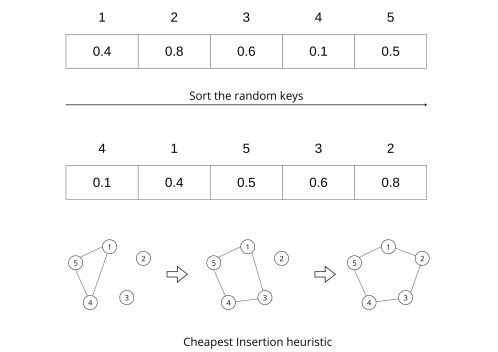
- RK-GRASPは、解を[0,1)の範囲にあるランダムキーのベクトルとして表現する連続的単位超立方体上で動作する。
- 問題固有のデコーダが各ランダムキーのベクトルを離散的問題空間における妥当な解にマッピングし、そのコストを評価する。
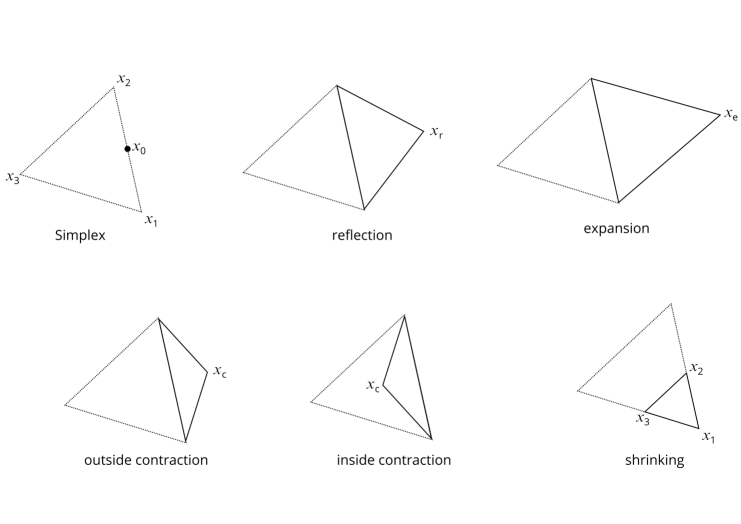
- グリーディなランダム構成フェーズと、グリッド探索、ネルダー・ミード探索、およびランダム変数近傍探索(RVND)を含む局所探索手順を組み合わせる。
- 複数の反復処理を通じて得られた最良の解を出力し、解の品質向上のため局所探索を適用する。
- メタヒューリスティック(ソルバ)と問題固有の論理(デコーダ)を分離することで、異なる最適化問題にわたる再利用が可能になる。
- CPU時間と解ギャップに基づくパフォーマンスプロファイルを用いて性能を評価し、収束閾値1%を設定する。
実験結果
リサーチクエスチョン
- RQ1ランダムキー最適化(RKO)パラダイムを用いて、問題に依存しないGRASPメタヒューリスティックを効果的に設計できるか?
- RQ2多様なNP困難な組合せ最適化問題において、RK-GRASPはBRKGAおよびMulti-Start手法と比較して、性能および解の品質で優れているか?
- RQ3グリッド探索、ネルダー・ミード探索、またはRVNDのうち、どの局所探索戦略がRK-GRASPフレームワークで最高のパフォーマンスを発揮するか?
- RQ4RK-GRASPは、NP困難問題のベンチマークインスタンスにおいて、新たな最良既知解をどの程度達成できるか?
- RQ5ランダムキー符号化とデコーダベースのマッピングは、異なる問題領域において効率的かつスケーラブルな最適化を可能にするか?
主な発見
- CPU時間の観点から、THLPインスタンスの97%、SSPインスタンスの100%、NCGPPインスタンスの75%において、RK-GRASPがRVNDを用いることでBRKGAおよびMulti-Start手法を上回った。
- 巡回セールスマン問題(TSP)において、BRKGAおよびRK-GRASP(RVND)ともに95%のインスタンスを性能比4以内で解釈できたが、累積パフォーマンスプロファイルにおいてRK-GRASP(RVND)が優位な支配的性能を示した。
- RK-GRASP(RVND)は、THLP、SSP、NCGPPにおいて新たな最良既知解を達成し、高品質な解を効果的に発見できることを示した。
- Steiner三重被覆問題(STCP)において、BRKGAおよびRK-GRASP(RVND)ともに40%のインスタンスを性能比4以内で解釈できたが、明確な優位性は観察されなかった。
- パフォーマンスプロファイル分析から、TSP、THLP、SSPにおいて、RK-GRASP(RVND)が性能比4以内の解の累積分布が最も高かった。
- フレームワークの問題に依存しない設計により、異なるデコーダを単に差し込むことで、同じソルバを再利用可能となり、新たな組合せ最適化問題への効率的対応が可能になった。
この論文を読む
Nubintのビューアで原文を開き、読みながら気になる箇所をすぐに質問できます。
Nubintでこの論文を読むこのレビューはAIが論文の原文をもとに作成しました。引用する前に原文をご確認ください。