
[論文レビュー] A red giant orbiting a black hole
本論文は、1277日、やや離心率の高い軌道で回る1 M☉の赤超巨星を周回する8.9±0.3 M☉の静止状態にあるブラックホールであるGaia BH2を特定した。分光および光度測定の追跡観測により、Gaia DR3の位置運動学的解が確認され、X線および電波の非検出は低効率な降着モデルを支持し、Gaia BH2は既知の第二番目に近いブラックホールであり、X線サーベイでは検出されない広がりのある静止状態のブラックホール連星の集団の存在を示している。
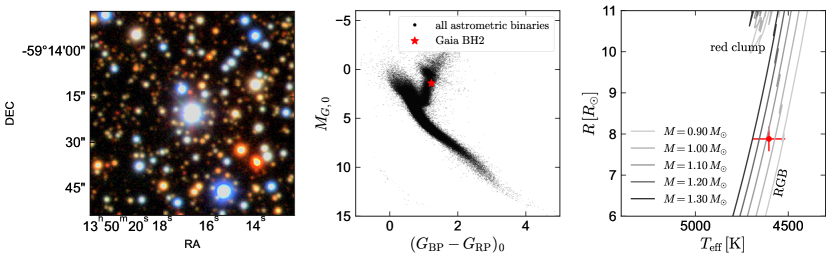
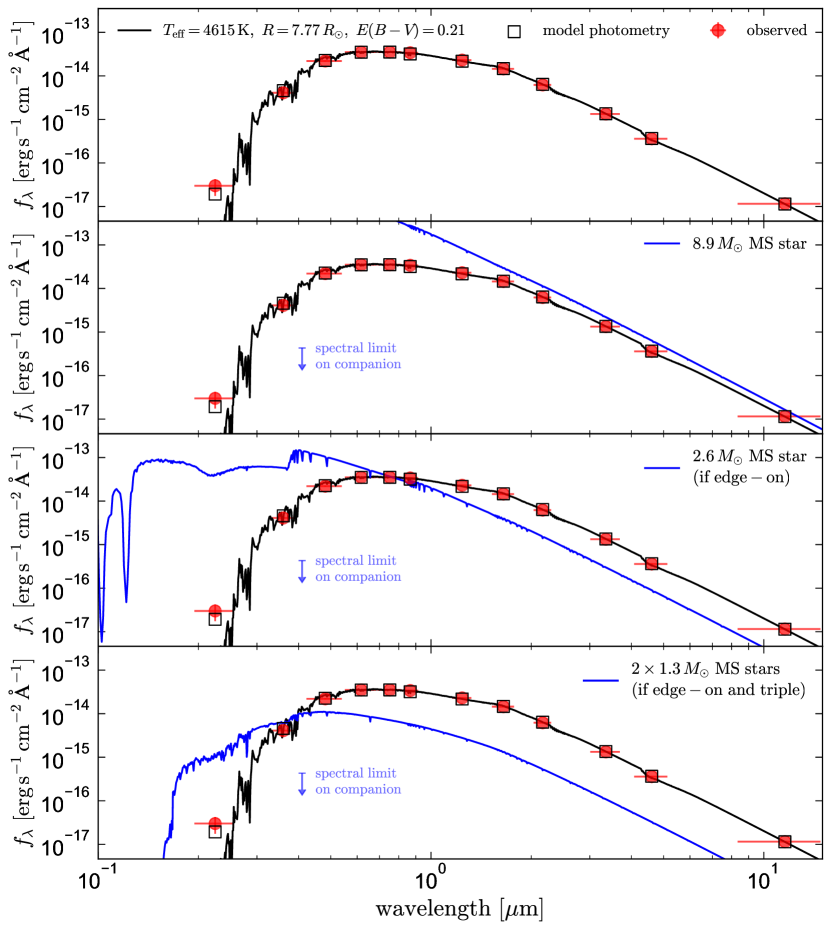
We report spectroscopic and photometric follow-up of a dormant black hole (BH) candidate from Gaia DR3. The system, which we call Gaia BH2, contains a $\sim 1M_{\odot}$ red giant and a dark companion with mass $M_2 = 8.9\pm 0.3\,M_{\odot}$ that is very likely a BH. The orbital period, $P_{ m orb} = 1277$ days, is much longer than that of any previously studied BH binary. Our radial velocity (RV) follow-up over a 7-month period spans more than 90% of the orbit's dynamic range in RV and is in excellent agreement with predictions of the Gaia solution. UV imaging and high-resolution optical spectra rule out all plausible luminous companions that could explain the orbit. The star is a bright ($G=12.3$), slightly metal-poor ($ m [Fe/H]=-0.22$) low-luminosity giant ($T_{ m eff}=4600\, m K$; $R = 7.8\,R_{\odot}$; $\log\left[g/\left({ m cm\,s^{-2}} ight) ight] = 2.6$). The binary's orbit is moderately eccentric ($e=0.52$). The giant is strongly enhanced in $α-$elements, with $ m [α/Fe] = +0.26$, but the system's Galactocentric orbit is typical of the thin disk. We obtained X-ray and radio nondetections of the source near periastron, which support BH accretion models in which the net accretion rate at the horizon is much lower than the Bondi-Hoyle-Lyttleton rate. At a distance of 1.16 kpc, Gaia BH2 is the second-nearest known BH, after Gaia BH1. Its orbit -- like that of Gaia BH1 -- seems too wide to have formed through common envelope evolution. Gaia BH1 and BH2 have orbital periods at opposite edges of the Gaia DR3 sensitivity curve, perhaps hinting at a bimodal intrinsic period distribution for wide BH binaries. Dormant BH binaries like Gaia BH1 and Gaia BH2 likely significantly outnumber their close, X-ray bright cousins, but their formation pathways remain uncertain.
研究の動機と目的
- Gaia DR3の位置運動学的連星候補(Gaia BH2)がブラックホール連星であることを、多波長にわたる追跡観測によって確認すること。
- 見えない伴星の軌道パラメータと動的質量を特定し、恒星またはコンパクト天体の代替説を除外すること。
- X線および電波の非検出を用いてブラックホールの降着状態を調査し、放射効率を評価すること。
- Gaia BH2を銀河系内ブラックホール連星形成の文脈に位置づけ、静止状態のブラックホール連星の広範な集団について考察すること。
提案手法
- 7か月にわたる分光的径速度モニタリングにより、軌道運動を測定し、Gaia DR3の位置運動学的解を確認する。
- 高分解能の光学およびUV分光測定により、観測された径速度曲線を模倣する明るい伴星の存在を除外する。
- Gaia DR3データを用いた位置運動学的解析により、周期、離心率、軌道傾きを含む軌道要素を導出する。
- ChandraおよびMeerKATを用いたX線および電波観測により、降着の兆候を探索し、放射効率を制限する。
- 赤超巨星の星大気モデルを用いて、効用温度、表面重力、金属量を導出する。
- システムの軌道パラメータを二重星進化モデルと比較し、形成経路を評価する。
実験結果
リサーチクエスチョン
- RQ1Gaia BH2の暗黒的伴星はブラックホールと整合的であり、その質量はいかほどか?
- RQ2X線および電波の非検出から、ブラックホールの降着状態はどのように推定されるか?
- RQ3Gaia BH2の軌道構造は、ブラックホール連星形成の理論的期待とどのように一致するか?
- RQ4Gaia BH2の存在は、銀河系内に広がる広がりのある静止状態のブラックホール連星集団について何を示唆するか?
- RQ5Gaia BH1およびGaia BH2の軌道周期が、なぜGaia DR3の感度曲線の両端に位置しているのか?
主な発見
- システムGaia BH2には、8.9±0.3 M☉のブラックホールが存在し、径速度モニタリングおよびGaia DR3との位置運動学的一致性により確認された。
- 赤超巨星の質量は約1 M☉、効用温度は4600 K、半径は7.8 R☉、表面重力はlog(g) = 2.6 cm s⁻²である。
- 軌道周期は1277日、離心率は0.52、近日点距離は2.4 auであり、赤超巨星の前身星の予想半径を上回る位置にある。
- X線および電波観測では非検出であり、放射効率が10⁻⁴未満であることを示唆し、放射的に非効率な降着モデルと整合的である。
- システムの距離は1.16 kpcであり、Gaia BH1に次いで第二に近い既知のブラックホールである。
- 軌道パラメータは、高質量主系列星の風駆動進化または力学的過程による形成を示唆し、標準的な共通エンvelope進化とは異なる。
この論文を読む
Nubintのビューアで原文を開き、読みながら気になる箇所をすぐに質問できます。
Nubintでこの論文を読むこのレビューはAIが論文の原文をもとに作成しました。引用する前に原文をご確認ください。