
[論文レビュー] A shared accretion instability for black holes and neutron stars
本論文は、ブラックホールおよび中性子星の周囲の降着円盤において、放射圧によって駆動される共通の堆積不安定性を提案し、周期的な内側円盤の枯渇と再充填を通じて多波長変動を説明する。この不安定性は相対論的噴流を生じさせ、X線および可視光帯域における「ハートビート」パターンを説明する。Swift J1858は、X線、UV、可視光、赤外線、電波帯域で相関する変動を示し、時間遅れのある応答が放射照射駆動の振動と整合的である強力な証拠を示している。
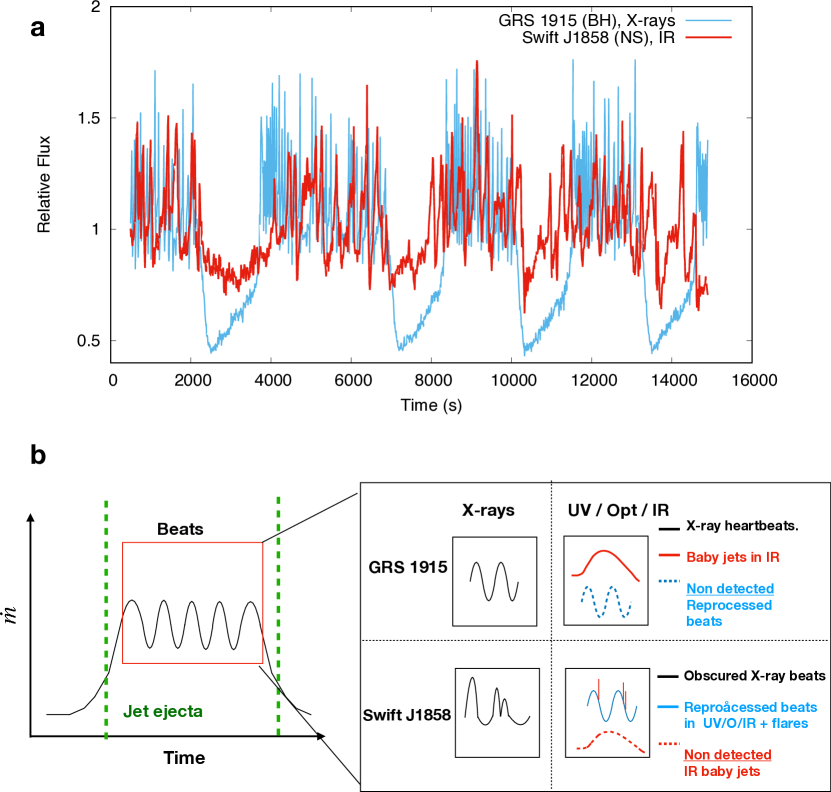
Accretion disks around compact objects are expected to enter an unstable phase at high luminosity. One instability may occur when the radiation pressure generated by accretion modifies the disk viscosity, resulting in the cyclic depletion and refilling of the inner disk on short timescales. Such a scenario, however, has only been quantitatively verified for a single stellar-mass black hole. Although there are hints of these cycles in a few isolated cases, their apparent absence in the variable emission of most bright accreting neutron stars and black holes has been a lingering puzzle. Here we report the presence of the same multiwavelength instability around an accreting neutron star. Moreover, we show that the variability across the electromagnetic spectrum-from radio to X-ray-of both black holes and neutron stars at high accretion rates can be explained consistently if the accretion disks are unstable, producing relativistic ejections during transitions that deplete or refill the inner disk. Such new association allows us to identify the main physical components responsible for the fast multiwavelength variability of highly accreting compact objects.
研究の動機と目的
- 高光度降着中性子星がブラックホールで観測される周期的変動を示さないという長年の謎を解明すること。
- ブラックホールにおける「ハートビート」状態を引き起こす同じ放射圧駆動の降着不安定性が中性子星でも作用するかどうかを検証すること。
- 円盤不安定性と放射照射駆動の振動を通じて、コンパクト天体全体にわたる高速多波長変動を統一的に説明する物理的枠組みを確立すること。
- このような不安定性が中性子星で発生する物理的条件——特に光度、磁場、磁気圏半径——を特定すること。
- 降着中性子星のパラメータ空間をマッピングし、理論的不安定性境界と照らし合わせてモデルを検証すること。
提案手法
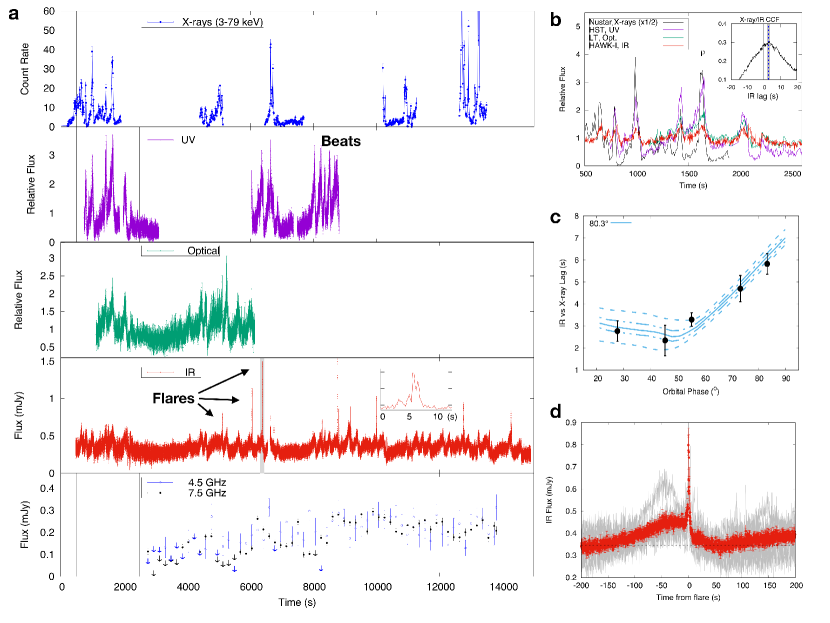
- Swift J1858を対象に、4時間程度にわたる同時多波長観測キャンペーンを実施。NuSTAR(X線)、Hubble(UV)、Liverpool Telescope(可視光)、VLT/HAWK-I(近赤外線)、VLA(電波)を用いた。
- X線(NuSTAR)と近赤外線(HAWK-I)の光曲線間の相互相関関数(CCF)を計算し、赤外線のX線に対する遅れが2.5〜5.5秒であることを特定。
- 観測された遅れをX線変動による円盤および供給星の放射照射によって説明し、軌道傾斜角が約80°であることが観測された軌道モodulationと整合的であることを確認。
- 放射圧支配の降着円盤の理論的モデルを適用し、磁気圏半径が星の半径を上回ることを条件として、不安定性の発生を予測。
- 粘性係数(α)、中性子星質量(m)、半径(R*,6)、磁場(B12)を含む式を用いて、不安定性の臨界光度閾値を導出。低・中・高磁場領域を区別。
- 『GRS 1915に類似した』変動を示す観測中性子星を、光度対磁場図にマッピングし、放射圧支配の不安定性領域との整合性を検証。
実験結果
リサーチクエスチョン
- RQ1ブラックホールで『ハートビート』状態を引き起こす同じ降着不安定性が、中性子星でも変動を説明できるか?
- RQ2特に光度、磁場、磁気圏半径といった物理的条件は、中性子星における放射圧駆動の円盤不安定性を可能にするか?
- RQ3大多数の明るい降着中性子星がブラックホールで観測される周期的変動を示さないのはなぜか?これは共通の不安定性メカニズムで説明可能か?
- RQ4X線と赤外線変動の時間遅れは、高降着系における多波長振動の起源をどのように制約するか?
- RQ5バーストパulsar、ラピッドバースターやULX NGC 3621といった源は、放射圧支配の円盤不安定性の予測されたパラメータ空間内にあるか?
主な発見
- Swift J1858は、X線、UV、可視光、赤外線、電波帯域で強く相関する多波長変動を示し、赤外線がX線に対して2.5〜5.5秒遅れる。これは円盤および供給星の放射照射と整合的である。
- 約100秒の時標識で『ビート』を示し、赤外線で急速なフレアを観測しており、GRS 1915+105で観測された『ハートビート』パターンに類似。共通の不安定性メカニズムを示唆。
- 観測された時間遅れと軌道モodulationは、X線変動が高軌道傾斜角(約80°)で円盤および供給星を放射照射するモデルと完全に整合的である。
- Swift J1858は、光度~10^37 erg s⁻¹、磁場が中程度であると一致する、放射圧支配の円盤領域に位置している。
- 合計10個の中性子星が『GRS 1915に類似した』パターンを示しており、バーストパulsar、ラピッドバースター、NGC 3621を含む。これらは放射圧支配の不安定性領域に位置しており、モデルを支持する。
- 理論的閾値は、光度L > 10^36 erg s⁻¹かつ磁場B < 10^12 Gの中性子星が不安定性領域に入ることを示唆。Z源やPULXsも、観測された噴流や円盤風と整合的であり、このフレームワークに適合している。
この論文を読む
Nubintのビューアで原文を開き、読みながら気になる箇所をすぐに質問できます。
Nubintでこの論文を読むこのレビューはAIが論文の原文をもとに作成しました。引用する前に原文をご確認ください。