
[論文レビュー] A Survey for Biomedical Text Summarization: From Pre-trained to Large Language Models
事前学習済み言語モデル(PLMs)と大規模言語モデル(LLMs)を焦点とした生物医学テキスト要約(BTS)の系統的レビューであり、データセット、手法、評価、課題、今後の方向性を網羅し、オープンリソースが利用可能である。
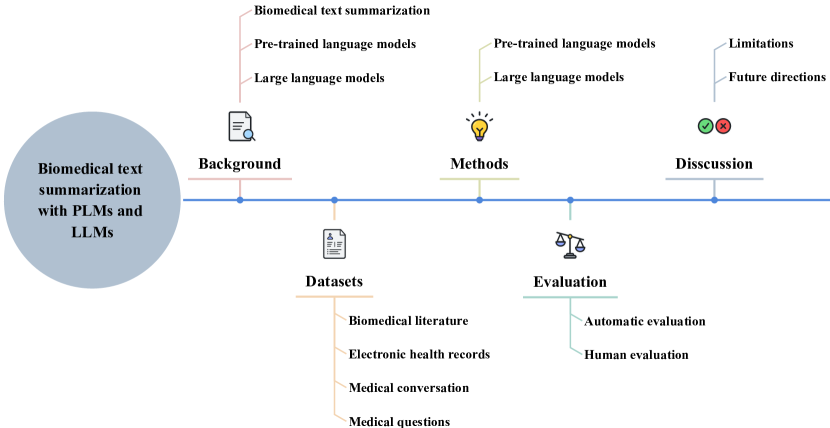
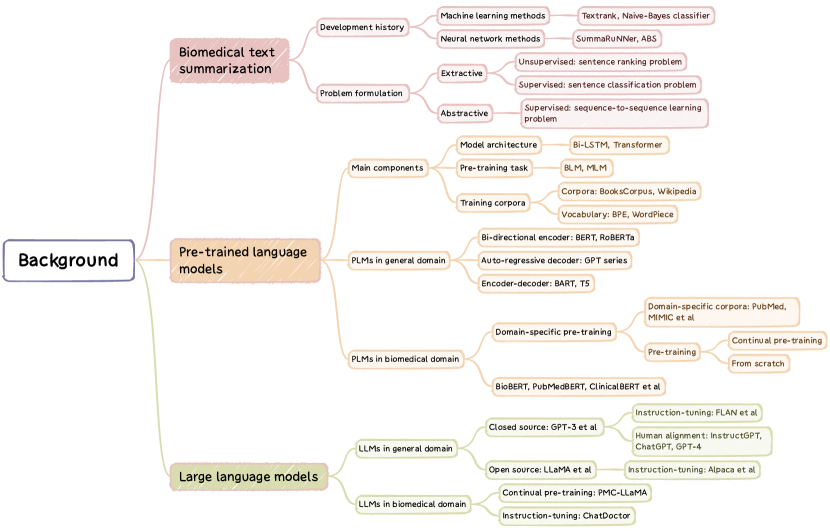
The exponential growth of biomedical texts such as biomedical literature and electronic health records (EHRs), poses a significant challenge for clinicians and researchers to access clinical information efficiently. To tackle this challenge, biomedical text summarization (BTS) has been proposed as a solution to support clinical information retrieval and management. BTS aims at generating concise summaries that distill key information from single or multiple biomedical documents. In recent years, the rapid advancement of fundamental natural language processing (NLP) techniques, from pre-trained language models (PLMs) to large language models (LLMs), has greatly facilitated the progress of BTS. This growth has led to numerous proposed summarization methods, datasets, and evaluation metrics, raising the need for a comprehensive and up-to-date survey for BTS. In this paper, we present a systematic review of recent advancements in BTS, leveraging cutting-edge NLP techniques from PLMs to LLMs, to help understand the latest progress, challenges, and future directions. We begin by introducing the foundational concepts of BTS, PLMs and LLMs, followed by an in-depth review of available datasets, recent approaches, and evaluation metrics in BTS. We finally discuss existing challenges and promising future directions in the era of LLMs. To facilitate the research community, we line up open resources including available datasets, recent approaches, codes, evaluation metrics, and the leaderboard in a public project: https://github.com/KenZLuo/Biomedical-Text-Summarization-Survey/tree/master. We believe that this survey will be a useful resource to researchers, allowing them to quickly track recent advancements and provide guidelines for future BTS research within the research community.
研究の動機と目的
- 生物医学テキスト要約における基礎的なBTS概念とPLMsおよびLLMsの役割を明確にする。
- 生物医学文献、電子カルテ(EHR)、対話データを横断するベンチマークBTSデータセットを整理・分析する。
- PLMsおよびLLMsを活用した既存のBTSアプローチをレビューし、長所と限界を強調する。
- LLMs時代における評価指標、現状の課題、および今後の方向性を論じる。
提案手法
- 2018年以降のBTS研究を対象としたPLMsおよびLLMsに焦点を当てた系統的文献調査。
- PLM/LLM時代における抽出型と生成型の方法の分類。
- ベンチマークデータセットとそのタスク設定(単一文書対多文書)の整備。
- 評価指標とリーダーボードの議論、オープンリソースを重視。
- LLMs下のBTSにおける制限と今後の方向性の特定。
実験結果
リサーチクエスチョン
- RQ1PLMsとLLMsを用いたBTSで用いられるベンチマークデータセットと評価基準は何か。
- RQ2PLMsとLLMsは生物医学分野の抽出型および要約型BTSタスクにどのように適用されてきたか。
- RQ3LLMs時代のBTSにおける現状の制限と有望な将来の方向性は何か?
主な発見
- PLMsとLLMsはBTSの主要な手法となり、生物医学テキストのエンコードと要約を改善している。
- 生物医学文献、EHR、医療対話、質問などを横断する公的なBTSデータセットが豊富で、単一文書および複数文書タスクがある。
- LLMsはゼロショットおよび指示チューニング能力を可能にし、特定の設定では小さなPLMsと同等またはそれを上回るBTSタスクを実現する。
- オープンソースおよび公開データセット、コード、リーダーボードが強調され、BTS研究の迅速な進展を支援する。
- 生物医学専用のPLMs(例: BioBERT, PubMedBERT)は、一般領域のPLMsに存在する語彙・用語のギャップに対処する。
この論文を読む
Nubintのビューアで原文を開き、読みながら気になる箇所をすぐに質問できます。
Nubintでこの論文を読むこのレビューはAIが論文の原文をもとに作成しました。引用する前に原文をご確認ください。