
[論文レビュー] A Survey of Graph Retrieval-Augmented Generation for Customized Large Language Models
この調査は、グラフ検索強化生成(GraphRAG)を用いたLLMのカスタマイズを分析し、分類法、検索と統合技術、ドメイン応用、課題、および今後の方向性を提示します。
Large language models (LLMs) have demonstrated remarkable capabilities in a wide range of tasks, yet their application to specialized domains remains challenging due to the need for deep expertise. Retrieval-Augmented generation (RAG) has emerged as a promising solution to customize LLMs for professional fields by seamlessly integrating external knowledge bases, enabling real-time access to domain-specific expertise during inference. Despite its potential, traditional RAG systems, based on flat text retrieval, face three critical challenges: (i) complex query understanding in professional contexts, (ii) difficulties in knowledge integration across distributed sources, and (iii) system efficiency bottlenecks at scale. This survey presents a systematic analysis of Graph-based Retrieval-Augmented Generation (GraphRAG), a new paradigm that revolutionizes domain-specific LLM applications. GraphRAG addresses traditional RAG limitations through three key innovations: (i) graph-structured knowledge representation that explicitly captures entity relationships and domain hierarchies, (ii) efficient graph-based retrieval techniques that enable context-preserving knowledge retrieval with multihop reasoning ability, and (iii) structure-aware knowledge integration algorithms that leverage retrieved knowledge for accurate and logical coherent generation of LLMs. In this survey, we systematically analyze the technical foundations of GraphRAG and examine current implementations across various professional domains, identifying key technical challenges and promising research directions. All the related resources of GraphRAG, including research papers, open-source data, and projects, are collected for the community in https://github.com/DEEP-PolyU/Awesome-GraphRAG.
研究の動機と目的
- グラフRAGが専門分野に合わせてLLMを調整するために必要である理由を説明する。
- 構造化された分類法(知識ベースのGraphRAG、インデックスベース、ハイブリッドGraphRAG)を提示し、従来のRAGと比較する。
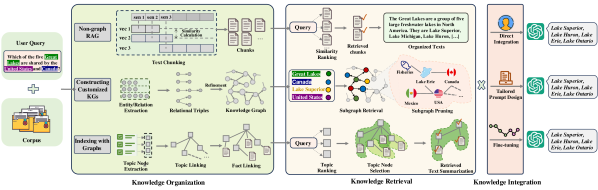
- GraphRAGにおける知識整理、検索、統合というコアコンポーネントを説明する。
- さまざまなドメインにわたる実装例、データセット、ベンチマーク、およびオープンソースリソースを調査する。
- GraphRAGシステムの主要な課題を特定し、有望な研究方向を提案する。
提案手法
- 従来のRAGからGraphRAGへの進化を概説し、GraphRAGの定義を形式化する。
- GraphRAGアプローチを知識ベース、インデックスベース、ハイブリッドGraphRAGの三つのカテゴリーに分類する。
- 構造化された知識のためのグラフベースのプランナーやマルチホップ推論を含む検索技術をレビューする。
- ノード、パス、サブグラフレベルでの知識統合戦略と、インコンテキスト学習の強化について議論する。
- ベンチマークに支えられたオープンソースプロジェクト、データセット、ドメイン別ケーススタディをまとめる。
- 知識品質、検索効率、一般化、およびセキュリティの限界と今後の方向性を強調する。
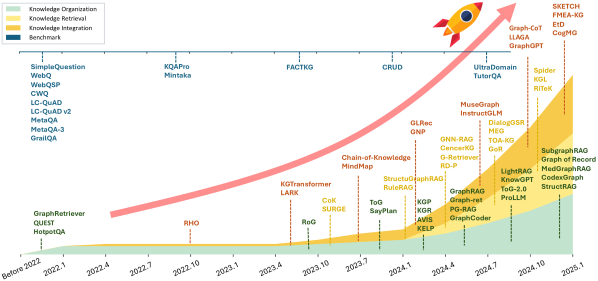
実験結果
リサーチクエスチョン
- RQ1GraphRAGとは何か、知識整理、検索、統合の点で従来のRAGとどう異なるか?
- RQ2主要なGraphRAGパラダイム(知識ベース、インデックスベース、ハイブリッド)とそれぞれのトレードオフは何か?
- RQ3グラフ構造化知識の検索技術とプランナーにはどのようなものがあり、マルチホップ推論能力を含むか?
- RQ4取得したグラフ知識をノード、パス、サブグラフのそれぞれのレベルでLLMプロンプトに効果的に統合するにはどうすればよいか?
- RQ5現在のドメイン応用、データセット、ベンチマーク、およびGraphRAGのオープンソース資源は何か、そして残る課題は何か?
主な発見
- GraphRAGはグラフ構造化知識を活用し、複雑な関係を捉え、文脈を保持したマルチホップ検索を可能にする。
- 3つのカテゴリの分類法がある:知識ベースGraphRAG、インデックスベースGraphRAG、ハイブリッドGraphRAGで、それぞれ異なる目的と機構を持つ。
- GraphRAGは平文テキストRAGと比較して、検索効率と分散知識ソース上の推論を改善する。
- 本調査は実用的な展開を支援するため、オープンソースプロジェクト、データセット、およびドメイン別ケーススタディを統合する。
- 知識品質、検索効率、システムの一般化、セキュリティなどの重要な課題を特定し、今後の研究の方向性を提案する。
この論文を読む
Nubintのビューアで原文を開き、読みながら気になる箇所をすぐに質問できます。
Nubintでこの論文を読むこのレビューはAIが論文の原文をもとに作成しました。引用する前に原文をご確認ください。