
[論文レビュー] A Survey on Graph Neural Networks for Time Series: Forecasting, Classification, Imputation, and Anomaly Detection
グラフニューラルネットワークを時系列データへ適用した予測、分類、異常検知、補完の包括的な調査で、統一されたタスク指向・方法論指向のフレームワークと今後の方向性。
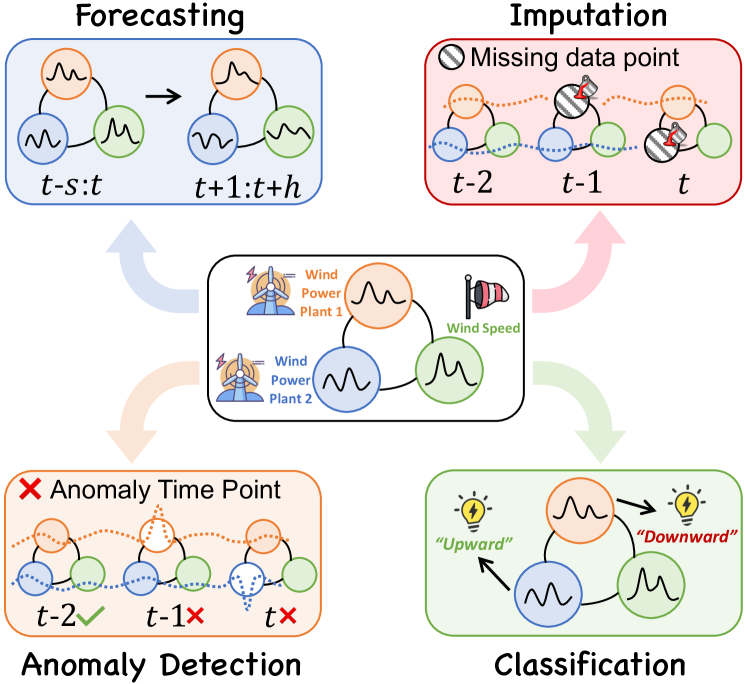
Time series are the primary data type used to record dynamic system measurements and generated in great volume by both physical sensors and online processes (virtual sensors). Time series analytics is therefore crucial to unlocking the wealth of information implicit in available data. With the recent advancements in graph neural networks (GNNs), there has been a surge in GNN-based approaches for time series analysis. These approaches can explicitly model inter-temporal and inter-variable relationships, which traditional and other deep neural network-based methods struggle to do. In this survey, we provide a comprehensive review of graph neural networks for time series analysis (GNN4TS), encompassing four fundamental dimensions: forecasting, classification, anomaly detection, and imputation. Our aim is to guide designers and practitioners to understand, build applications, and advance research of GNN4TS. At first, we provide a comprehensive task-oriented taxonomy of GNN4TS. Then, we present and discuss representative research works and introduce mainstream applications of GNN4TS. A comprehensive discussion of potential future research directions completes the survey. This survey, for the first time, brings together a vast array of knowledge on GNN-based time series research, highlighting foundations, practical applications, and opportunities of graph neural networks for time series analysis.
研究の動機と目的
- 時系列分析におけるGNNのタスク指向の分類法を提供する(予測、異常検知、補完、分類)。
- 時系列データをグラフにエンコードして表現を学習するための統一的な方法論フレームワーク(空間-時間GNN)を提示する。
- ドメインを横断する代表的な研究と応用を調査し、GNN4TSシステムの設計と実装を導く。
- GNNベースの時系列研究を前進させるための未解決課題と今後の方向性を論じる。
提案手法
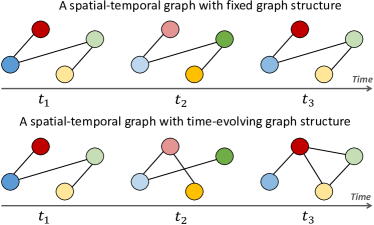
- 属性付きグラフの系列として多変量時系列を表す空間-時間グラフを定義する。
- アプローチをタスク別に分類し(予測、異常検知、補完、分類)、空間的/時間的モデリングの選択(スペクトルGNN vs 空間GNN、時 domain vs 周波数ドメイン、離散 vs 連続アーキテクチャ)で分類する。
- データ処理とグラフ構築、STGNNベースの表現学習、下流タスク予測器からなる統一パイプラインを提案する。
- ヒューリスティックベースと学習ベースのグラフ構築手法をレビューする(近接性、結合性、類似性、機能的依存、学習済みグラフ)。
- アーキテクチャパターン(因子分解型 vs 結合型STGNN)と時系列モジュール(RNN、TCN、Transformer、ハイブリッド)を説明する。
- 代表的なモデルとそれらのタスク特異的定式化を要約する(例: 予測損失、補完損失、分類損失)。
実験結果
リサーチクエスチョン
- RQ1GNNベースの時系列分析における主なタスクカテゴリは何で、どのようにモデル化されるのか?
- RQ2空間-時間グラフとSTGNNアーキテクチャをどのように統一して多様な時系列タスクに対応させるか?
- RQ3時系列のコアなグラフ構築戦略(ヒューリスティックと学習ベース)は何で、性能にどう影響するか?
- RQ4時系列予測、異常検知、補完、分類におけるSTGNNの共通のアーキテクチャパターン(離散 vs 連続、因子分解型 vs 結合型)は何か?
- RQ5GNNを用いた時系列研究の重要な方向性と未解決の課題は何か?
主な発見
- この調査は、予測、分類、異常検知、補完にわたるGNNベースの時系列分析の初の包括的かつ最新のレビューを提供する。
- タスクと方法論の観点から統一された構造化された分類法を提供し、三部構成のフレームワーク(空間モジュール、時間モジュール、全体アーキテクチャ)を導入する。
- 適用分野の幅広さと、変数間および時系列間の依存をモデル化するGNN4TSの柔軟性を強調する。
- ヒューリスティックおよび学習ベースのグラフ構築戦略を論じ、それぞれが適切な状況を詳述する。
- 今後の研究方向とGNN4TSにおける未解決の問いを概説し、今後の研究を指針する。
この論文を読む
Nubintのビューアで原文を開き、読みながら気になる箇所をすぐに質問できます。
Nubintでこの論文を読むこのレビューはAIが論文の原文をもとに作成しました。引用する前に原文をご確認ください。