
[論文レビュー] A Survey on LLM-Generated Text Detection: Necessity, Methods, and Future Directions
本調査は、大規模言語モデルによって生成されたテキストを検出するための進展を総合し、検出器、データセット、評価、課題、今後の方向性を網羅する。
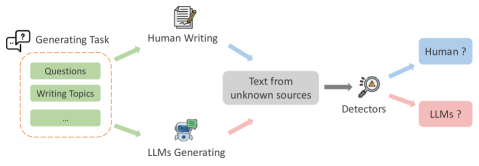
The powerful ability to understand, follow, and generate complex language emerging from large language models (LLMs) makes LLM-generated text flood many areas of our daily lives at an incredible speed and is widely accepted by humans. As LLMs continue to expand, there is an imperative need to develop detectors that can detect LLM-generated text. This is crucial to mitigate potential misuse of LLMs and safeguard realms like artistic expression and social networks from harmful influence of LLM-generated content. The LLM-generated text detection aims to discern if a piece of text was produced by an LLM, which is essentially a binary classification task. The detector techniques have witnessed notable advancements recently, propelled by innovations in watermarking techniques, statistics-based detectors, neural-base detectors, and human-assisted methods. In this survey, we collate recent research breakthroughs in this area and underscore the pressing need to bolster detector research. We also delve into prevalent datasets, elucidating their limitations and developmental requirements. Furthermore, we analyze various LLM-generated text detection paradigms, shedding light on challenges like out-of-distribution problems, potential attacks, real-world data issues and the lack of effective evaluation framework. Conclusively, we highlight interesting directions for future research in LLM-generated text detection to advance the implementation of responsible artificial intelligence (AI). Our aim with this survey is to provide a clear and comprehensive introduction for newcomers while also offering seasoned researchers a valuable update in the field of LLM-generated text detection. The useful resources are publicly available at: https://github.com/NLP2CT/LLM-generated-Text-Detection.
研究の動機と目的
- LLM-generated text detectorsの必要性を喚起し、AI対応テキストにおける悪用を抑止し、信頼性を維持する。
- 最近の検出アプローチ、データセット、評価慣行を総合的に取りまとめ、分析する。
- 現状の限界を特定し、検出を強化する将来の研究方向を示す。
- 新規参入者向けに明確で最新の導入を提供し、研究者向けには要点を短くまとめた更新を提供する。
提案手法
- Kitchenhamガイドラインに従って、LLM-generated text検出文献をレビューする体系的文献調査(SLR)を実施した。
- ターゲット検索語を使用: “LLM-generated text detection” OR “machine-generated text detection” OR “AI-written text detection” OR “deepfake text detection”。
- 出典は Google Scholar、ArXiv、Scopus、Web of Science、IEEE Xplore、Springer Link、ACL Anthology、ACM DL など。
- 適用した包含基準: (i) 検出方法に焦点を当てたレビュー、(ii) 検出方法論を提案、(iii) 課題と将来の方向性を論じる、(iv) 必要性と応用を明確にする。
- 関連論文82件をスクリーニングし、データ、検出器、指標、問題、および将来の方向性を分析した。
実験結果
リサーチクエスチョン
- RQ1LLM-generated textを検出する現在の主流手法とそれに伴う課題は何か?
- RQ2LLM-generated text検出のためのデータセットとベンチマークは何が存在し、どのような限界があるか?
- RQ3どの評価指標が用いられ、さまざまな条件下で検出器はどの程度性能を発揮するか?
- RQ4主要な課題(例: out-of-distribution、攻撃、データの曖昧さ)と堅牢な検出器の将来方向性は何か?
主な発見
- LLM-generated text検出に関する2023年の研究急増がある。
- 本調査は、水印、ゼロショット、LM微調整法、敵対的学習、検出器としてのLLMs、人間支援アプローチなど、検出器を網羅している。
- 広範なデータセットとベンチマークが存在する(例: HC3、CHEAT、GROVERベースのデータセット、TweepFake、GPT-2 Output Dataset); 指摘された制約と改善の必要性。
- 評価指標には accuracy、AUROC、recall、F1-score が含まれ、out-of-distribution およびデータ曖昧性の課題についての議論。
- 検出器への攻撃などの問題と、資源の乏しい環境やデータの曖昧性の下での堅牢な検出器の必要性について論じている。
- 将来の方向性として、攻撃に対して堅牢な検出器の構築、ゼロショット検出器の強化、マルチエージェントシステムなどを強調している。)

この論文を読む
Nubintのビューアで原文を開き、読みながら気になる箇所をすぐに質問できます。
Nubintでこの論文を読むこのレビューはAIが論文の原文をもとに作成しました。引用する前に原文をご確認ください。