
[論文レビュー] A Survey on Safety-Critical Driving Scenario Generation -- A Methodological Perspective
本サーベイは、自律走行車の安全運転シナリオ生成における包括的な方法論的分類を提示し、データ駆動型、敵対的、知識ベース型の手法に分類する。主な課題として、忠実度、効率性、多様性、移行性、制御性を特定し、今後の方向性として、物理法則の統合や、カリキュラム学習および敵対的訓練を用いたロバストネスと一般化性能の向上に向けたシナリオ生成の活用を提案する。
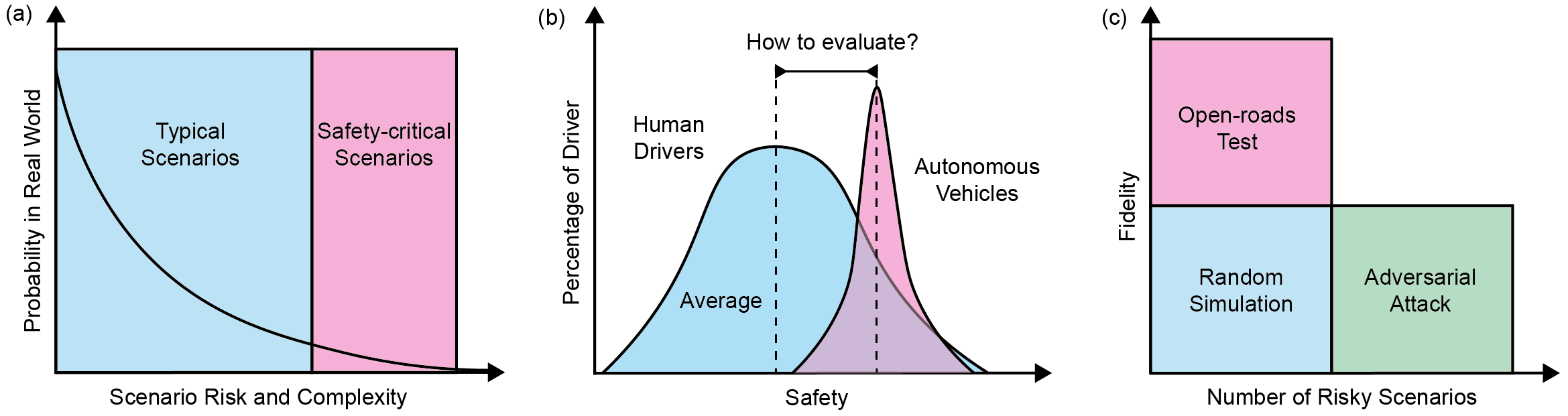
Autonomous driving systems have witnessed a significant development during the past years thanks to the advance in machine learning-enabled sensing and decision-making algorithms. One critical challenge for their massive deployment in the real world is their safety evaluation. Most existing driving systems are still trained and evaluated on naturalistic scenarios collected from daily life or heuristically-generated adversarial ones. However, the large population of cars, in general, leads to an extremely low collision rate, indicating that the safety-critical scenarios are rare in the collected real-world data. Thus, methods to artificially generate scenarios become crucial to measure the risk and reduce the cost. In this survey, we focus on the algorithms of safety-critical scenario generation in autonomous driving. We first provide a comprehensive taxonomy of existing algorithms by dividing them into three categories: data-driven generation, adversarial generation, and knowledge-based generation. Then, we discuss useful tools for scenario generation, including simulation platforms and packages. Finally, we extend our discussion to five main challenges of current works -- fidelity, efficiency, diversity, transferability, controllability -- and research opportunities lighted up by these challenges.
研究の動機と目的
- 実世界のデータに存在しないが、まれで高リスクなシナリオにおける自律走行車の安全性評価という、極めて重要な課題に対処すること。
- その情報源とフレームワークに基づいて、既存のシナリオ生成手法を体系的に分類すること。
- 現在のシナリオ生成手法における主な課題(忠実度、効率性、多様性、移行性、制御性)を特定すること。
- 特定の評価ニーズに応じて適切な生成アルゴリズムを選定するための指針を研究者および実務家に提供すること。
- 今後の研究方向性を提示すること。具体的には、物理法則の統合、オフライン強化学習の活用、生成シナリオを用いたシステムのロバストネスと一般化性能の向上。
提案手法
- シナリオ生成を、主に3つの方法論的ファミリーに分類する:データ駆動型(実世界データに深層生成モデルを適用)、敵対的(最適化または強化学習を用いて失敗事例を特定)、知識ベース型(ルールベースまたは記号的制約を用いて安全を重視する状態を定義)。
- 物理法則と物体間相互作用を統合した階層的シナリオ表現を提案し、現実性と解釈可能性を向上させる。
- 広く使われているシミュレーションプラットフォーム(例:CARLA、LGSVL)およびオープンソースツール(例:AirSim、ScenarioGen)をレビューし、シナリオ設計および評価に活用する。
- オフライン強化学習と模倣学習を統合し、生成シナリオが実世界データの分布と整合するようにする。
- データ駆動型+敵対的、知識ベース型+敵対的といった組み合わせを提案し、多様性、現実性、制御性のバランスを図る。
- カリキュラム学習および分布的ロバスト最適化を、生成シナリオを用いて自律走行車の一般化性能とロバストネスを向上させる戦略として提案する。
実験結果
リサーチクエスチョン
- RQ1シナリオ生成の背後にある方法論および情報源に基づいて、安全を重視する走行シナリオを体系的に分類する方法は何か?
- RQ2現在のシナリオ生成手法における主な制限要因は何か。それらは自律走行車の安全性評価にどのように影響を与えるか?
- RQ3生成されたシナリオを、現実的(高忠実度)かつ、システムの脆弱性を効果的に特定できる(高臨界度)ようにするにはどうすればよいか?
- RQ4物理法則や交通ルールといった外部知識が、生成シナリオの解釈可能性と妥当性を向上させる役割を果たすか?
- RQ5生成シナリオを評価のためのものにとどめず、自律走行システムのロバストネスと一般化性能を向上させるためにどのように活用できるか?
主な発見
- 特に深層生成モデルを用いたデータ駆動型手法は、複雑な交通パターンを捉えることができるが、データのスパarsityのため、高リスクなシナリオを生成できないことが多い。
- 敵対的生成手法は、失敗事例の発見に有効であるが、現実的でない、あるいは物理的に不条件なシナリオを生成する可能性がある。
- 知識ベース型手法は高い解釈可能性と制御性を提供するが、多様性に欠け、まれで複雑な相互作用を逃すことがある。
- データ駆動型と敵対的手法を組み合わせることで、多様で現実的かつ安全を重視するシナリオを発見する有望な道筋が得られる。
- 物理法則と実世界データの分布をシナリオ生成に統合することで、忠実度が向上し、生成シナリオが意味的かつ検証可能なものとなる。
- 生成シナリオをカリキュラム学習および敵対的訓練フレームワークに活用することで、自律走行システムのロバストネスと一般化性能を顕著に向上させることができる。

より良い研究を、今すぐ始めましょう
論文の読解から最終レビューまで、研究時間を劇的に削減しましょう。
クレジットカード登録不要
このレビューはAIが作成し、人間の編集者が確認しました。