
[論文レビュー] A Survey on Spectral Graph Neural Networks
この論文はspectral GNNsを体系的にレビューし、方法を eigenvalues または eigenvectors で分類し、理論と応用を分析し、データセット全体でのパフォーマンスをベンチマークする。
Graph neural networks (GNNs) have attracted considerable attention from the research community. It is well established that GNNs are usually roughly divided into spatial and spectral methods. Despite that spectral GNNs play an important role in both graph signal processing and graph representation learning, existing studies are biased toward spatial approaches, and there is no comprehensive review on spectral GNNs so far. In this paper, we summarize the recent development of spectral GNNs, including model, theory, and application. Specifically, we first discuss the connection between spatial GNNs and spectral GNNs, which shows that spectral GNNs can capture global information and have better expressiveness and interpretability. Next, we categorize existing spectral GNNs according to the spectrum information they use, \ie, eigenvalues or eigenvectors. In addition, we review major theoretical results and applications of spectral GNNs, followed by a quantitative experiment to benchmark some popular spectral GNNs. Finally, we conclude the paper with some future directions.
研究の動機と目的
- 空間 GNNs と spectral GNNs を区別し、spectral methods の固有の課題を強調する。
- spectral GNNs を eigenvalue-based および eigenvector-based のカテゴリに分類し、サブカテゴリを設ける。
- 主要な理論的結果(expressive power、robustness、transferability)と主要な応用を要約する。
- 標準データセット上で人気の spectral GNNs の定量的ベンチマークを提供し、今後の方向性を論じる。
提案手法
- spectral graph convolution を graph Fourier transform と eigenspaces を用いて定義する。
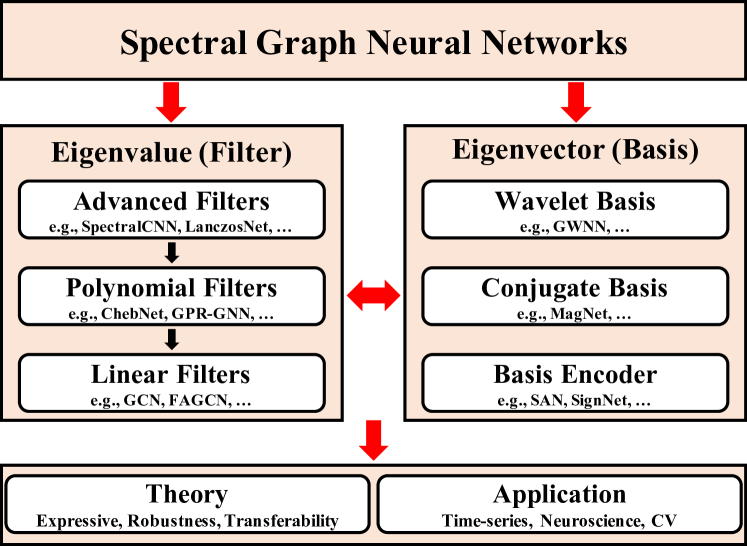
- spectral GNNs を eigenvalue-based(advanced、polynomial、linear filters)と eigenvector-based(wavelet、conjugate/basis encoders)アプローチに分類する。
- expressiveness、robustness、transferability に関する理論的結果について論じる。
- multivariate time-series forecasting、neuroscience、computer vision における主要な応用をレビューする。
- 統一的なフレームワークを用いて six datasets で spectral GNNs を比較するベンチマークを実施する。
実験結果
リサーチクエスチョン
- RQ1spectral GNNs が用いる主なスペクトル情報源(eigenvalues vs eigenvectors)は何で、それらのトレードオフは何か?
- RQ2スペクトル GNNs は空間 GNNs と比較して表現力、スケーラビリティ、解釈性においてどのように異なるか?
- RQ3expressiveness、robustness、transferability の点で spectral GNNs に対する理論的保証は何か?
- RQ4homophilic なグラフと heterophilic なグラフ、実世界タスクにおける spectral GNNs の経験的性能はどうか?
主な発見
- Spectral GNNs はグローバルな情報を捉え、学習された周波数成分を通じて解釈性を提供する。
- 二つの主要なスペクトルカテゴリが存在する: eigenvalue-based filters(advanced、polynomial、linear)と eigenvector-based bases(wavelets、conjugate bases、basis encoders)。
- Polynomial と linear filters は大規模グラフでの学習をスケーラブルにする一方で表現力にトレードオフがある。advanced filters は強力だが計算コストが高い。
- Eigenvector-based methods(例:graph wavelets、Hermitian Laplacian)は局所化と方向情報を提供するが、まだ十分に探索されていない。
- 本論文は expressiveness、perturbation robustness、transferability に関する理論を論じ、データセット間での性能差を示すベンチマーク結果を提示する。
この論文を読む
Nubintのビューアで原文を開き、読みながら気になる箇所をすぐに質問できます。
Nubintでこの論文を読むこのレビューはAIが論文の原文をもとに作成しました。引用する前に原文をご確認ください。