
[論文レビュー] ACLM: A Selective-Denoising based Generative Data Augmentation Approach for Low-Resource Complex NER
ACLMは、注意マップを用いたキーワード選択による選択的ノイズ除去と条件付き生成に基づくデータ拡張手法を提案する。低リソースな複雑なNERに対して、注意マップを用いたキーワード選択により名前付きエンティティと文脈的に関連するキーワードを保持する、新たなテキスト再構築タスクで微調整されたBARTを用いる。文脈エンティティ不一致を緩和するため、一貫性があり多様で事実に即した拡張を生成し、単語・多言語・多言語設定のあらゆる低リソース環境でベースラインを1%〜36%上回る性能を発揮する。
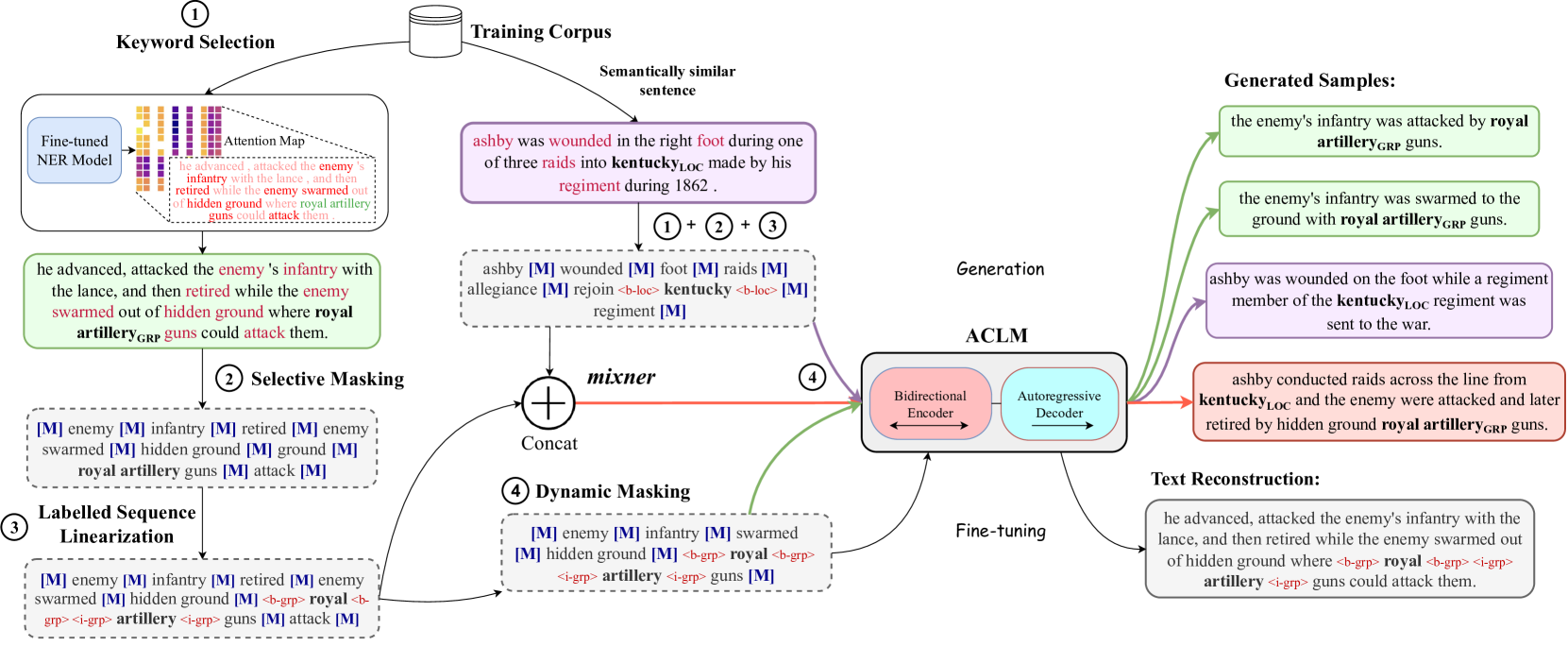
Complex Named Entity Recognition (NER) is the task of detecting linguistically complex named entities in low-context text. In this paper, we present ACLM Attention-map aware keyword selection for Conditional Language Model fine-tuning), a novel data augmentation approach based on conditional generation to address the data scarcity problem in low-resource complex NER. ACLM alleviates the context-entity mismatch issue, a problem existing NER data augmentation techniques suffer from and often generates incoherent augmentations by placing complex named entities in the wrong context. ACLM builds on BART and is optimized on a novel text reconstruction or denoising task - we use selective masking (aided by attention maps) to retain the named entities and certain keywords in the input sentence that provide contextually relevant additional knowledge or hints about the named entities. Compared with other data augmentation strategies, ACLM can generate more diverse and coherent augmentations preserving the true word sense of complex entities in the sentence. We demonstrate the effectiveness of ACLM both qualitatively and quantitatively on monolingual, cross-lingual, and multilingual complex NER across various low-resource settings. ACLM outperforms all our neural baselines by a significant margin (1%-36%). In addition, we demonstrate the application of ACLM to other domains that suffer from data scarcity (e.g., biomedical). In practice, ACLM generates more effective and factual augmentations for these domains than prior methods. Code: https://github.com/Sreyan88/ACLM
研究の動機と目的
- 標準的なデータ拡張手法が文脈エンティティ不一致のため失敗する低リソースな複雑なNERにおけるデータ不足問題を解決すること。
- 複雑な名前付きエンティティの真正の意味を保持する一貫性があり多様で事実に即した拡張を生成すること。
- 既存手法がエンティティを置換または再表現するが、言語的・文脈的整合性を維持しないという限界を克服すること。
- エンティティ自体を変更するのではなく、エンティティの周囲りに新しい文脈パターンを導入する条件付き生成フレームワークを構築すること。
- 本手法が医療・科学的テキストを含む他の低リソース分野へも適用可能であることを示すこと。
提案手法
- ACLMは、名前付きエンティティと文脈的に関連するキーワードを保持する選択的マスキングを用いた、変更されたノイズ除去目的でBARTを微調整する。
- キーワードは注意マップの分析により特定され、複雑なエンティティの周囲りの意味的・構文的に関連する文脈を保持する。
- 入力の破損(テンプレート)は、名前付きエンティティと選択されたキーワードを除き、非エンティティ語がマスキングされる。
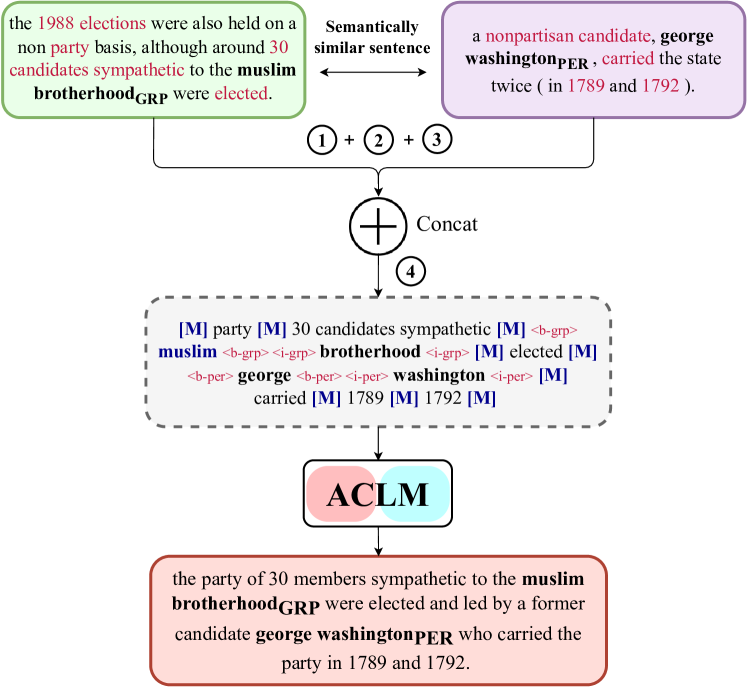
- モデルはテンプレートを条件として完全な文を生成し、多様で文脈的に整合性のある拡張を生成する。
- 推論時に複数のテンプレートを組み合わせることで、生成の多様性を向上させるミックスナーレーション戦略を導入する。
- 外部知識は不要であるが、今後の研究で知識統合への拡張性を設計済みである。
実験結果
リサーチクエスチョン
- RQ1条件付き生成に基づくデータ拡張手法は、文脈エンティティ不一致を引き起こさずに、低リソースな複雑なNERにおけるデータ不足問題を効果的に解決できるか?
- RQ2注意マップに従った選択的マスキングは、ランダムマスキングやエンティティのみマスキングと比較して、生成された拡張の質と一貫性をどのように向上させるか?
- RQ3ACLMは、複雑な名前付きエンティティの元の意味を保持しつつ、多様で事実に即し文脈的に適切な拡張をどの程度生成できるか?
- RQ4ACLMは、ニュース以外の低リソース分野、例えば医療・科学的テキストなどにも一般化可能か?
- RQ5NER F1スコアおよび生成品質メトリクスの観点から、ACLMの性能は既存のニューラルベースラインと比べてどの程度か?
主な発見
- ACLMは、単語・多言語・多言語設定のあらゆる低リソースな複雑なNER環境において、F1スコアで全ニューラルベースラインを1%〜36%上回る。
- 500件の訓練サンプルでのMultiCoNERでは、ACLMは23%のSOTA手法と比較して31.8%の性能低下に抑えるなど、優れたロバスト性を示す。
- 生成評価の定量的分析では、ACLMは200件の訓練サンプルで最高の多様性スコア(エンティティ:22.48、長さ:5.67)と最低のパープレキシティ(80.77)を達成した。
- 医療データセット(BC2GMおよびNCBI Disease)では、ACLMがベースラインを5.8〜6.0ポイント上回り、優れた汎用性を示した。
- 定性的分析では、ACLMはMELM や LwTR よりも一貫性があり詳細で文脈的に適切な拡張を生成するが、後者はしばしば不整合または最小限にしか変更されない出力を生成する。
- ACLMは、MELM や LwTR が頻繁に意味的カテゴリー(例:映画を本に)を交換して誤った事実を生成するのとは異なり、文脈エンティティ不一致を回避する。
この論文を読む
Nubintのビューアで原文を開き、読みながら気になる箇所をすぐに質問できます。
Nubintでこの論文を読むこのレビューはAIが論文の原文をもとに作成しました。引用する前に原文をご確認ください。