
[論文レビュー] Adaptive Few-Shot Learning Algorithm for Rare Sound Event Detection
本論文は、メトリクスベースの少サンプル学習を向上させるために、すべてのサポート例におけるクラス間の差異とクラス内の一貫性をモデル化する、タスク適応型モジュールを提案する。これにより特徴表現の適応性が向上し、5-way 1-shot設定下でESC-50とnoiseESC-50でそれぞれ+6.8%および+5.9%の精度向上を達成し、最先端の性能を実現した。
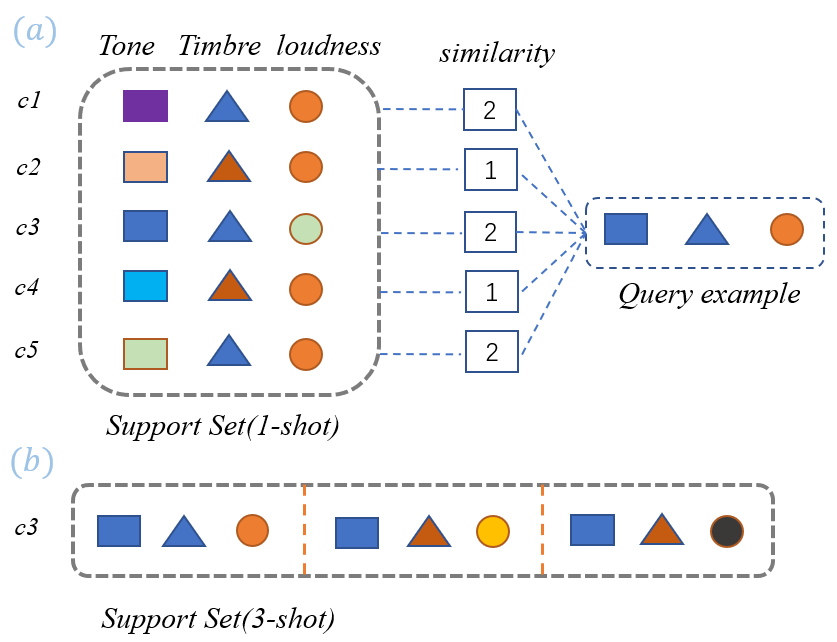
Sound event detection is to infer the event by understanding the surrounding environmental sounds. Due to the scarcity of rare sound events, it becomes challenging for the well-trained detectors which have learned too much prior knowledge. Meanwhile, few-shot learning methods promise a good generalization ability when facing a new limited-data task. Recent approaches have achieved promising results in this field. However, these approaches treat each support example independently, ignoring the information of other examples from the whole task. Because of this, most of previous methods are constrained to generate a same feature embedding for all test-time tasks, which is not adaptive to each inputted data. In this work, we propose a novel task-adaptive module which is easy to plant into any metric-based few-shot learning frameworks. The module could identify the task-relevant feature dimension. Incorporating our module improves the performance considerably on two datasets over baseline methods, especially for the transductive propagation network. Such as +6.8% for 5-way 1-shot accuracy on ESC-50, and +5.9% on noiseESC-50. We investigate our approach in the domain-mismatch setting and also achieve better results than previous methods.
研究の動機と目的
- 豊富なベースクラスで学習されたモデルにおけるラベル付きデータの不足と過学習の問題に起因するレア音声イベント検出の課題に対処すること。
- 従来のメトリクスベースの少サンプル学習フレームワークが、サポート例を独立して扱い、例間の関係性を無視するという制限を克服すること。
- すべてのサポート例を統合的にモデル化することで、タスク固有の判別的特徴を特定し、低データ環境下での一般化性能を向上させること。
- ドメイン不一致の状況下でもモデルのロバスト性を向上させるために、ドメイン不変表現とアテンションメカニズムを統合すること。
- 既存の少サンプル学習フレームワークと互換性があり、アーキテクチャの大規模な見直しを伴わずに性能を向上できるプラグイン型モジュールの開発
提案手法
- すべてのサポート例から得られる情報を統合することで、クラス内の一貫性とクラス間の差異を特定するタスク適応型抽出器(TAE)を導入する。
- 全サポートセットに注目するアテンション機構を用いて、クラス間の特徴差を学習するプロジェクターヘッドを設計し、入力クエリごとに特徴の重み付けを適応的に制御する。
- 学習の多様性を高め、データ不足の影響を軽減するため、音声イベント指向のデータ拡張戦略を組み込む。
- 原始音声埋め込みにおける時間的およびチャンネル別コンテキストを捉えるために、特徴エンコーダーにアテンション機構を統合する。
- プロトタイプネットワークやTPNのようなメトリクスベースのフレームワークと組み合わせ、最小限の変更でエンドツーエンド学習が可能なタスク適応型モジュールを実装する。
- 一般化性能の向上を目的として、ドメイン適応(DA)および時間的/チャンネル別に配慮したデータ拡張を適用する。
実験結果
リサーチクエスチョン
- RQ1サポート例間の関係性をモデル化することで、独立した類似度計算を上回る少サンプル音声イベント検出の性能向上が可能か?
- RQ2タスク適応型モジュールは、クラス内一貫性とクラス間独自性を捉えることで、特徴表現をどのように向上させるか?
- RQ3学習データとテストデータが異なる分布に属するドメイン不一致状況下でも、提案手法はどの程度一般化性能を示すか?
- RQ4アテンション機構とデータ拡張を統合することで、ESC-50やnoiseESC-50のような多様なベンチマークで一貫した性能向上が得られるか?
- RQ51ショットでは優れた性能を示すが、マルチショット設定では性能が劣化する理由は何か。また、高速適応における限界は何か?
主な発見
- 提案手法は、ベースラインのProtoNetと比較して、ESC-50データセットで5-way 1-shot精度に+6.8%の向上を達成した。
- noiseESC-50データセットでは、ベースラインより5-way 1-shot精度が+5.9%向上し、ノイズの多い音声環境下でも高いロバスト性を示した。
- ドメイン不一致設定下では、TA+ProtoNet+DAモデルが、音楽分類でAUC 0.779、動物分類でAUC 0.705を達成し、すべてのベースラインを上回った。
- アテンション機構により、'銃声'のような短時間イベントの局所化が向上し、非アテンションモデルと比較して誤検出(偽陰性)が減少した。
- 時間的およびチャンネル別に配慮したデータ拡張を適用したモデルは、ドメイン不一致評価で最高のAUC(音楽で0.857、動物で0.768)を達成した。
- 可視化解析により、アテンション機構が関連するサポート例を正しく特定しているのに対し、非アテンションモデルは静音や背景音の類似性に起因して誤ったマッチングを行う傾向があることが確認された。

より良い研究を、今すぐ始めましょう
論文の読解から最終レビューまで、研究時間を劇的に削減しましょう。
クレジットカード登録不要
このレビューはAIが作成し、人間の編集者が確認しました。