
[論文レビュー] Adaptive Few-shot Prompting for Machine Translation with Pre-trained Language Models
AFSPは入力文に対して適切な翻訳デモを自動選択するハイブリッドLMM-埋め込み検索モジュールを使用し、複数の出力を生成して自己教師付きリランカーで再ランク付けすることで、外交官向け中国語–英語およびUNコーパスの機械翻訳を改善する。
Recently, Large language models (LLMs) with in-context learning have demonstrated remarkable potential in handling neural machine translation. However, existing evidence shows that LLMs are prompt-sensitive and it is sub-optimal to apply the fixed prompt to any input for downstream machine translation tasks. To address this issue, we propose an adaptive few-shot prompting (AFSP) framework to automatically select suitable translation demonstrations for various source input sentences to further elicit the translation capability of an LLM for better machine translation. First, we build a translation demonstration retrieval module based on LLM's embedding to retrieve top-k semantic-similar translation demonstrations from aligned parallel translation corpus. Rather than using other embedding models for semantic demonstration retrieval, we build a hybrid demonstration retrieval module based on the embedding layer of the deployed LLM to build better input representation for retrieving more semantic-related translation demonstrations. Then, to ensure better semantic consistency between source inputs and target outputs, we force the deployed LLM itself to generate multiple output candidates in the target language with the help of translation demonstrations and rerank these candidates. Besides, to better evaluate the effectiveness of our AFSP framework on the latest language and extend the research boundary of neural machine translation, we construct a high-quality diplomatic Chinese-English parallel dataset that consists of 5,528 parallel Chinese-English sentences. Finally, extensive experiments on the proposed diplomatic Chinese-English parallel dataset and the United Nations Parallel Corpus (Chinese-English part) show the effectiveness and superiority of our proposed AFSP.
研究の動機と目的
- 各ソース入力ごとに高品質デモを自動選択することで機械翻訳におけるインコンテキスト学習のプロンプト感度を解決する。
- デプロイ済みLLMの埋め込みを用いて意味的に関連する翻訳デモを取得するハイブリッドデモ取得モジュールを構築する。
- 意味的一貫性のある翻訳を選択し出力バイアスを緩和する自己教師付きリランカーを導入する。
- 高品質な外交中国語–英語平行データセットとUN中国語–英語サブセット上で有効性を検証し、領域横断での効果を評価する。
提案手法
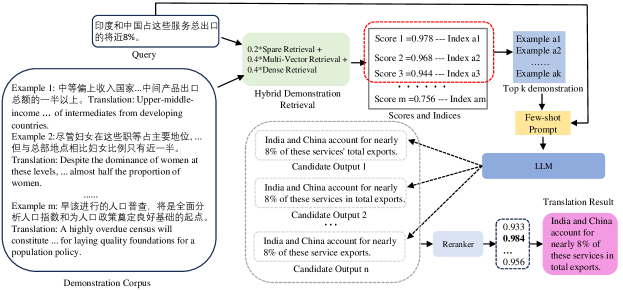
- 展開済みLLMの埋め込みを用いたデモ取得(密、疎、多ベクトル)に基づくハイブリッド検索モジュールを用いてハイブリッド関連度スコアを計算し、トップkのデモを取得する。
- 取得したデモを固定プロンプトテンプレートに埋め込み、LLMのFew-shotプロンプトを形成する。
- LLM が複数のターゲット言語出力を生成し、自己監視付きの負サンプリングで訓練した小規模言語モデル(SLM)リランカーで再ランク付けする。
- 劣化させたターゲット文と歪みから導出された品質スコアを用いて自己教師付きリランカーを訓練し、 大規模な訓練データを作成する。
- AFSPをゼロショット、少数Shots、KNNベースのベースラインと、外交・UN中国語–英語データセットで標準MT指標と人間評価で比較する。
実験結果
リサーチクエスチョン
- RQ1適応的デモ取得は入力ごとに固定プロンプトより翻訳品質を改善できるか。
- RQ2ハイブリッド埋め込みベースの取得は単一モデル埋め込みより意味的に関連性の高いデモを得られるか。
- RQ3自己教師付きリランカーは意味的整合性を改善し出力バイアスを低減できるか。
- RQ4AFSPは外交中国語–英語およびUN中国語–英語データでベースラインと比べてどの程度改善するか。
主な発見
- AFSPは評価対象データセットと言語方向でゼロショット、少数Shots、およびKNNベースのベースラインを一貫して上回る。
- 展開済みLLMの埋め込みを用いたデモ取得(密、疎、マルチベクトル)と適応プロンプトの使用は翻訳指標を改善する。
- 自己教師付きリランカーは高品質な翻訳を効果的に選択し、自動指標とヒト評価の双方を向上させる。
- AFSPはDiplomaticコーパスおよびUN Parallel Corpus(中国語–英語)で複数の指標とデモンストレーションにおいて顕著な改善を達成する。
- ヒト評価はAFSPがベースラインより流暢さ、正確さ、スタイル保持の点で優れていることを示す。
この論文を読む
Nubintのビューアで原文を開き、読みながら気になる箇所をすぐに質問できます。
Nubintでこの論文を読むこのレビューはAIが論文の原文をもとに作成しました。引用する前に原文をご確認ください。