
[論文レビュー] Advancing LLM Reasoning Generalists with Preference Trees
Eurusは UltraInteract でファインチューニングされたオープンソースの LLM のスイートであり、ツリー構造の嗜好データアプローチと新規報酬モデリングを活用することにより、公開モデルの中で最先端の推論性能を達成し、難易度の高いベンチマークで GPT-3.5 Turbo と競争力のある結果を示します。
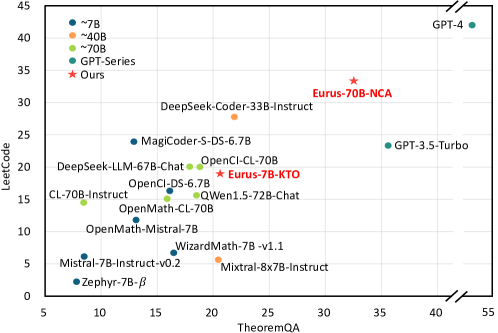
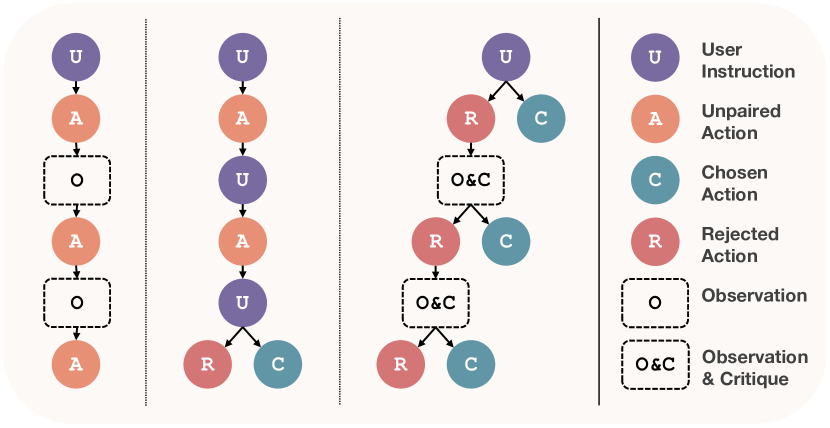
We introduce Eurus, a suite of large language models (LLMs) optimized for reasoning. Finetuned from Mistral-7B and CodeLlama-70B, Eurus models achieve state-of-the-art results among open-source models on a diverse set of benchmarks covering mathematics, code generation, and logical reasoning problems. Notably, Eurus-70B beats GPT-3.5 Turbo in reasoning through a comprehensive benchmarking across 12 tests covering five tasks, and achieves a 33.3% pass@1 accuracy on LeetCode and 32.6% on TheoremQA, two challenging benchmarks, substantially outperforming existing open-source models by margins more than 13.3%. The strong performance of Eurus can be primarily attributed to UltraInteract, our newly-curated large-scale, high-quality alignment dataset specifically designed for complex reasoning tasks. UltraInteract can be used in both supervised fine-tuning and preference learning. For each instruction, it includes a preference tree consisting of (1) reasoning chains with diverse planning strategies in a unified format, (2) multi-turn interaction trajectories with the environment and the critique, and (3) pairwise data to facilitate preference learning. UltraInteract allows us to conduct an in-depth exploration of preference learning for reasoning tasks. Our investigation reveals that some well-established preference learning algorithms may be less suitable for reasoning tasks compared to their effectiveness in general conversations. Inspired by this, we derive a novel reward modeling objective which, together with UltraInteract, leads to a strong reward model.
研究の動機と目的
- 複雑な推論におけるオープンソースモデルとプロプライエタリモデルのギャップを埋めるため、推論の整列データの質と嗜好学習を改善する。
- UltraInteract の整列データを用いて Mistral-7B および CodeLlama-70B をファインチューニングして Eurus モデルを開発する。
- 推論タスクに対する嗜好学習アルゴリズム(DPO、KTO、NCA)の有効性を調査し、報酬モデリングの目的を導出する。
- 監視付き微調整と嗜好学習のための高品質で木構造化された整列データセット(UltraInteract)を提供する。
提案手法
- UltraInteract を作成:多ターン推論のために嗜好ツリーとして整理された 86K の指示と 220K のアクションペア。
- 問題をサブタスクに分解し、テキストまたはコードで逐次のアクションを生成し、環境(Python インタプリタ)と批評モデルと相互作用する。
- Eurus-7B-SFT および Eurus-70B-SFT を葉のみが正解となるアクションとデータ混合(UltraChat、ShareGPT2、OpenOrca)で訓練する。
- 多ターンの軌跡ペアを用いて 3 つの嗜好学習アルゴリズム(DPO、KTO、NCA)を探索し、Bradley-Terry 目的をデータ報酬正則化項で拡張する。
- 選択されたアクションの報酬を増やし、拒否されたアクションの報酬を減らす修正された目的を持つ Eurus-RM-7B 報酬モデルを開発し、RM ベンチマークで評価する。
実験結果
リサーチクエスチョン
- RQ1UltraInteract のツリー構造の多ターン整列データは、従来の単一ターンデータよりもオープンソース LLM の推論能力を改善しますか?
- RQ2推論タスクに最も効果的な嗜好学習アルゴリズムはどれで、報酬強調(絶対報酬 vs 相対報酬)が性能にどのように影響しますか?
- RQ3UltraInteract を他の整列データと混ぜると、指示遵守性を保ちながら推論能力とツール活用能力を高められますか?
- RQ4専用の報酬モデル(Eurus-RM-7B)が推論ベースの評価指標と再ランク付けタスクを改善する効果はどれくらいですか?
主な発見
- 同程度のサイズのオープンソースモデルの中で、Eurus-7B および Eurus-70B は多様な推論ベンチマークで総合的に最高の性能を達成します。
- Eurus-70B-SFT はいくつかのベンチマークで GPT-3.5 Turbo に匹敵する性能を達成し、KTO/NCA の追加で数理や多ターン評価が改善されます。
- DPO は多くのベンチマークで推論性能を下げることがある一方、KTO と NCA は一貫して改善をもたらし、選択された解の絶対報酬が高いほど性能が向上します。
- Eurus-RM-7B は強力な報酬モデルベースのリランクを提供し、しばしばより大きなベースラインを上回り、推論タスクでの人間評価との相関も高いです。
- UltraInteract のデータ設計(多様な推論パターン、ツール使用、マルチターンの批評)は、標準的な SFT データと混合したときに推論能力の向上に不可欠です。
この論文を読む
Nubintのビューアで原文を開き、読みながら気になる箇所をすぐに質問できます。
Nubintでこの論文を読むこのレビューはAIが論文の原文をもとに作成しました。引用する前に原文をご確認ください。