
[論文レビュー] AI-Aristotle: A Physics-Informed framework for Systems Biology Gray-Box Identification
AI-Aristotle は、eXtreme Theory of Functional Connections (X-TFC)、Physics-Informed Neural Networks (PINNs)、および記号回帰 (SR) を統合する物理情報付きフレームワークであり、システム生物学における正確なパラメータ推定とグレイボックス同定を可能にする。限られたデータからでも、薬代謝動態および超サイクロメトニック内分泌モデルにおける欠落した微分方程式項を高い精度で同定でき、PySR などの強力な SR ツールを用いて解釈可能な記号的表現を生成する。
Discovering mathematical equations that govern physical and biological systems from observed data is a fundamental challenge in scientific research. We present a new physics-informed framework for parameter estimation and missing physics identification (gray-box) in the field of Systems Biology. The proposed framework -- named AI-Aristotle -- combines eXtreme Theory of Functional Connections (X-TFC) domain-decomposition and Physics-Informed Neural Networks (PINNs) with symbolic regression (SR) techniques for parameter discovery and gray-box identification. We test the accuracy, speed, flexibility and robustness of AI-Aristotle based on two benchmark problems in Systems Biology: a pharmacokinetics drug absorption model, and an ultradian endocrine model for glucose-insulin interactions. We compare the two machine learning methods (X-TFC and PINNs), and moreover, we employ two different symbolic regression techniques to cross-verify our results. While the current work focuses on the performance of AI-Aristotle based on synthetic data, it can equally handle noisy experimental data and can even be used for black-box identification in just a few minutes on a laptop. More broadly, our work provides insights into the accuracy, cost, scalability, and robustness of integrating neural networks with symbolic regressors, offering a comprehensive guide for researchers tackling gray-box identification challenges in complex dynamical systems in biomedicine and beyond.
研究の動機と目的
- 生物学的システムを記述する微分方程式に含まれる未知または欠落した項を、データ駆動型かつ物理情報付きの手法を用いて同定する課題に対処すること。
- ニューラルネットワークと記号回帰を統合した包括的フレームワークを構築し、システム生物学における解釈可能性とモデル忠実度を向上させること。
- X-TFC と PINNs のパラメータ推定およびグレイボックス同定における性能を、さまざまなデータ条件下で評価・比較すること。
- 記号回帰ツール(PySR と gplearn)の、学習済みニューラルネットワークの代替物から解釈可能な数学的表現を抽出する際の頑健性と効率性を評価すること。
- バイオメディカルおよび動的システムに適用可能なスケーラブルで正確かつ計算的に効率的なグレイボックス同定ソリューションを提供すること。
提案手法
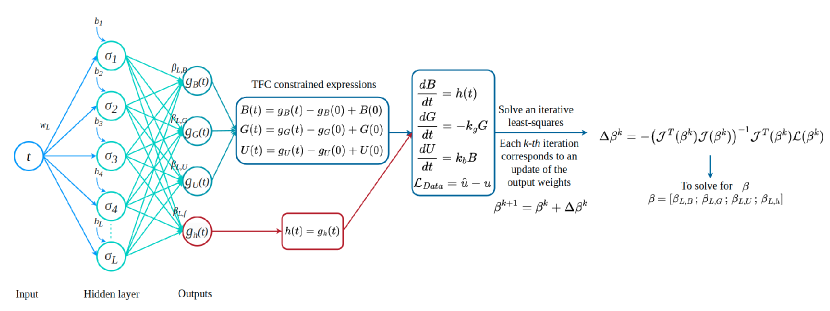
- フレームワークは X-TFC と PINNs をニューラルネットワークソルバーとして用い、微分方程式における未知のパラメータおよび欠落した項を推定する。ドメイン分割を活用することで、精度を向上させる。
- 既知の微分方程式構造をニューラルネットワークの学習プロセスに組み込む物理情報付き制約を用いることで、物理的整合性を確保する。
- 訓練済みニューラルネットワーク代替物から解釈可能な閉形式の数学的表現を抽出するために、PySR および gplearn を用いた記号回帰を適用する。
- 微分方程式の解法には最小二乗法最適化(X-TFC)と逆誤差伝搬(PINNs)を組み合わせ、データスパarsity のレベルに応じて性能を評価する。
- フレームワークの正確性、頑健性、スケーラビリティを検証するために、2 つのベンチマーク系(薬代謝動態および超サイクロメトニックグルコースインスリンダイナミクス)を用いる。
- 結果の一貫性と信頼性を確認するため、2 つの SR ツールを用いたクロスバリデーションを実施する。
実験結果
リサーチクエスチョン
- RQ1データがスパースまたは豊富な状況下で、X-TFC と PINNs のパラメータ推定およびグレイボックス同定における性能はどのように比較されるか?
- RQ2PySR や gplearn などの記号回帰ツールは、システム生物学モデルのニューラルネットワーク代替物から信頼性高く解釈可能な数学的表現を回復できるか?
- RQ3データセットサイズが、X-TFC と PINNs のグレイボックス同定における正確性および計算効率に与える影響は何か?
- RQ4異なる SR 実装およびモデルの複雑さに対して、同定された記号的表現の頑健性はどの程度か?
- RQ5AI-Aristotle フレームワークは、現実のバイオメディカル応用におけるノイズの多いまたは実験的データをどの程度処理できるか?
主な発見
- 十分なデータが利用可能な場合、X-TFC は逆誤差伝搬ではなく最小二乗法最適化を用いるため、PINNs よりも正確性と計算効率に優れる。
- 小規模なデータセットでは PINNs が X-TFC よりも高い正確性を達成し、データが限られる状況下での優れた性能を示す。
- PySR は gplearn よりも一貫して高速かつ頑健で、ハイパーパramータのチューニングが少なく、CPU で約 10 分で記号回帰を完了する一方、gplearn は最大 1 時間を要する。
- 両方の SR ツールを用いても、薬代謝動態および超サイクロメトニック内分泌モデルの両方でほぼ同一の式が回復され、結果の一貫性が確認された。
- フレームワークは微分方程式における欠落項の同定において高い正確性を達成し、回復された記号的表現は真値の関数形に非常に近い。
- AI-Aristotle フレームワークはノイズの多い実験的データを処理でき、標準のラップトップで数分でブラックボックス同定を実行できることから、実用的なスケーラビリティを示している。
より良い研究を、今すぐ始めましょう
論文の読解から最終レビューまで、研究時間を劇的に削減しましょう。
クレジットカード登録不要
このレビューはAIが作成し、人間の編集者が確認しました。