
[論文レビュー] Align and Distill: Unifying and Improving Domain Adaptive Object Detection
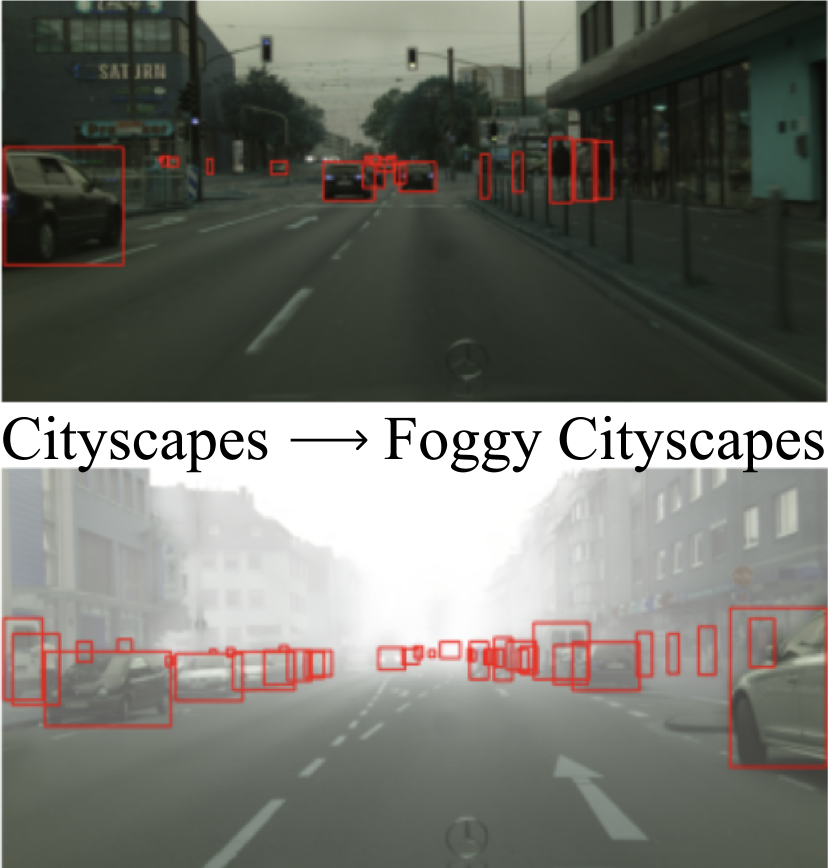
本論文は、ドメイン適応物体検出(DAOD)のための統合的ベンチマークおよびトレーニングフレームワークであるALDIを紹介する。これにより、先行研究における評価手法の根本的な欠陥が是正される。実装の標準化、CFC-DAODベンチマークの導入、ALDI++の提案を通じて、状態の最良(SOTA)の性能が達成された。Cityscapes→Foggy Cityscapesでは+3.5 AP50、Sim10k→Cityscapesでは+5.7 AP50の性能向上を達成した。一方で、過去の結果は一貫性のないベースラインやハイパーパrameter選択のため、過大評価されていたことが明らかになった。
Object detectors often perform poorly on data that differs from their training set. Domain adaptive object detection (DAOD) methods have recently demonstrated strong results on addressing this challenge. Unfortunately, we identify systemic benchmarking pitfalls that call past results into question and hamper further progress: (a) Overestimation of performance due to underpowered baselines, (b) Inconsistent implementation practices preventing transparent comparisons of methods, and (c) Lack of generality due to outdated backbones and lack of diversity in benchmarks. We address these problems by introducing: (1) A unified benchmarking and implementation framework, Align and Distill (ALDI), enabling comparison of DAOD methods and supporting future development, (2) A fair and modern training and evaluation protocol for DAOD that addresses benchmarking pitfalls, (3) A new DAOD benchmark dataset, CFC-DAOD, enabling evaluation on diverse real-world data, and (4) A new method, ALDI++, that achieves state-of-the-art results by a large margin. ALDI++ outperforms the previous state-of-the-art by +3.5 AP50 on Cityscapes to Foggy Cityscapes, +5.7 AP50 on Sim10k to Cityscapes (where ours is the only method to outperform a fair baseline), and +0.6 AP50 on CFC Kenai to Channel. ALDI and ALDI++ are architecture-agnostic, setting a new state-of-the-art for YOLO and DETR-based DAOD as well without additional hyperparameter tuning. Our framework, dataset, and state-of-the-art method offer a critical reset for DAOD and provide a strong foundation for future research. Code and data are available: https://github.com/justinkay/aldi and https://github.com/visipedia/caltech-fish-counting.
研究の動機と目的
- DAOD研究における根本的なベンチマーク評価の欠陥を是正する。具体的には、力の弱いベースライン、一貫性のない実装、古くまたは限定的なベンチマークの問題を解決する。
- アーキテクチャ的およびハイパーパrameterの改善からドメイン適応性能を分離できる、公平で透明な評価プロトコルを確立する。
- DAOD手法の汎化性と適用性を向上させるために、新しい多様性に富んだ実世界のベンチマークデータセット、CFC-DAODを構築する。
- 統合的アライメントと蒸留を組み合わせたALDI++という新しいDAOD手法を提案し、複数のベンチマークでSOTA性能を達成することで、その有効性を示す。
- 再現可能で透明かつ比較可能な今後のDAOD研究を可能にするために、公開のコードベースと標準化されたフレームワークを提供する。
提案手法
- 異なる物体検出バックボーンやライブラリ間で、DAOD手法のトレーニング、評価、実装を標準化する統合フレームワークALDIを導入する。
- すべての手法(ソースオンリーベースラインおよびオラクルベースラインを含む)に対して、一貫したアーキテクチャ、ハイパーパramータ、データオーグメンテーションを用いた公平なトレーニングおよび評価プロトコルを実装する。
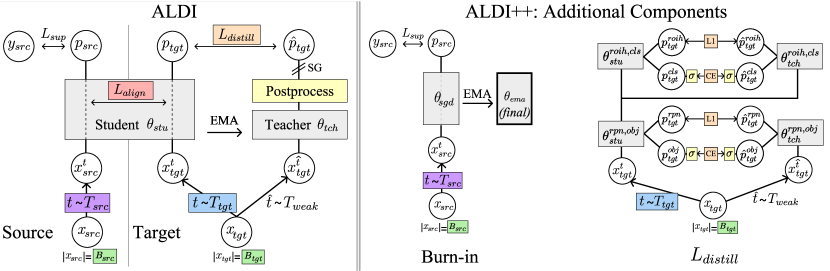
- 教師モデルの予測が一貫性正則化を通じて学生モデルをガイドする、特徴アライメントと自己トレーニング蒸留を組み合わせたALDI++を設計する。
- 2段階のトレーニングプロセスを採用する:まず、ソースデータ上で学生モデルを事前学習し、次にモーメンタム平均を用いた教師モデルを用いて、無ラベルのターゲットデータ上で反復的な自己トレーニングを実施して予測を精緻化する。
- ソースとターゲットの特徴間のコントラスト型損失を用いて特徴レベルのアライメントを実現し、ドメインシフトを低減する一方で、検出ヘッドの一貫性を維持する。
- 強力なデータオーグメンテーションと、トレーニング中にネットワーク重みの指数移動平均(EMA)を適用することで、ターゲットラベルが不要なまま一般化性能を向上させる。
実験結果
リサーチクエスチョン
- RQ1一貫性のないまたは力の弱いベースラインやハイパーパramータ選択のため、先行のDAOD結果が性能を過大評価している可能性はどの程度か?
- RQ2アーキテクチャ的およびトレーニング改善からドメイン適応性能を分離できる公平で標準化されたプロトコルのもとで、DAOD手法の性能はどのように変化するか?
- RQ3統合的フレームワークとベンチマークの導入により、DAOD研究の再現性、透明性、一般化性は向上するか?
- RQ4特徴アライメントと自己トレーニングの相対的寄与度は何か?また、両者を組み合わせた場合の相互作用はいかなるものか?
- RQ5CFC-DAODのような新しいベンチマークは、実世界のドメインシフトの課題をよりよく反映でき、より強固な手法評価を可能にするか?
主な発見
- 公平なプロトコルのもとで評価したところ、既存のすべてのDAOD手法がオラクルモデルを上回ることはなく、多くの手法がソースオンリーベースラインを上回ることでないことが判明。これは、従来報告された性能向上とは矛盾する。
- ALDI++は、Cityscapes→Foggy Cityscapesで+3.5 AP50、Sim10k→Cityscapesで+5.7 AP50の性能向上を達成し、先行SOTA手法を大きく上回った。
- 特徴アライメント単体では最大2.6 AP50の向上が得られるが、自己トレーニングと組み合わせた場合、その効果は≤0.2 AP50にまで低下する。これは、自己トレーニングが主な性能向上要因であることを示している。
- VitDetのような強力なバックボーンや、EMAや強力なオーグメンテーションといった改善されたトレーニング手法により、ソースオンリーベースラインの性能が著しく向上し、過去のDAOD手法を上回ることが多い。
- VitDetのような高度なアーキテクチャにおいても、DAOD手法とオラクル性能の差は依然として大きく、今後の改善の余地が広く残っていることが示された。
- 評価時にターゲットドメインの検証セットが使用されていることは、DAODの無教師仮定に反するため、実世界への適用性が制限され、無教師の検証手順の必要性を示唆している。
この論文を読む
Nubintのビューアで原文を開き、読みながら気になる箇所をすぐに質問できます。
Nubintでこの論文を読むこのレビューはAIが論文の原文をもとに作成しました。引用する前に原文をご確認ください。