
[論文レビュー] Aligning Language Models to Explicitly Handle Ambiguity
本論文は、大規模言語モデル(LLMs)が内在的知識を活用して自己脱ambiguity化することで、曖昧なクエリを明示的に処理できる新たなアライメント手法を提案する。モデルの視点からの曖昧さを特定するためのプロキシタスクと情報利得指標(Infogain)を用い、明確な質問では性能が低下しない一方で曖昧な入力に対するロバスト性を向上させる。この有効性は複数のQAベンチマークで検証された。
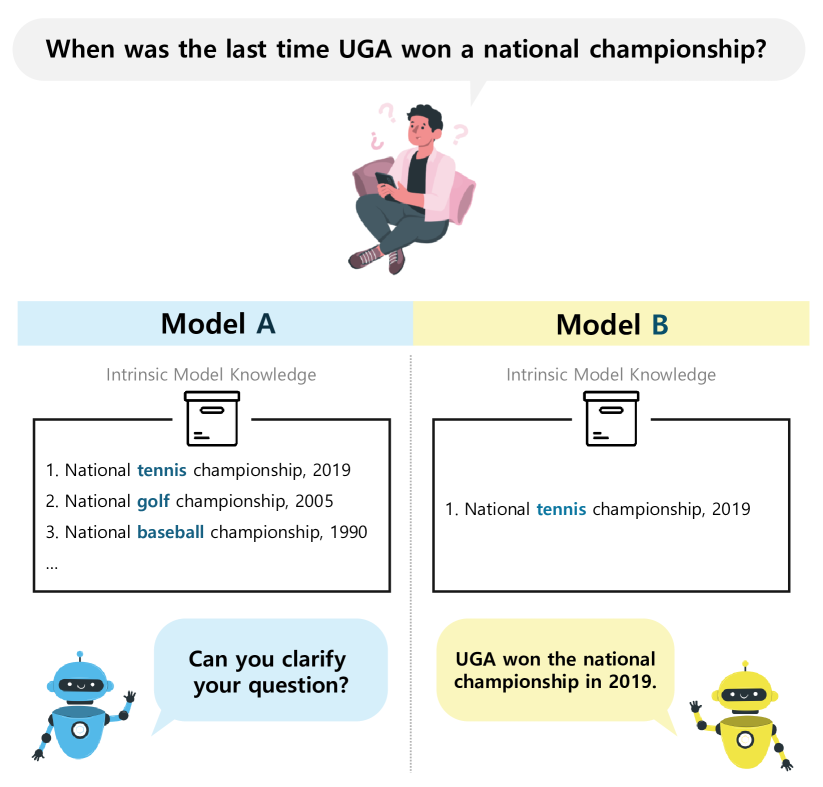
In interactions between users and language model agents, user utterances frequently exhibit ellipsis (omission of words or phrases) or imprecision (lack of exactness) to prioritize efficiency. This can lead to varying interpretations of the same input based on different assumptions or background knowledge. It is thus crucial for agents to adeptly handle the inherent ambiguity in queries to ensure reliability. However, even state-of-the-art large language models (LLMs) still face challenges in such scenarios, primarily due to the following hurdles: (1) LLMs are not explicitly trained to deal with ambiguous utterances; (2) the degree of ambiguity perceived by the LLMs may vary depending on the possessed knowledge. To address these issues, we propose Alignment with Perceived Ambiguity (APA), a novel pipeline that aligns LLMs to manage ambiguous queries by leveraging their own assessment of ambiguity (i.e., perceived ambiguity). Experimental results on question-answering datasets demonstrate that APA empowers LLMs to explicitly detect and manage ambiguous queries while retaining the ability to answer clear questions. Furthermore, our finding proves that APA excels beyond training with gold-standard labels, especially in out-of-distribution scenarios. The data and code are available at https://github.com/heyjoonkim/APA.
研究の動機と目的
- LLMsが曇った訓練を受けていないため、曇ったユーザークエリを認識せず、適切に対応できないという課題に対処すること。
- モデルの内在的知識に依存するため、モデルの視点からの曇りの測定が難しいという困難を克服すること。
- モデルが認識する曇りに基づいたデータ選択戦略を開発し、特定のアライメントによるロバスト性の向上を可能にすること。
- 曇った入力に対してこのアライメント手法の有効性を評価するとともに、曇らない入力では高い性能を維持すること。
- LLMsにおける曇りのロバスト性の広範な評価を支援するため、新しいデータセットAmbigTriviaQAを寄与すること。
提案手法
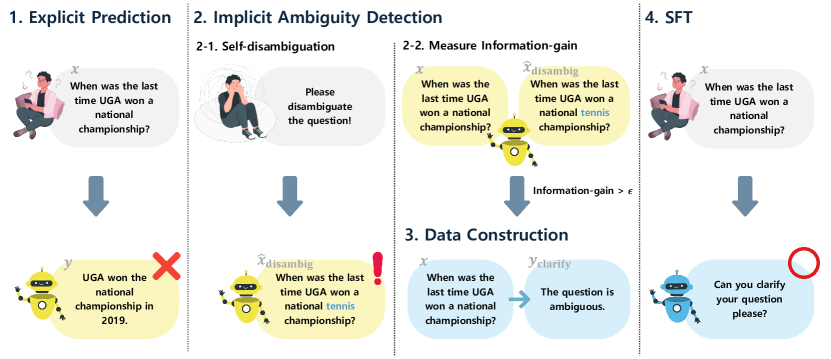
- LLMが内在的知識を用いて与えられたクエリを自己脱ambiguity化するようプロンプトするプロキシタスクを導入する。
- Infogainを脱ambiguity化による情報利得の測定として定義し、モデルが認識する曇りの間接的指標とする。
- Infogainスコアを用いて、モデルの視点から曇ったとみなされるサンプルを、後続のアライメント用に選択する。
- 教師強化学習(SFT)を用いて、選択された曇ったサンプル上でLLMをファインチューニングし、明確化要求の生成に焦点を当てる。
- Valid Alignment Rate(VAR)、Misaligned Clarification Rate(MCR)、Overall Alignment Performance(OAP)などの指標を用いてアライメント性能を評価する。
- LLMsにおける曇りの処理の包括的評価を支援するため、新しいベンチマークデータセットAmbigTriviaQAを構築する。
実験結果
リサーチクエスチョン
- RQ1LLMsは、内在的知識のみを用いて、曇ったクエリを認識し、明示的に応答できるように効果的にアライメント可能か?
- RQ2人間がラベル付けしたデータに依存せず、モデルの視点からの曇りを定量的に測定する方法は何か?
- RQ3Infogainをデータ選択のキューとして用いることで、曇ったクエリの処理能力が向上し、曇らないクエリの性能に悪影響を与えないか?
- RQ4モデルの知識ベースが変化するにつれて、モデルが認識する曇りはどのように変化するか?また、これをより良いアライメントに活用できるか?
- RQ5提案されたアライメント手法は、分布外の曇った入力に対しても一般化可能か?
主な発見
- 提案されたアライメント手法は、AmbigQAにおいてベースライン手法と比較して12.5%のValid Alignment Rate(VAR)の向上を達成し、曇ったクエリに対する明確化要求の生成能力が著しく向上した。
- ランダムサンプリングと比較してF1スコアで5ポイントの向上を達成し、Implicitベースラインを上回った。これにより、Infogainがデータ選択キューとしての有効性が裏付けられた。
- Llama2 7Bにおける提案手法のOverall Alignment Performance(OAP)は0.84に達し、Honesty-tuned(0.71)とFull-set(0.78)を上回った。これは、曇った入力への対応と曇らない入力での正しい応答の維持の両立が図れていることを示している。
- モデルは、分布外の曇ったクエリに対してもロバストであることが確認され、AmbigQAやTriviaQAを含む複数のデータセットで一貫した性能向上が得られた。
- 事例研究により、モデルが知識が不足している場合に曇りを正しく認識できること、また、曇らないクエリでは誤検出(偽陽性)を避けることができることが確認されたが、複数のメディアタイトルとの知識の過剰関連により一部の誤分類が生じた。
- 新規に構築されたAmbigTriviaQAデータセットは、曇りのロバスト性の評価をより包括的に行うことを可能にし、今後の研究を支援する。
この論文を読む
Nubintのビューアで原文を開き、読みながら気になる箇所をすぐに質問できます。
Nubintでこの論文を読むこのレビューはAIが論文の原文をもとに作成しました。引用する前に原文をご確認ください。