
[論文レビュー] An Empirical Study of Training End-to-End Vision-and-Language Transformers
本稿では、視覚変換器(ViT)を画像エンコーダーとして用いた、エンドツーエンドで訓練可能な視覚・言語変換器のフレームワークであるMeterを紹介する。視覚エンコーダー、テキストエンコーダー、統合モジュール、事前学習目的のあらゆる組み合わせについて体系的なアブレーションを実施した結果、400万枚の画像のみを用いてVQAv2で77.64%の精度を達成。これは、従来の領域ベースのモデルより1.04%、かつての完全に変換器ベースのモデルより1.6%高い性能を発揮した。
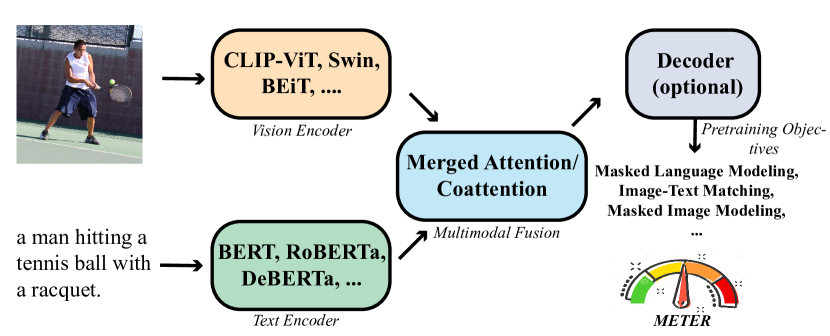
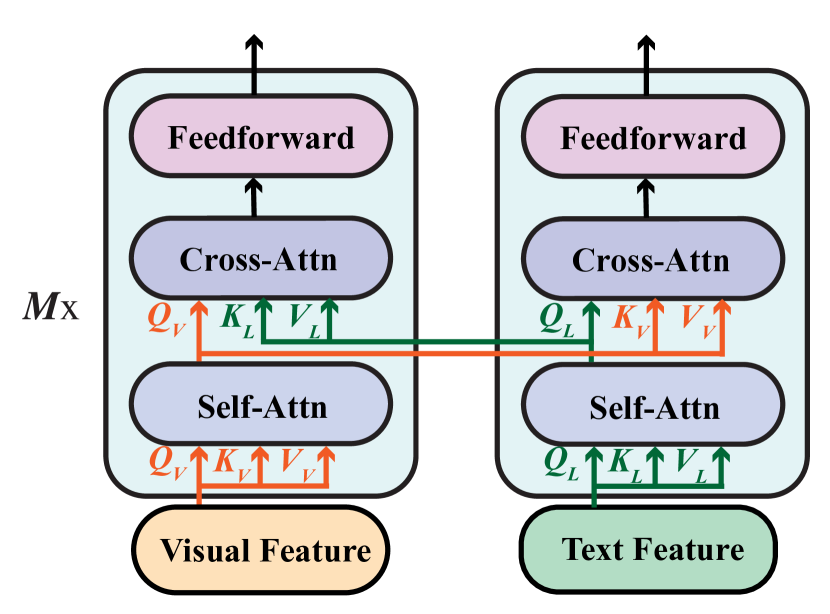
Vision-and-language (VL) pre-training has proven to be highly effective on various VL downstream tasks. While recent work has shown that fully transformer-based VL models can be more efficient than previous region-feature-based methods, their performance on downstream tasks often degrades significantly. In this paper, we present METER, a Multimodal End-to-end TransformER framework, through which we investigate how to design and pre-train a fully transformer-based VL model in an end-to-end manner. Specifically, we dissect the model designs along multiple dimensions: vision encoders (e.g., CLIP-ViT, Swin transformer), text encoders (e.g., RoBERTa, DeBERTa), multimodal fusion module (e.g., merged attention vs. co-attention), architectural design (e.g., encoder-only vs. encoder-decoder), and pre-training objectives (e.g., masked image modeling). We conduct comprehensive experiments and provide insights on how to train a performant VL transformer. METER achieves an accuracy of 77.64% on the VQAv2 test-std set using only 4M images for pre-training, surpassing the state-of-the-art region-feature-based model by 1.04%, and outperforming the previous best fully transformer-based model by 1.6%. Notably, when further scaled up, our best VQA model achieves an accuracy of 80.54%. Code and pre-trained models are released at https://github.com/zdou0830/METER.
研究の動機と目的
- 領域特徴に基づくモデルと完全に変換器ベースのモデルの間の性能格差を埋める。
- 視覚変換器(ViT)を画像エンコーダーとして用いたエンドツーエンドの視覚・言語変換器の効果的な設計および事前学習法を調査すること。
- 高性能なエンドツーエンドVLモデルに最適なアーキテクチャ的要素および事前学習目的を同定すること。
- 適切に設計・事前学習されたViTベースのモデルが、領域ベースのモデルを上回ることを実証すること。
提案手法
- 視覚エンコーダー(例:CLIP-ViT、Swin Transformer)、テキストエンコーダー(例:RoBERTa、DeBERTa)、マルチモーダル統合モジュール(マージドアテンション対コアテンション)の体系的アブレーションを可能にする統合フレームワーク「Meter」を提案。
- VQA、リtrieval、視覚的推論タスクにおける下流性能を重視し、エンコーダー・オンリーおよびエンコーダー・デコーダーのアーキテクチャを比較分析。
- マスクド言語モデリング(MLM)、画像・テキストマッチング(ITM)、マスクド画像モデリング(MIM)を組み合わせた、COCO、Conceptual Captions、SBU Captions、Visual Genomeの4つの大規模データセットを用いて事前学習。
- コアテンション機構を導入することでマルチモーダル統合を強化し、自己アテンションのみのアプローチに比べて一貫した性能向上を示した。
- モデルのバリエーション間で公平な比較プロトコルを採用し、一貫したハイパーパrameter設定および学習スケジュールを保証。
- 最良の構成をCoSwin-HugeとRoBERTa-baseを用いて1400万枚の画像にスケーリングし、VQAv2で最先端の性能を達成。
実験結果
リサーチクエスチョン
- RQ1エンドツーエンドの視覚・言語事前学習において、視覚変換器(ViT)は領域ベースの手法を上回る効果的な画像エンコーダーとして機能できるか?
- RQ2異なる視覚およびテキストエンコーダー(例:CLIP-ViT、RoBERTa)は、エンドツーエンドVLモデルの下流性能にどのように影響を与えるか?
- RQ3マルチモーダル統合モジュールにコアテンションを組み込むことで、自己アテンションのみの機構に比べて性能が向上するか?
- RQ4分類的タスク(例:VQAやゼロショットリtrieval)において、エンコーダー・オンリーのアーキテクチャはエンコーダー・デコーダーのアーキテクチャを上回るか?
- RQ5マスクド画像モデリング(MIM)は、ViTベースのVLモデルの下流性能を向上させるか、それとも矛盾する監視信号を導入するか?
主な発見
- 視覚・言語事前学習において、視覚変換器(ViT)は言語変換器よりもより重要な役割を果たしており、単一モードタスクの性能はVL性能の予測には信頼できない。
- マルチモーダル統合モジュールにコアテンションを組み込むことで、自己アテンションのみの機構に比べてより優れた下流性能が得られる。
- 公平な比較のもとで、エンコーダー・オンリーのアーキテクチャはVQAおよびゼロショット画像・テキストリtrievalタスクでエンコーダー・デコーダーのアーキテクチャを上回る。
- マスクド画像モデリング(MIM)は、VQAv2およびFlickr30kリtrievalタスクの両方で性能を低下させる傾向にあり、矛盾する目的やノイズの多いパッチ監視信号が原因である可能性がある。
- Meterは、わずか400万枚の画像を用いてVQAv2のtest-stdセットで77.64%の精度を達成。これは、従来の最先端の領域特徴ベースのモデル(VinVL)を1.04%上回り、かつての最高の完全に変換器ベースのモデル(ALBEF)を1.6%上回った。
- CoSwin-HugeとRoBERTa-baseを用いて最良のモデルを1400万枚の画像にスケーリングした結果、VQAv2で80.54%の精度を達成。これは新たな最先端性能を記録し、18億枚の画像で事前学習されたモデルをも凌駆した。
この論文を読む
Nubintのビューアで原文を開き、読みながら気になる箇所をすぐに質問できます。
Nubintでこの論文を読むこのレビューはAIが論文の原文をもとに作成しました。引用する前に原文をご確認ください。