
[論文レビュー] Anchor-Assisted Channel Estimation for Intelligent Reflecting Surface Aided Multiuser Communication
本稿では、インテリジェントリフレクティングサーフェス(IRS)を用いたマルチユーザー系における訓練オーバーヘッドを低減する2つのアンカーヘルプドチャネル推定方式を提案する。2つの固定アンカーノード(A1, A2)を導入することで、BSは共通のBS-IRSリンクまたは中間チャネルの部分的なCSIを取得可能となり、リアルタイムの訓練を削減した効率的なカスケードチャネル推定が可能になる。従来手法に比べスペクトル効率と遅延の両面で優れる。
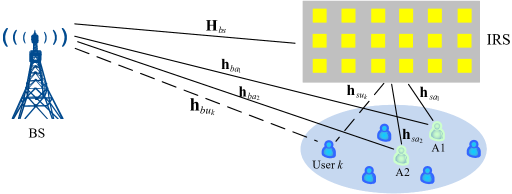
Channel estimation is a practical challenge for intelligent reflecting surface (IRS) aided wireless communication. As the number of IRS reflecting elements or IRS-aided users increases, the channel training overhead becomes excessively high, which results in long delay and low throughput in data transmission. To tackle this challenge, we propose in this paper a new anchor-assisted channel estimation approach, where two anchor nodes, namely A1 and A2, are deployed near the IRS for facilitating its aided base station (BS) in acquiring the cascaded BS-IRS-user channels required for data transmission. Specifically, in the first scheme, the partial channel state information (CSI) on the element-wise channel gain square of the common BS-IRS link for all users is first obtained at the BS via the anchor-assisted training and feedback. Then, by leveraging such partial CSI, the cascaded BS-IRS-user channels are efficiently resolved at the BS with additional training by the users. While in the second scheme, the BS-IRS-A1 and A1-IRS-A2 channels are first estimated via the training by A1. Then, with additional training by A2, all users estimate their individual cascaded A2-IRS-user channels simultaneously. Based on the CSI fed back from A2 and all users, the BS resolves the cascaded BS-IRS-user channels efficiently. In both schemes, the quasi-static channels among the fixed BS, IRS, and two anchors are estimated off-line only, which greatly reduces the real-time training overhead. Simulation results demonstrate that our proposed anchor-assisted channel estimation schemes achieve superior performance as compared to existing IRS channel estimation schemes, under various practical setups. In addition, the first proposed scheme outperforms the second one when the number of antennas at the BS is sufficiently large, and vice versa.
研究の動機と目的
- 大規模なIRSエレメントと複数ユーザーによるIRS支援マルチユーザー系における高い訓練オーバーヘッドを解消する。
- 固定アンカーノードを活用して長期間チャネル成分を事前推定することで、リアルタイムのチャネル推定オーバーヘッドを低減する。
- アンカーノードからのCSIフィードバックを活用し、最小限のパイロット信号で効率的なカスケードチャネル推定(BS-IRS-ユーザー)を実現する。
- 長期間チャネルと短期間チャネルの訓練を分離することで、IRS支援系における低遅延・高スループット通信を実現する。
提案手法
- IRSに近接して2つのアンカーノード(A1, A2)を配置し、チャネル訓練およびフィードバックのための中間リレーサービスを提供する。
- スケーム1では、BSがA1およびA2経由で共通のBS-IRSリンクの部分CSIを推定し、その後ユーザー固有の訓練により個々のカスケードチャネルを解明する。
- スケーム2では、A1がBS-IRS-A1およびA1-IRS-A2チャネルを推定し、その後A2が追加の訓練によりA2-IRS-ユーザーのチャネルをすべてのユーザーに対して推定する。
- BSはA2からのCSIとユーザーからのフィードバックを統合し、行列の逆行列化および対角化技術を用いて、完全なカスケードBS-IRS-ユーザーチャネルを再構築する。
- IRSの反射係数が受動的かつ位相制御可能であることに着目し、構造化された信号設計を用いたパイロットベースの訓練を実現する。
- 推定されたカスケードチャネル行列から、ユーザー固有のチャネルを行列の逆行列化および対角化により解明する。全ランク条件を満たす場合、一意な回復が保証される。
実験結果
リサーチクエスチョン
- RQ1IRSにアクティブRFチェーンを必要としない条件下でも、固定アンカーノードがIRS支援マルチユーザー系におけるリアルタイム訓練オーバーヘッドを低減できるか?
- RQ2共通のBS-IRSリンクの部分CSIをどのように活用することで、複数ユーザー向けの効率的なカスケードチャネル推定を実現できるか?
- RQ32つの提案スケームの間で、訓練オーバーヘッドとスペクトル効率のトレードオフはどのように変化するか?
- RQ4推定されたBS-IRSチャネルが正確でない場合でも、パイロット信号からカスケードBS-IRS-ユーザーチャネルを一意に回復できるか?
主な発見
- 提案されたアンカーヘルプドスケームは、IRS支援マルチユーザー系における従来のパイロットベース手法に比べ、訓練オーバーヘッドを顕著に低減する。
- スケーム1は、BSに多数のアンテナが装備されている場合にスケーム2を上回る。これは空間多重性利得をより効果的に活用できるためである。
- スケーム2は、BSアンテナ数が少ない場合にはスケーム1を上回る。これは中間チャネル推定がより効率的であるためである。
- 推定されたBS-IRSチャネルが正確でない場合でも、アンカーヘルプド訓練およびフィードバックによりカスケードBS-IRS-ユーザーチャネルは一意に回復可能である。
- シミュレーション結果は、さまざまな実用的IRSおよびユーザー構成において、優れたスペクトル効率と低遅延を確認した。
- 提案手法は最小限のリアルタイム信号伝送で高精度なチャネル推定を実現でき、大規模IRS展開にとって実用的である。

より良い研究を、今すぐ始めましょう
論文の読解から最終レビューまで、研究時間を劇的に削減しましょう。
クレジットカード登録不要
このレビューはAIが作成し、人間の編集者が確認しました。