
[論文レビュー] Andes: Defining and Enhancing Quality-of-Experience in LLM-Based Text Streaming Services
Andesは、動的で事前的スケジューリングとクライアント側トークンバッファによってトークンストリーミングを最適化するQoEを意識したLLM提供システムを提案し、vLLMなどのベースラインと比較して、バースト的な負荷下で最大3.2xのQoE向上または1.6xのスループット向上を達成する。
Large language models (LLMs) are now at the core of conversational AI services such as real-time translation and chatbots, which provide live user interaction by incrementally streaming text to the user. However, existing LLM serving systems fail to provide good user experience because their optimization metrics are not always aligned with user experience. In this paper, we first introduce and define the notion of Quality-of-Experience (QoE) for text streaming services by considering each user's end-to-end interaction timeline. Based on this, we propose Andes, a QoE-aware LLM serving system that enhances user experience by ensuring that users receive the first token promptly and subsequent tokens at a smooth, digestible pace, even during surge periods. This is enabled by Andes's preemptive request scheduler that dynamically prioritizes requests at the token granularity based on each request's expected QoE gain and GPU resource usage. Our evaluations demonstrate that, compared to state-of-the-art LLM serving systems, Andes improves the average QoE by up to $4.7 imes$ given the same GPU resource, or saves up to 61% GPU resources while maintaining the same high QoE.
研究の動機と目的
- トークンが断続的に配信されるテキストストリーミングサービスのための正式なQuality-of-Experience (QoE) 指標を定義する。
- 動的なトークンレベルのスケジューリングとプリエンプションを通じてQoEを最適化するようにAndesを設計する。
- サーバーの変動を受けてもユーザー体験を標準化するためのクライアント側トークンバッファを共同設計する。
- OPTモデル(13B–175B)上でAndesを評価し、最先端のベースライン(例: vLLM)と比較する。
- 追加リソースを必要とせずにAndesがQoEおよび/またはスループットを改善することを示す。
提案手法
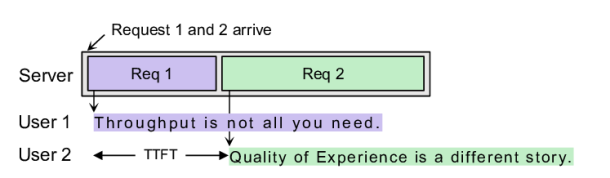
- TTFTとTDSにより定義された期待タイムラインと実際のトークン配信タイムラインを比較する正式なQoE指標。
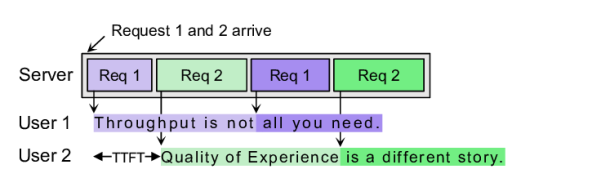
- トークン単位で動作し、時間量Δt内でQoEを最大化するQoE認識オンラインプリエンプティブスケジューラ。
- バッチサイズとGPUメモリ制約がどのリクエストを処理するかを定義する最適化問題を、ナップザックのような定式化。
- QoEゲイン、メモリ使用量、スターベーション回避をバランスさせる優先度関数を持つ貪欲パッキングアルゴリズム(式(5))。
- プリエンプション時にKVキャッシュを移動または再計算するための2つのプリエンプション機構(スワップと再計算)。
- サーバー側のペース配分に関係なく、ユーザーの期待するTDSに合わせてトークン配信を平滑化するクライアント側トークンバッファ。
実験結果
リサーチクエスチョン
- RQ1増分的でストリーミングされるLLMの対話に対してQoEを正式にどのように定義できるか。
- RQ2リクエストレートの急増圧力の下で、過剰なリソースの割当を避けつつQoE認識スケジューラがユーザー体験を改善できるか。
- RQ3メモリ制約を respect しつつ、平均QoEを最大化するスケジューリングアルゴリズムとバッチサイズ戦略は何か。
- RQ4プリエンプションのオーバーヘッドがトークン配信遅延と全体のQoEに与える影響は何か。
- RQ513B–175B OPTのような異なるモデルサイズでAndesの性能はどのようで、vLLMなどのベースラインとどう比較されるか。
主な発見
- Andesは高負荷/バースト時にベースラインと比較して平均QoEを最大3.2x向上させる。
- Andesは追加リソースを用意せずに高 QoE を維持しつつ最大1.6xの高いリクエストレートに対応できる。
- 負荷が増加してもスループットはベースラインと同程度で、最大でも10%の低下にとどまる。
- TTFTは大幅に改善され、TDSをユーザーが期待するスピード以上に維持。
- O(N log N)の複雑さを持つ貪欲なナップサックベースのスケジューリング解は、オーバーヘッドが低いDP解と同等の性能を達成。
- クライアント側トークンバッファはトークン配信を平滑化し、サーバー側のスケジューリングやネットワークの変動からユーザー体験を切り離す。
この論文を読む
Nubintのビューアで原文を開き、読みながら気になる箇所をすぐに質問できます。
Nubintでこの論文を読むこのレビューはAIが論文の原文をもとに作成しました。引用する前に原文をご確認ください。