
[論文レビュー] Approximating Online Human Evaluation of Social Chatbots with Prompting
本稿では、大規模言語モデル(LLM)を用いて、ソーシャルチャットボットのオンライン人間評価を自動的に近似するプロンプトベースのフレームワークDEPを提案する。LLMに特定の社会的役割を担わせ、指示微調整プロンプトを適用することで、最大0.95のピアソン相関を示す合成対話ログと評価スコアを生成する。これにより、現実の相互作用環境におけるスケーラブルで低コストかつ高精度なチャットボット評価が可能になる。
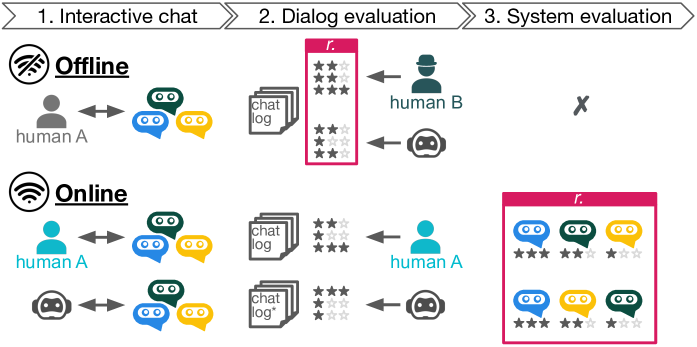
As conversational models become increasingly available to the general public, users are engaging with this technology in social interactions. Such unprecedented interaction experiences may pose considerable social and psychological risks to the users unless the technology is properly controlled. This highlights the need for scalable and robust evaluation metrics for conversational chatbots. Existing evaluation metrics aim to automate offline user evaluation and approximate human judgment of pre-curated dialogs. However, they are limited in their ability to capture subjective perceptions of users who actually interact with the bots and might not generalize to real-world settings. To address this limitation, we propose an approach to approximate online human evaluation leveraging large language models (LLMs) from the GPT family. We introduce a new Dialog system Evaluation framework based on Prompting (DEP), which enables a fully automatic evaluation pipeline that replicates live user studies and achieves an impressive correlation with human judgment (up to Pearson r=0.95 on a system level). The DEP approach involves collecting synthetic chat logs of evaluated bots with an LLM in the other-play setting, where the LLM is carefully conditioned to follow a specific scenario. We further explore different prompting approaches to produce evaluation scores with the same LLM. The best performing prompts, which contain few-shot demonstrations and instructions, show outstanding performance on the tested dataset and demonstrate the ability to generalize to other dialog corpora.
研究の動機と目的
- リアルタイムの対話におけるソーシャルチャットボットに対する実際のユーザーの主観的認識を捉えられない既存の評価指標のギャップを埋める。
- ライブユーザー研究のダイナミクスを再現する、自動的でスケーラブルかつ低コストなオンライン人間評価の代替手段を開発する。
- LLMが会話システムにおいて、人間らしく社会的役割と評価行動を模倣するために効果的にプロンプトされるかを検証する。
- 共感的およびオープンドメインの対話設定において、自動評価スコアと人間の判断との間に高い相関を達成する。
- 基本的な品質指標を超えて、さまざまな対話コーパスや社会的現象(例:共感、毒性)への評価の一般化を可能にする。
提案手法
- GPTファミリーのLLMを合成対話相手として用い、『他者がプレイする』設定で、評価対象のチャットボットと現実的な対話ログを生成する。
- 役割固有のプロンプトでLLMを条件づけ、対話生成中に特定の社会的役割(例:共感的聴衆、感情表現者)を模倣する。
- アノテート済み例を用いたfew-shotプロンプトを適用し、対話品質の次元に基づいて微細な評価スコアを割り当てるようにLLMを誘導する。
- 微細な属性(例:共感、一貫性)を全体的な対話スコアに明示的に結びつける指示プロンプトを設計し、人間の判断との整合性を向上させる。
- 複数の対話セッションにわたる評価スコアを集約し、比較分析のためのシステムレベル順位付けを実施する。
- ベンチマークデータセット(iEval, FED, DSTC9)を用いてフレームワークを検証し、人間がアノテートした真値との相関を測定する。
実験結果
リサーチクエスチョン
- RQ1LLMは会話相互作用において、人間らしく社会的役割を模倣するために効果的にプロンプトされるか、現実的な合成対話ログを生成できるか?
- RQ2指示微調整プロンプトは、オンライン評価環境において、人間の判断と相関する評価スコアをどの程度生成できるか?
- RQ3DEPフレームワークは、異なる対話コーパスや社会的相互作用現象(例:共感、毒性)にどの程度一般化できるか?
- RQ4どのようなプロンプト戦略(例:few-shotデモ、詳細な指示)が人間評価との相関を最も高めるか?
- RQ5本フレームワークは、基本的な応答品質を超えた複雑な社会的行動(例:感情的サポート、ユーモア)の評価に適応可能か?
主な発見
- DEPフレームワークは、iEvalデータセットにおいてシステムレベルで最大0.95のピアソン相関を人間の判断と達成し、人間評価と強い整合性を示した。
- 詳細な指示を含むfew-shotプロンプトは、評価スコアの正確性を顕著に向上させ、ゼロショットや一般的なプロンプトアプローチを上回った。
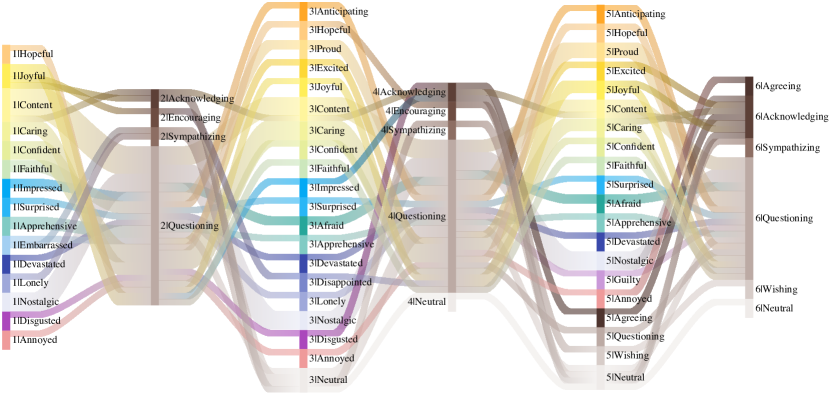
- 合成対話ログにおけるLLMの行動は、感情や意図の分布を含め、人間の会話パターンに類似しているが、一部のサブフロー(例:感謝)ではRLHFトレーニングに起因するモデルの個性がうかがえる。
- フレームワークはFEDやDSTC9など他の対話コーパスに対しても良好に一般化でき、さまざまな評価文脈における頑健性を示した。
- 合成対話ログと評価アノテーションは公開されており、再現性と今後のベンチマークの実施を可能にしている。
- 本フレームワークにより、人間のアノテータを必要とせず、迅速かつ自動的にチャットボットを評価できるようになり、時間とコストを削減しながらも高い信頼性を維持できる。
この論文を読む
Nubintのビューアで原文を開き、読みながら気になる箇所をすぐに質問できます。
Nubintでこの論文を読むこのレビューはAIが論文の原文をもとに作成しました。引用する前に原文をご確認ください。