
[論文レビュー] Attack-Resilient Image Watermarking Using Stable Diffusion
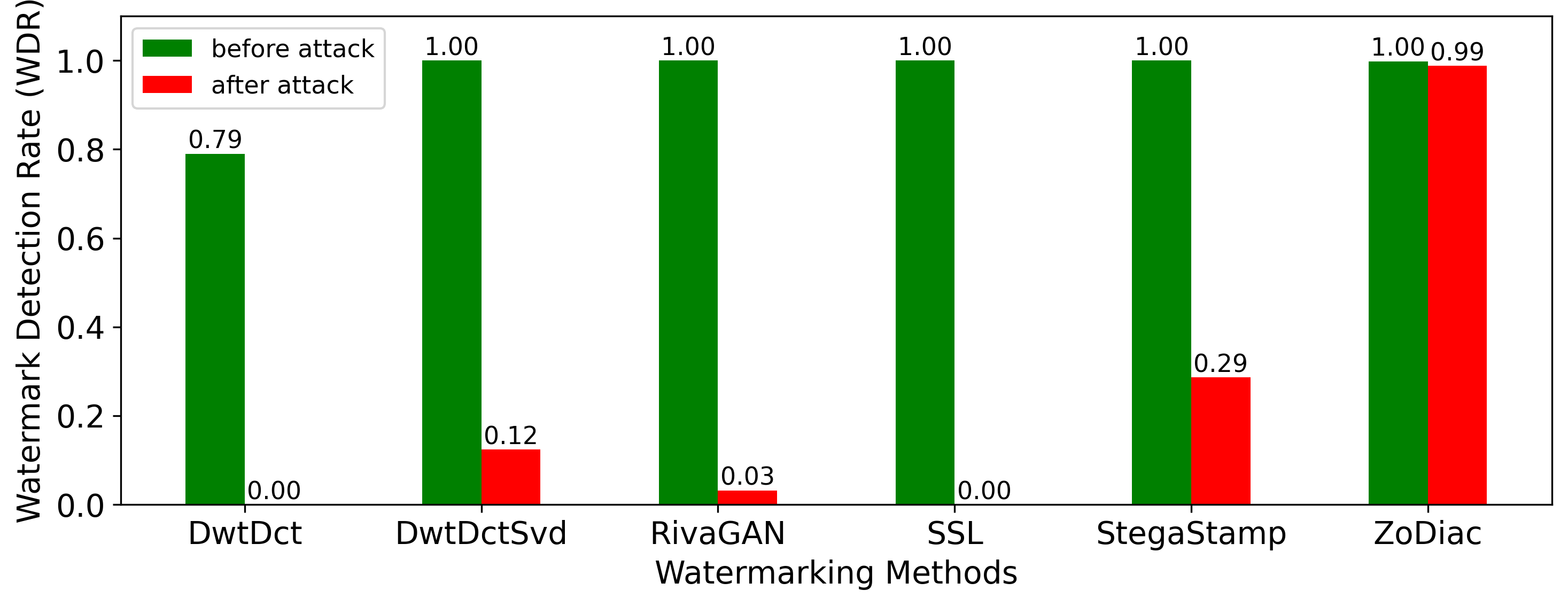
ZoDiac は、事前学習済み Stable Diffusion モデルの潜在空間に見えないウェアラブル水 Stamper を埋め込むゼロショット画像ウェアラブル水 Stamper フレームワークであり、高度な Stable Diffusion を用いた攻撃に対しても耐性のある検出を可能にする。MS-COCO、DiffusionDB、WikiArt データセットにおいて、98%を超えるウェアラブル水 Stamper 検出率と6.4%未満の偽陽性率を達成し、耐性と品質保持の面で既存手法を上回っている。
Watermarking images is critical for tracking image provenance and proving ownership. With the advent of generative models, such as stable diffusion, that can create fake but realistic images, watermarking has become particularly important to make human-created images reliably identifiable. Unfortunately, the very same stable diffusion technology can remove watermarks injected using existing methods. To address this problem, we present ZoDiac, which uses a pre-trained stable diffusion model to inject a watermark into the trainable latent space, resulting in watermarks that can be reliably detected in the latent vector even when attacked. We evaluate ZoDiac on three benchmarks, MS-COCO, DiffusionDB, and WikiArt, and find that ZoDiac is robust against state-of-the-art watermark attacks, with a watermark detection rate above 98% and a false positive rate below 6.4%, outperforming state-of-the-art watermarking methods. We hypothesize that the reciprocating denoising process in diffusion models may inherently enhance the robustness of the watermark when faced with strong attacks and validate the hypothesis. Our research demonstrates that stable diffusion is a promising approach to robust watermarking, able to withstand even stable-diffusion--based attack methods. ZoDiac is open-sourced and available at https://github.com/zhanglijun95/ZoDiac.
研究の動機と目的
- 既存のウェアラブル水 Stamper 手法が損なわれる可能性がある、Stable Diffusion を用いたウェアラブル水 Stamper 削除攻撃の増加する脅威に対処すること。
- 生成的 AI を用いた再生成攻撃を含む、単一および複合攻撃に対して耐性を持つウェアラブル水 Stamper フレームワークを開発すること。
- 微調整なしで既存の画像にウェアラブル水 Stamper を適用できるようにし、事前学習済みの拡散モデルを活用してゼロショット適用を実現すること。
- 強力なウェアラブル水 Stamper の見えなさと検出可能性を確保しながら、高い知覚的画像品質を維持すること。
- 回転などの組み合わせ的または幾何的攻撃に対して失敗する既存手法の限界を克服すること。
提案手法
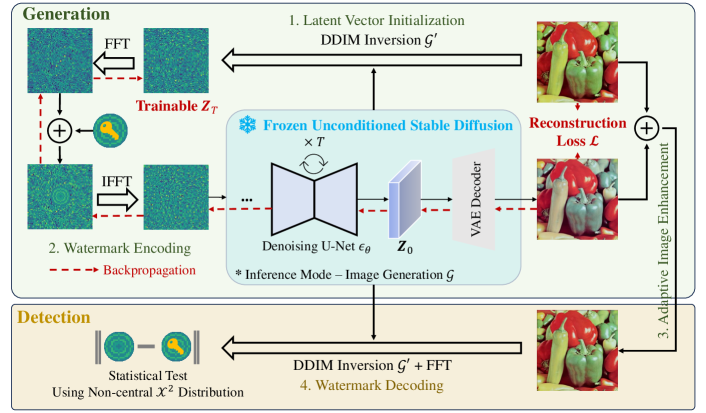
- ZoDiac は、事前学習済み Stable Diffusion モデルの学習可能な潜在空間にウェアラブル水 Stamper を埋め込み、複数の潜在ベクトルが同じ画像にマッピングできるというモデルの能力を活用する。
- 最適化を用いて、元の画像にマッピングされるウェアラブル水 Stamper が埋め込まれた潜在ベクトルを特定し、ウェアラブル水 Stamper がモデルの潜在表現に埋め込まれていることを保証する。
- フレームワークは、ウェアラブル水 Stamper 画像から潜在ベクトルを再構築するために拡散逆転を用い、埋め込まれたウェアラブル水 Stamper パatters を検出するための統計的検定を実行する。
- 元の画像とウェアラブル水 Stamper 画像の間の適応的ブレンドにより、PSNR >30 dB および SSIM >0.9 を達成し、知覚的品質を保証する。
- 回転に対する耐性を高めるために、ZoDiac は回転不変の検出メカニズムを統合し、検出率が99%以上を維持する。
- 専用のウェアラブル水 Stamper モデルの学習を避けており、代わりに事前学習済み拡散モデルの潜在空間を活用してゼロショットウェアラブル水 Stamper を実現する。
実験結果
リサーチクエスチョン
- RQ1事前学習済み Stable Diffusion モデルの潜在空間におけるウェアラブル水 Stamper は、生成的 AI を用いたウェアラブル水 Stamper 削除攻撃に対して耐性を高めることができるか?
- RQ2複数の歪み技術を組み合わせた複合攻撃下での ZoDiac のパフォーマンスはいかがなものか?
- RQ3ゼロショットウェアラブル水 Stamper フレームワークにおいて、ウェアラブル水 Stamper 検出率、偽陽性率、画像品質のトレードオフはどのようなものか?
- RQ4再学習なしで、回転などの幾何的変換に対しても高い耐性を維持できるか?
- RQ5先進的な攻撃に対して、ZoDiac は最先端のウェアラブル水 Stamper 手法と比べて、見えなさと耐性の面で優れているか?
主な発見
- ZoDiac は、最新の Stable Diffusion を用いた攻撃に対して、MS-COCO、DiffusionDB、WikiArt データセットすべてで98%を超えるウェアラブル水 Stamper 検出率を達成した。
- 偽陽性率は6.4%未満であり、標準検出では0.4%、回転耐性を含む場合は3.4%であった。
- 複合攻撃状況(回転を除く)では、ZoDiac は50%を超える検出率を維持したが、すべての既存手法は0%の検出率に失敗した。
- ZoDiac は高い画像品質を維持し、PSNR >30 dB および SSIM >0.9 を達成しており、強力な知覚的見えなさを示している。
- 回転に対する耐性を示し、検出率が99%以上を維持した。これは、回転攻撃で失敗する既存手法を著しく上回っている。
- ZoDiac は、最新の Stable Diffusion を用いた再生成攻撃に対しても耐性を持つ最初のウェアラブル水 Stamper 手法であり、ゼロショットウェアラブル水 Stamper 分野における顕著な前進を示している。
この論文を読む
Nubintのビューアで原文を開き、読みながら気になる箇所をすぐに質問できます。
Nubintでこの論文を読むこのレビューはAIが論文の原文をもとに作成しました。引用する前に原文をご確認ください。