
[論文レビュー] BanglaAutoKG: Automatic Bangla Knowledge Graph Construction with Semantic Neural Graph Filtering
BanglaAutoKG は、多言語 LLM、BERT ベースの埋め込み、GNN ベースの意味的フィルタリングパイプラインを用いて、任意のテキストから意味的に豊富なバングラ知識グラフを完全に自動で構築する画期的なフレームワークである。最小限の人的介入で高品質な KG の構築を達成し、さまざまなバングラテキストタイプに普遍的に適用可能であることが示された。
Knowledge Graphs (KGs) have proven essential in information processing and reasoning applications because they link related entities and give context-rich information, supporting efficient information retrieval and knowledge discovery; presenting information flow in a very effective manner. Despite being widely used globally, Bangla is relatively underrepresented in KGs due to a lack of comprehensive datasets, encoders, NER (named entity recognition) models, POS (part-of-speech) taggers, and lemmatizers, hindering efficient information processing and reasoning applications in the language. Addressing the KG scarcity in Bengali, we propose BanglaAutoKG, a pioneering framework that is able to automatically construct Bengali KGs from any Bangla text. We utilize multilingual LLMs to understand various languages and correlate entities and relations universally. By employing a translation dictionary to identify English equivalents and extracting word features from pre-trained BERT models, we construct the foundational KG. To reduce noise and align word embeddings with our goal, we employ graph-based polynomial filters. Lastly, we implement a GNN-based semantic filter, which elevates contextual understanding and trims unnecessary edges, culminating in the formation of the definitive KG. Empirical findings and case studies demonstrate the universal effectiveness of our model, capable of autonomously constructing semantically enriched KGs from any text.
研究の動機と目的
- 包括的なバングラ知識リソース(KG、NER モデル、エンコーダーなど)の著しい不足に対処すること。
- 人為的ラベルなしで多様なテキストソースから高品質なバングラ KG を構築する普遍的で自動化されたフレームワークを開発すること。
- 事前学習済み埋め込みのノイズを克服し、グラフベースのフィルタリングと GNN を用いて意味的関連性を向上させること。
- スケーラブルで文脈認識可能な知識抽出を実現し、情報検索、文化的保存、AI 應用を支援すること。
提案手法
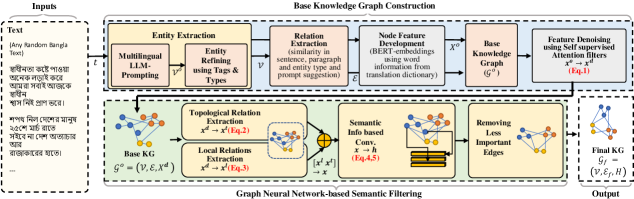
- 生のバングラテキストから名前付きエンティティおよびそのタイプを抽出するために多言語 LLM を使用する。
- 翻訳辞書を活用してバングラエンティティを英語同等にマッピングし、クロスリンガルな意味的整合性を実現する。
- 事前学習済み BERT モデルをバングラ向けに微調整して、初期の単語埋め込みを構築する。
- 局所的近隣関係とトポロジカル構造を活用して、埋め込みのノイズを低減するためのグラフベースの多項式フィルタを適用する。
- 自己教師付きアテンションを備えた GNN ベースの意味的フィルタを実装し、不適切なエッジを削除し、文脈的に重要な関係を保持する。
- 反復的フィルタリングと文脈的精錬を通じて、初期 KG を最終的な意味的に豊富なグラフに自動で精錬する。
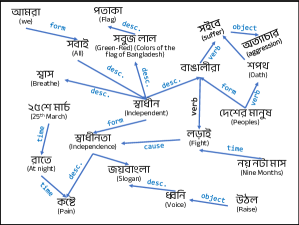
実験結果
リサーチクエスチョン
- RQ1微調整なしで、多言語 LLM は多様なバングラテキストタイプからエンティティと関係を効果的に抽出できるか?
- RQ2辞書ベースのクロスリンガルマッピングは、バングラ KG の意味的整合性を向上させるのにどの程度効果的か?
- RQ3グラフベースの多項式フィルタリングは、低リソース言語の KG における埋め込みノイズをどの程度低減できるか?
- RQ4GNN ベースの意味的フィルタは、誤ったまたは不適切な関係を削除することで KG の品質を顕著に向上させられるか?
- RQ5提案されたフレームワークは、ニュース、ウィキペディア、文学的テキストなど、さまざまなテキストドメインに普遍的に適用可能か?
主な発見
- 本フレームワークは、ウィキペディア、ニュース、文学的コンテンツを含む多様なテキストソースから、人的介入を最小限に抑えて意味的に整合性のあるバングラ KG を構築できた。
- アブレーションスタディの結果、GNN ベースの意味的フィルタと多項式フィルタリングの両方が、ベースライン手法と比較して KG の品質を顕著に向上させたことが確認された。
- 多言語 LLM と翻訳辞書の統合により、低リソース環境下でも堅牢なクロスリンガルエンティティアライメントが実現した。
- モデルはテキストタイプにわたって優れた一般化性能を示したが、古風または非常に比喩的な文章では性能にわずかな差が見られた。
- 実証的結果と事例研究により、フレームワークが自動的に高品質な KG を生成できること、エンティティの関連性と関係の正確性が明確に向上していることが検証された。
この論文を読む
Nubintのビューアで原文を開き、読みながら気になる箇所をすぐに質問できます。
Nubintでこの論文を読むこのレビューはAIが論文の原文をもとに作成しました。引用する前に原文をご確認ください。