
[論文レビュー] Basic syntax from speech: Spontaneous concatenation in unsupervised deep neural networks
この論文は、rawな音声から学習する教師なし深層畳み込みニューラルネットワーク(CNN)が、複数語の入力にさらされなくても、二語や三語の合成語のような語の連結列を自発的に生成できることを示している。ciwGANアーキテクチャを用いて、モデルは個々の語彙を組み合わせて、訓練データにない新しい語の組み合わせを生成し、完全な複接(reduplication)でさえも生成する。これは、連結という基本的な文法的演算が、音声入力から単独で出現しうることを示唆している。
Computational models of syntax are predominantly text-based. Here we propose that the most basic first step in the evolution of syntax can be modeled directly from raw speech in a fully unsupervised way. We focus on one of the most ubiquitous and elementary suboperation of syntax -- concatenation. We introduce spontaneous concatenation: a phenomenon where convolutional neural networks (CNNs) trained on acoustic recordings of individual words start generating outputs with two or even three words concatenated without ever accessing data with multiple words in the input. We replicate this finding in several independently trained models with different hyperparameters and training data. Additionally, networks trained on two words learn to embed words into novel unobserved word combinations. We also show that the concatenated outputs contain precursors to compositionality. To our knowledge, this is a previously unreported property of CNNs trained in the ciwGAN/fiwGAN setting on raw speech and has implications both for our understanding of how these architectures learn as well as for modeling syntax and its evolution in the brain from raw acoustic inputs. We also propose a potential neural mechanism called disinhibition that outlines a possible neural pathway towards concatenation and compositionality and suggests our modeling is useful for generating testable prediction for biological and artificial neural processing of speech.
研究の動機と目的
- 教師なしの深層ニューラルネットワークが、語の連結といった基本的な文法的性質をrawな音声から直接学習できるかどうかを調査すること。
- 単語単位の入力のみで訓練された畳み込みニューラルネットワークが、複数語のデータにさらされないまま、自発的に複数語の出力を生成できるかどうかを検証すること。
- 一語および二語の入力で訓練されたモデルが、語を訓練データにない新しい組み合わせに埋め込むことができるかどうかを調査すること。
- 潜在空間が、合成語や複接形といった未観測の言語的構造をどのように符号化しているかを検討すること。
- 自発的な連結が、ニューラルアーキテクチャにおける文法の進化や言語習得のモデル化に与える意味を評価すること。
提案手法
- TIMITデータセットのraw音声から、単語単位の入力のみを用いて、ciwGANおよび修正版fiwGANを訓練する。
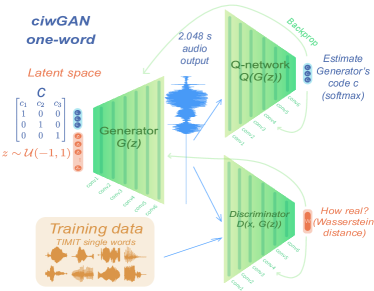
- 生成器ネットワークが、潜在コードc(one-hotまたはバイナリ)とランダムノイズzを入力とし、2.048秒の音声サンプルを出力する。
- 判別器はWasserstein損失を用いて、本物の音声と生成された音声を識別し、別個のQネットワークを用いて生成音声から潜在コードcを復号する。
- 生成器を、判別器の誤差を最大化し、Qネットワークの誤差を最小化するように訓練することで、言語的単位の情報量が多く、分離された表現を促進する。
- 訓練データに存在しない出力の自発的連結、複接、および新しい語の組み合わせを評価する。
- 二段階の実験設計を用いる:最初に一語の訓練を行い、その後、保留された組み合わせを含む二語の入力で訓練し、新しいペアの埋め込みをテストする。
実験結果
リサーチクエスチョン
- RQ1教師なしの深層ニューラルネットワークが、単語単位の音声入力のみで、自発的に二語や三語の連結列を生成できるか?
- RQ2これらのモデルは、訓練中に繰り返し語を学習していないにもかかわらず、自発的な複接(語の完全な繰り返し)を示すか?
- RQ3一語および二語の入力で訓練されたモデルが、個々の語を訓練データにない新しい二語の組み合わせに埋め込むことができるか?
- RQ4生成器の潜在空間が、合成語や複接形といった未観測の言語的構造をどのように符号化しているか?
- RQ5これらのモデルにおける自発的連結は、人間の言語習得の初期段階や文法の進化をどれほど模倣できるか?
主な発見
- 一語モデルは、潜在コード[0,0,-40,0,0]に対して10回中7回の試行で「greasy greasy」を生成し、繰り返し語にさらされない状況下でも自発的な完全な複接を示した。
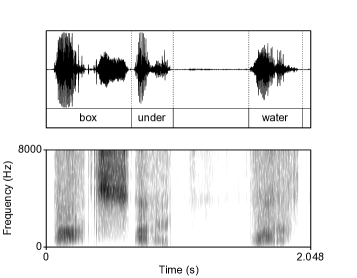
- 複数語の訓練データが一切存在しない状況下でも、モデルは二語や三語の連結された語列を自発的に生成した。これは、自発的な連結が生じたことを示している。
- 二語の入力で訓練されたモデルは、語を訓練データにない組み合わせに埋め込むことに成功しており、学習データを超えた一般化能力があることを示唆している。
- 潜在コードの負の値が、新しい連結出力を符号化するために使用されており、ネットワークが言語的イノベーションのために未使用の潜在空間を利用していることを示している。
- モデルの出力は顕著で解釈可能であり、まれに曇りのないものであった。著者がトランスクリプションを実施し、正確性を保証した。
- 結果から、語の連結といった基本的な文法的演算が、言語固有のインダクティブバイアスがなくても、教師なしモデルにおいてrawな音声入力から自発的に出現しうることが示唆された。
この論文を読む
Nubintのビューアで原文を開き、読みながら気になる箇所をすぐに質問できます。
Nubintでこの論文を読むこのレビューはAIが論文の原文をもとに作成しました。引用する前に原文をご確認ください。