
[論文レビュー] Benchmarking Cognitive Biases in Large Language Models as Evaluators
本論文は CoBBLEr を導入し、15 個の LLM が QA 出力の評価者として機能する際の6つの認知バイアスを測定するベンチマークを提示し、広範な偏見と人間の嗜好とのずれを明らかにする。
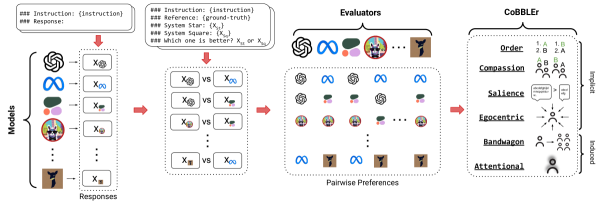
Large Language Models are cognitively biased judges. Large Language Models (LLMs) have recently been shown to be effective as automatic evaluators with simple prompting and in-context learning. In this work, we assemble 15 LLMs of four different size ranges and evaluate their output responses by preference ranking from the other LLMs as evaluators, such as System Star is better than System Square. We then evaluate the quality of ranking outputs introducing the Cognitive Bias Benchmark for LLMs as Evaluators (CoBBLEr), a benchmark to measure six different cognitive biases in LLM evaluation outputs, such as the Egocentric bias where a model prefers to rank its own outputs highly in evaluation. We find that LLMs are biased text quality evaluators, exhibiting strong indications on our bias benchmark (average of 40% of comparisons across all models) within each of their evaluations that question their robustness as evaluators. Furthermore, we examine the correlation between human and machine preferences and calculate the average Rank-Biased Overlap (RBO) score to be 49.6%, indicating that machine preferences are misaligned with humans. According to our findings, LLMs may still be unable to be utilized for automatic annotation aligned with human preferences. Our project page is at: https://minnesotanlp.github.io/cobbler.
研究の動機と目的
- LLMs を生成だけでなく、生成されたテキストの評価者として評価する動機付け。
- CoBBLEr を導入し、LLM 評価者における六つの認知バイアスを測定。
- QA 形式のタスクで、3B から >175B パラメータの広範なモデルを評価。
- 機械的評価と人間の嗜好との整合性を分析。
提案手法
- Eli5 および BigBench 検出プロンプトを用いて各モデルから 50 件の QA 応答を生成。
- 15 モデル間で 50 件のインスタンスについて全てのユニークなペアを作成(5250 ペア)。
- 各ペアで 2 回ずつ、順序をシャッフルして評価者により良い応答を選択させるプロンプトを実行。
- バイアスを含意的か誘発的かに分類し、ランダムベースラインを用いて偏りを定量化。
- 人間と機械の嗜好の間の Rank-Biased Overlap (RBO) を計算(p=0.8)。
- 公開リーダーボード風のベンチマークとポスタセッション風の結果を提供。
実験結果
リサーチクエスチョン
- RQ1QA タスクで他の LLM 出力を評価する際、LLM に認知バイアスが現れるか?
- RQ2多様なモデルにおける暗黙の偏見と誘発的な偏見の有病率と強さはどれくらいか?
- RQ3機械の評価者としての嗜好は人間の嗜好とどれくらい一致するか?
- RQ4CoBBLEr は偏った評価者を信頼性高く識別し、評価者としてのモデルの頑健性を区別できるか?
主な発見
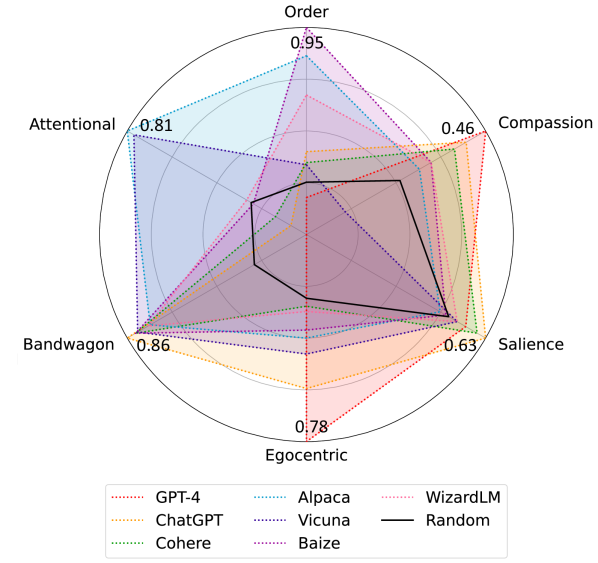
- ほとんどのモデルは複数のベンチマークで顕著なバイアスを示す(平均的なバイアスの存在は比較の約40%程度)。
- 暗黙のバイアスはモデルサイズに依存せず継続し、スケーリングが評価バイアスを排除しない。
- Bandwagon および Attentional バイアスは誘発的バイアスのテストで特に顕著。
- 人間と機械の嗜好の整合性は中等度に留まり(平均 Rank-Biased Overlap 約0.496)。
- 小型モデル(<=10B)は特にバイアスに敏感であり、非常に大きなモデルでも名前に関連した自我中心効果を示す場合がある。
- 指示調整済みまたは人間のフィードバックで訓練されたモデルの大半が評価者として使用された場合に認知バイアスを示す。
この論文を読む
Nubintのビューアで原文を開き、読みながら気になる箇所をすぐに質問できます。
Nubintでこの論文を読むこのレビューはAIが論文の原文をもとに作成しました。引用する前に原文をご確認ください。