
[論文レビュー] Benchmarking Out-of-Distribution Generalization Capabilities of DNN-based Encoding Models for the Ventral Visual Cortex
本稿では、30万枚以上の画像に対するマカクの頭頂外側側頭皮質反応を収集した大規模データセットである MacaqueITBench を紹介し、分布外(OOD)シフト下でのDNNベースの符号化モデルのベンチマークを実施する。画像の属性変更(例:コントラスト、色相)による単純なシフトでも、モデル性能が分布内性能の最低20%まで低下することが判明。また、事前学習済みDNN特徴量間の単純なコサイン距離メトリックが、OOD一般化失敗を強く予測することが示された。
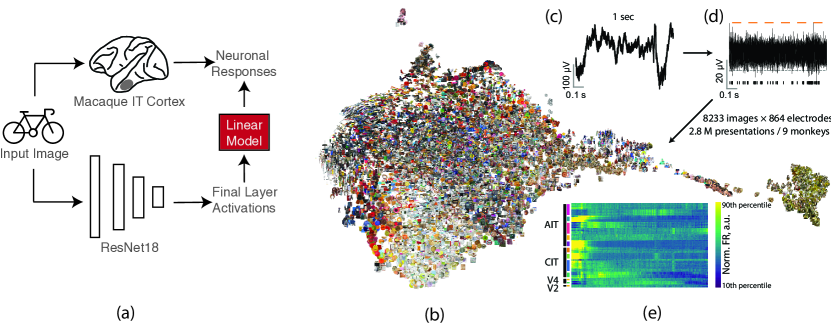
We characterized the generalization capabilities of DNN-based encoding models when predicting neuronal responses from the visual cortex. We collected extit{MacaqueITBench}, a large-scale dataset of neural population responses from the macaque inferior temporal (IT) cortex to over $300,000$ images, comprising $8,233$ unique natural images presented to seven monkeys over $109$ sessions. Using extit{MacaqueITBench}, we investigated the impact of distribution shifts on models predicting neural activity by dividing the images into Out-Of-Distribution (OOD) train and test splits. The OOD splits included several different image-computable types including image contrast, hue, intensity, temperature, and saturation. Compared to the performance on in-distribution test images -- the conventional way these models have been evaluated -- models performed worse at predicting neuronal responses to out-of-distribution images, retaining as little as $20\%$ of the performance on in-distribution test images. The generalization performance under OOD shifts can be well accounted by a simple image similarity metric -- the cosine distance between image representations extracted from a pre-trained object recognition model is a strong predictor of neural predictivity under different distribution shifts. The dataset of images, neuronal firing rate recordings, and computational benchmarks are hosted publicly at: https://bit.ly/3zeutVd.
研究の動機と目的
- 霊長類腹側視覚皮質の DNN ベース符号化モデルの分布外(OOD)一般化能力を調査すること。
- 低レベルの画像属性(例:コントラスト、彩度)の分布シフトが、神経応答予測性能に及ぼす影響を特定し、その程度を評価すること。
- 訓練データとテストデータの画像表現の類似性に基づいて、OOD モデル性能低下を予測可能な計算可能なメトリックを開発・検証すること。
- 今後の神経符号化および一般化に関する研究を支援するため、公開可能な大規模神経データセット(MacaqueITBench)を提供すること。
提案手法
- 8,233枚のユニークな自然画像を30万回以上提示し、109セッションにわたりマカクのIT皮質における神経集団応答を収集した。
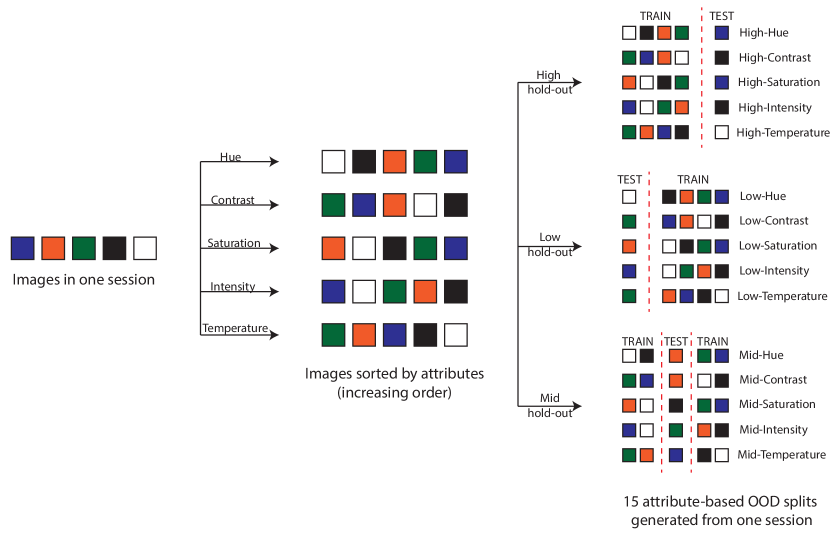
- 画像属性(コントラスト、色相、明度、温度、彩度)を変更することでOODスプリットを作成し、ニアOODおよびファーOODのテストセットを構築した。
- 事前学習済みResNet18の特徴量を用いて線形符号化モデルを訓練し、画像入力から神経細胞の発火率を予測した。
- 訓練データとテストデータの画像表現間の分布シフトの大きさを測定するため、Closest-Cosine Distance(DCCD)メトリックを提案した。
- Spearman相関を用いて、DCCD、MMD、およびCovariate-ShiftメトリックがOOD性能低下をどの程度予測できるかを評価した。
- 複数のOODスプリットおよびセッションにおいて、分布内、ニアOOD、ファーOODのテスト分布を比較し、モデル性能を評価した。
実験結果
リサーチクエスチョン
- RQ1DNNベースの符号化モデルは、分布外の画像シフト下で分布内一般化と比べて、どの程度の性能を示すか?
- RQ2コントラスト、色相、彩度などの低レベルの画像属性のシフトが、神経応答予測性能にどの程度悪影響を及ぼすか?
- RQ3計算可能な画像類似度メトリックは、OODシフト下での性能低下の大きさを予測できるか?
- RQ4Closest-Cosine Distance、MMD、Covariate-Shift のうち、どのメトリックが神経符号化モデルにおけるOOD一般化失敗を最もよく予測できるか?
主な発見
- DNNベースの符号化モデルはOODシフト下で著しく性能を低下させ、分布内性能の最低20%まで低下することが判明した。
- OODシフト下での性能低下は、Closest-Cosine Distance(DCCD)メトリックで測定した分布シフトの大きさと強く相関していた。
- 3段階の分布シフト(InD、ニアOOD、ファーOOD)において、DCCDはOOD性能低下と-0.49のSpearman相関を示した。
- 色相、彩度、温度、コントラスト、明度の15の属性ベースのOODスプリットにおいて、DCCDはOOD性能と-0.45のSpearman相関を示し、MMDおよびCovariate-Shiftを上回った。
- 対応t検定により、分布内からニアOOD、さらにファーOODのテストセットに移行するに従い、モデル性能が有意にかつ段階的に低下した(p < 0.01)。
- ResNet18特徴量から計算されたClosest-Cosine Distanceメトリックは、OOD神経予測性の強力な予測因子であり、表現類似度が一般化失敗を駆動していることを示唆している。
この論文を読む
Nubintのビューアで原文を開き、読みながら気になる箇所をすぐに質問できます。
Nubintでこの論文を読むこのレビューはAIが論文の原文をもとに作成しました。引用する前に原文をご確認ください。