
[論文レビュー] Beyond Demographic Parity: Redefining Equal Treatment
本論文は、シャープレー値を用いた特徴レベルのモデル解釈を分析することで、機械学習における等しい扱いの新しい形式化を提案する。保護群ごとの解釈分布を定義し、AUCに基づく分類器二標本検定(C2ST)を用いて不均等な扱いを検出する。デモグラフィックパリティが不正義を隠蔽する可能性があることを示し、従来の指標が見逃す乖離を同定する。実用的利用を目的として、オープンソースツール「explanationspace」を公開した。
Liberalism-oriented political philosophy reasons that all individuals should be treated equally independently of their protected characteristics. Related work in machine learning has translated the concept of \emph{equal treatment} into terms of \emph{equal outcome} and measured it as \emph{demographic parity} (also called \emph{statistical parity}). Our analysis reveals that the two concepts of equal outcome and equal treatment diverge; therefore, demographic parity does not faithfully represent the notion of \emph{equal treatment}. We propose a new formalization for equal treatment by (i) considering the influence of feature values on predictions, such as computed by Shapley values decomposing predictions across its features, (ii) defining distributions of explanations, and (iii) comparing explanation distributions between populations with different protected characteristics. We show the theoretical properties of our notion of equal treatment and devise a classifier two-sample test based on the AUC of an equal treatment inspector. We study our formalization of equal treatment on synthetic and natural data. We release exttt{explanationspace}, an open-source Python package with methods and tutorials.
研究の動機と目的
- 哲学的意味での等しい扱いと機械学習の公平性指標(例:デモグラフィックパリティ)との乖離を是正すること。
- 結果の分布ではなく、特徴レベルのモデル解釈に基づいて等しい扱いを形式化すること。
- 結果が各グループ間でバランスしているように見えても、不均等な扱いを検出できる手法を開発すること。
- 実務者による不正義の監査が可能な解釈可能でオープンソースのツールを構築すること。
- 解釈分布を通じた公平性の測定に関する理論的・実証的基盤を確立すること。
提案手法
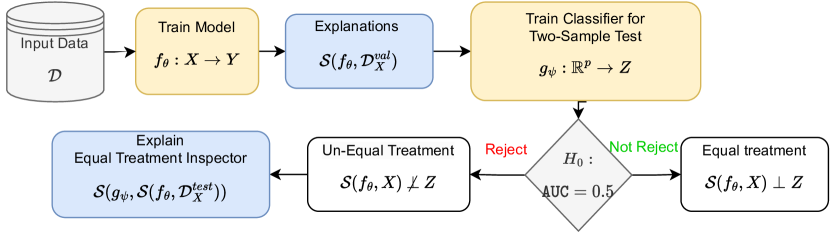
- 個々の個人のモデル予測を特徴レベルの帰属割り当てに分解するためにシャープレー値を用いる。
- 保護群内の個人のシャープレー値の集まりとして、解釈分布を定義する。
- AUCに基づく分類器二標本検定(C2ST)を用いて、グループ間の解釈分布を比較する。
- 不均等な扱いをフラグとして特定し、寄与要因となる特徴を説明する診断ツール「Equal Treatment Inspector」を設計する。
- scikit-learnと互換性を持つオープンソースPythonパッケージ「explanationspace」にこの手法を実装する。
- UCIおよび米国国勢調査データを含む、合成データおよび実世界のデータセットを用いて手法を検証する。
実験結果
リサーチクエスチョン
- RQ1デモグラフィックパリティは哲学的意味での等しい扱いを信頼性を持って反映しているのか、それとも不正義を隠蔽する可能性があるのか?
- RQ2シャープレー値から導かれる解釈分布は、保護群間での不均等な扱いを効果的に捉えられるか?
- RQ3提案手法(C2STベース)は、従来の公平性指標に比べて、隠れた乖離を検出する上で優れているか?
- RQ4Equal Treatment Inspectorが明らかにした不均等な扱いに最も寄与している要因は何か?
- RQ5この手法は、解釈可能な診断を備えた実世界のモデルに実用的に適用可能か?
主な発見
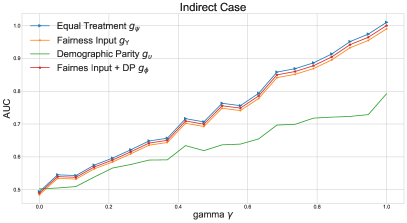
- デモグラフィックパリティが満たされている場合でも、本手法は不均等な扱いを検出でき、結果の平等が等しい扱いを保証するわけではないことを示した。
- UCI Adultデータセットでは、人種グループ間で解釈分布の顕著な乖離が検出され、AUC値が区別可能な分布を示した(例:雇用におけるWhite-BlackのAUC = 0.651 ± 0.009)。
- LIMEベースの解釈は安定性が低く、実行時間が長かったが、SHAPは精度と効率の両面で一貫して優れていた。
- 合成データにおけるC2STのAUCは、間接的および情報のない状況の両方で0.6を超える強力な検出能力を示した。
- explanationspaceパッケージにより、最小限の統合コストでモデルの不均等な扱いに対するエンドツーエンドの監査が可能になった。
- 移動関連のタスクでは、結果ベースの公平性指標がパリティに近い場合でも、意味のある乖離(例:Asian-MixedのAUC = 0.753 ± 0.02)を同定した。
この論文を読む
Nubintのビューアで原文を開き、読みながら気になる箇所をすぐに質問できます。
Nubintでこの論文を読むこのレビューはAIが論文の原文をもとに作成しました。引用する前に原文をご確認ください。