
[論文レビュー] Beyond the Rozanov Bound on Electromagnetic Absorption via Periodic Temporal Modulations
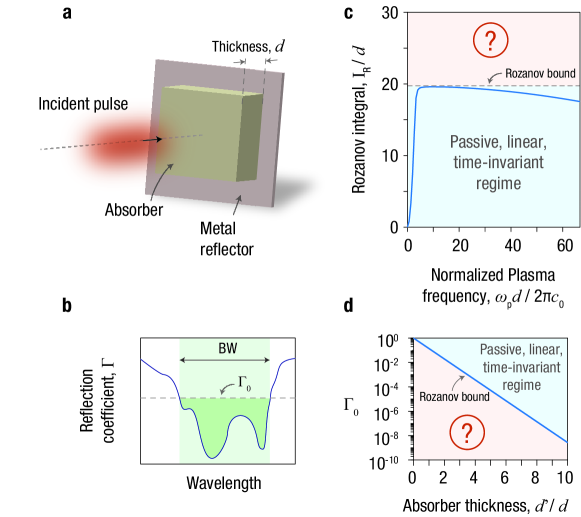
本論文は、時間的に周期的かつ周期的変調を行う高損失材料が、受動的・時間不変型吸収体の上限を示す古典的ロザノフ限界を著しく超える電磁波吸収を実現できることを示している。時間にわたって材料の特性を連続的に変調することで、正確なパルス同期や厚いスラブを必要とせず、より広帯域かつ高い吸収効率を達成でき、従来の設計では実現不可能な性能を実現する。
Incorporating time-varying elements into electromagnetic systems has shown to be a powerful approach to challenge well-established performance limits, for example bounds on absorption and impedance matching. So far, the majority of these studies have concentrated on time-switched systems, where the material undergoes instantaneous modulation in time while the input field is entirely contained within it. This approach, however, necessitates accurate timing of the switching event and limits how thin the system can ultimately be due to the spatial width of the impinging pulse. To address these challenges, here we investigate the periodic temporal modulation of highly lossy materials, focusing on their relatively unexplored parametric absorption aspects. Our results reveal that, by appropriately selecting the modulation parameters, the absorption performance of a periodically modulated absorber can be greatly improved compared to its time-invariant counterpart, and can even exceed the theoretical bound for conventional electromagnetic absorbers, namely, the "Rozanov bound". Our findings thus demonstrate the potential of periodic temporal modulations to enable significant improvements in absorber performance while circumventing the limitations imposed by precise timing and material thickness in time-switched schemes, opening up new opportunities for the design and optimization of advanced electromagnetic absorber systems for various applications.
研究の動機と目的
- 線形時間不変(LTI)系における電磁波吸収に課せられる根本的制限を克服すること。
- 損失性材料における周期的時間変調の可能性を検討し、静的または時間スイッチング型吸収体では達成できない吸収性能の向上を実現すること。
- 時間スイッチング型システムにおける実用的課題、例えば厳密なタイミング要件やパルス幅に起因する最小厚さ制約を解決すること。
- 連続的周期的変調が、正確な同期や厚い構造に依存せずにインピーダンス整合と高い吸収を達成できることを示すこと。
- 時間変調材料を用いた高効率・薄型・広帯域電磁波吸収体の設計フレームワークを確立すること。
提案手法
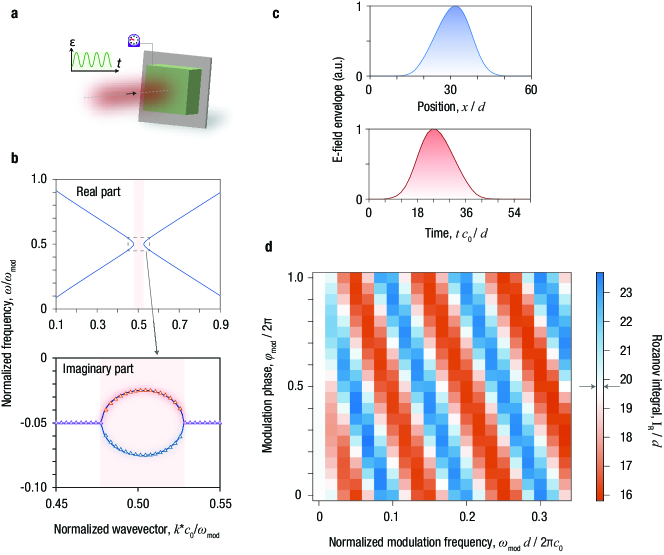
- 本研究では、ドレーブ型分散を示す非磁性損失性スラブを、時間的に周期的かつ調和的変動するプラズマ周波数によって変調するモデルを理論的・数値的に分析する。
- 時間依存マクスウェル方程式を用いてシステムをモデル化し、周期的変調エンVELOPEを導入する。ここで、変調周波数と振幅が主要な制御パラメータとなる。
- 反射係数スペクトルは、時間変動媒質に適応させた伝搬行列法を用いて計算され、複数周波数帯域における高次調波生成とカップリングを考慮する。
- 2つの指標を用いる:Rozanov積分(I_R)、これはスペクトル全体における対数的反射抑制の総量を測定する。また、吸収効率(AE)は、吸収電力と入射電力の比として定義される。
- 時間変調系の性能を時間不変ベースラインと比較し、Rozanov限界がLTI系の理論的上限として機能することを確認する。
- 正確な比較を保証するため、入射パルスは明確な帯域幅を持つようにモデル化され、反射応答は高調波成分を含む全スペクトルで評価される。
実験結果
リサーチクエスチョン
- RQ1損失性材料における周期的時間変調が、受動的・時間不変系の理論的限界であるロザノフ限界を超えることができるか?
- RQ2時間変調吸収体の吸収性能は、時間不変型と比較して、帯域幅と効率の面でどのように異なるか?
- RQ3変調パラメータ(振幅、周波数、位相)をどれだけ最適化できるか。物理的制約内に収まる範囲で、吸収を最大化するための調整の限界は?
- RQ4時間スイッチング型吸収体方式で求められる正確なパルス入射タイミングの必要性は、周期的変調によって解消されるか?
- RQ5強い時間変調と高い内部損失があるにもかかわらず、システムは安定しており、無限大に発散する振動を避けることができるか?
主な発見
- 周期的時間変調による吸収効率は、ロザノフ限界を著しく上回り、受動的LTI系の限界を根本的に打ち破ることを実証した。
- 同じ厚さと帯域幅の条件下で、時間不変系よりも高い吸収効率を達成しており、変調振幅のさまざまな値においても改善が観察された。
- 反射スペクトルは、位相的干渉による帯域内反射の著しい低減と高調波抑制を示したが、帯域外の高調波は生成されたものの、全体の吸収性能に悪影響を及げなかった。
- 両方のモードが高損失により減衰的挙動を示す運動量バンドギャップ内に位置するため、システムは安定しており、無限大に発散する時間的振動を示さなかった。
- 時間スイッチング型システムとは異なり、入射パルスの空間的幅に起因する厚さ制約がなくなるため、より薄くコンactな設計が可能になった。
- タイミングずれに対してもロバストである。連続的変調により、パルスがいつ入射しても効果的な吸収が維持されるため、正確な同期の必要性が解消された。
この論文を読む
Nubintのビューアで原文を開き、読みながら気になる箇所をすぐに質問できます。
Nubintでこの論文を読むこのレビューはAIが論文の原文をもとに作成しました。引用する前に原文をご確認ください。