
[論文レビュー] Bi-Bimodal Modality Fusion for Correlation-Controlled Multimodal Sentiment Analysis
本稿では、二つの独立したトランスフォーマー基盤の二モーダル融合モジュール(TVおよびTA)を用いて、同時に融合と分離を実行するエンドツーエンドのマルチモーダルセンチメント分析モデルであるBi-Bimodal Fusion Network(BBFN)を提案する。層別特徴空間分離器により特徴空間の崩壊を軽減し、ゲート制御機構により細分化された制御を可能にすることで、モダリティ表現の独立性を維持しつつ、性能を向上させる。BBFNは、CMU-MOSI、CMU-MOSEI、UR-FUNNYの各データセットにおいて最先端性能を達成し、センチメント強度予測およびユーモア認識の両面で、先行手法を上回っている。
Multimodal sentiment analysis aims to extract and integrate semantic information collected from multiple modalities to recognize the expressed emotions and sentiment in multimodal data. This research area's major concern lies in developing an extraordinary fusion scheme that can extract and integrate key information from various modalities. However, one issue that may restrict previous work to achieve a higher level is the lack of proper modeling for the dynamics of the competition between the independence and relevance among modalities, which could deteriorate fusion outcomes by causing the collapse of modality-specific feature space or introducing extra noise. To mitigate this, we propose the Bi-Bimodal Fusion Network (BBFN), a novel end-to-end network that performs fusion (relevance increment) and separation (difference increment) on pairwise modality representations. The two parts are trained simultaneously such that the combat between them is simulated. The model takes two bimodal pairs as input due to the known information imbalance among modalities. In addition, we leverage a gated control mechanism in the Transformer architecture to further improve the final output. Experimental results on three datasets (CMU-MOSI, CMU-MOSEI, and UR-FUNNY) verifies that our model significantly outperforms the SOTA. The implementation of this work is available at https://github.com/declare-lab/multimodal-deep-learning.
研究の動機と目的
- 既存のマルチモーダル融合手法が、モダリティ寄与度の不均衡処理や、モダリティ相関・独立性に対する制御の欠如に起因する限界を是正すること。
- スタックドトランスフォーマー構造における特徴空間の崩壊を軽減すること。これは、モダリティ独立性を損なう要因となり、融合性能を低下させる。
- モダリティペア間の段階的かつ双方向の補完的相互作用を可能にするとともに、それぞれの独自表現を保持する融合スキームの開発。
- モダリティ間の情報フローを動的に調整できるゲート制御機構の導入により、センチメント分析の性能を向上させること。
提案手法
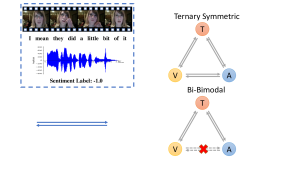
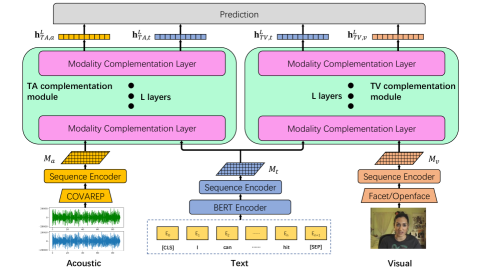
- モデルは、テキスト-ビジュアル(TV)およびテキスト・アコースティック(TA)ペアを対象とした二つの並列二モーダル融合モジュールを採用し、焦点を当てたペアワイズ融合を可能にする。
- 各モジュールは、モダリティ固有の特徴空間分離器を備えたスタックドトランスフォーマーレイヤーを用い、表現の崩壊を防ぎ、モダリティ独立性を維持する。
- 各融合レイヤーにゲート制御機構を導入し、保持用と複合(クロスモダリティ)アテンション用の別個のゲートを用いることで、情報フローの動的制御を可能にする。
- 複合ゲート重みはモダリティ依存性を決定するのに用いられ、高い重みは他方のモダリティ表現への依存度の高さを示す。
- 二つの融合モジュールは同時に学習され、融合と分離の間で競合的かつ協調的なダイナミクスを模倣することで、表現品質の向上を図る。
- アーキテクチャはエンドツーエンドで学習可能であり、自己注意機構と残差接続を活用して、モダリティ間の長距離依存関係を保持する。
実験結果
リサーチクエスチョン
- RQ1マルチモーダルセンチメント分析において、特にテキストなど優位なモダリティが存在する場合、異なるモダリティの寄与度をよりよくバランスさせる融合機構はどのように設計できるか?
- RQ2専用の特徴空間分離器は、スタックドトランスフォーマー基盤のマルチモーダルモデルにおける表現の崩壊をどの程度軽減できるか?
- RQ3ゲート制御機構により、モダリティ間の相互作用と依存性を動的に制御することで、融合性能を向上させられるか?
- RQ4提案された二モーダル融合アーキテクチャは、対称的三モーダル融合と比較して、多様なデータセットにおいて性能および頑健性に優れているか?
- RQ5モダリティ固有のアテンション制御は、センチメント予測の解釈可能性と正確性にどのような影響を与えるか?
主な発見
- BBFNは、CMU-MOSI、CMU-MOSEI、UR-FUNNYで最先端性能を達成し、CMU-MOSEIにおける平均絶対誤差(MAE)は0.529を記録。これは、先行SOTA手法を上回っている。
- アブレーションスタディの結果、特徴空間分離器を削除するとMAEが0.533に上昇し、表現の崩壊軽減におけるその役割が裏付けられた。
- ゲート制御機構を削除すると性能が低下し、MAEは0.531に上昇した。これは、動的モダリティ相互作用におけるその重要性を示している。
- BBFNはCMU-MOSEIで0.775の相関スコアを達成し、比較対象のすべての手法の中で最高水準であり、正解との整合性が向上したことを示している。
- ゲート重みの可視化により、モデルが人間の解釈と整合するモダリティ依存パターン(例:情報量が少ないモダリティに対して高い複合ゲート重み)を学習していることが確認された。
- 特にケースAにおいて、BBFNはMISAよりも正解に近い予測を示しており、テキストが支配的であることを正しく識別し、ノイズの多いビジュアルやアコースティックの情報への過剰依存を回避している。
この論文を読む
Nubintのビューアで原文を開き、読みながら気になる箇所をすぐに質問できます。
Nubintでこの論文を読むこのレビューはAIが論文の原文をもとに作成しました。引用する前に原文をご確認ください。