
[論文レビュー] Bi-level Contrastive Learning for Knowledge-Enhanced Molecule Representations
本稿では、分子グラフと知識グラフのサブ構造の両方で共同事前学習を行うことで、分子表現を向上させる二段階対照的学習フレームワークGodeを提案する。対照的学習により両者の埋め込みを整列させることで、Godeは最先端の性能を達成し、11の分子特性予測タスク全体で平均ROC-AUCを12.7%向上、RMSE/MAEを34.4%低減した。
Molecular representation learning is vital for various downstream applications, including the analysis and prediction of molecular properties and side effects. While Graph Neural Networks (GNNs) have been a popular framework for modeling molecular data, they often struggle to capture the full complexity of molecular representations. In this paper, we introduce a novel method called GODE, which accounts for the dual-level structure inherent in molecules. Molecules possess an intrinsic graph structure and simultaneously function as nodes within a broader molecular knowledge graph. GODE integrates individual molecular graph representations with multi-domain biochemical data from knowledge graphs. By pre-training two GNNs on different graph structures and employing contrastive learning, GODE effectively fuses molecular structures with their corresponding knowledge graph substructures. This fusion yields a more robust and informative representation, enhancing molecular property predictions by leveraging both chemical and biological information. When fine-tuned across 11 chemical property tasks, our model significantly outperforms existing benchmarks, achieving an average ROC-AUC improvement of 12.7% for classification tasks and an average RMSE/MAE improvement of 34.4% for regression tasks. Notably, GODE surpasses the current leading model in property prediction, with advancements of 2.2% in classification and 7.2% in regression tasks.
研究の動機と目的
- 生化学的知識グラフからの豊かな文脈的知識を捉えられない標準的な分子グラフ表現の限界を是正すること。
- 分子グラフの構造的情報を知識グラフの関係的知識と統合することで、分子特性予測を向上させること。
- 分子グラフと知識グラフのサブ構造という2つの異なるグラフレベル間の表現を整列させる、強固な自己教師付き事前学習パラダイムの開発。
- 知識駆動型分子表現学習を支援するための包括的な分子知識グラフ(MolKG)の構築。
- 二段階対照的学習が、多様な分子特性予測タスクにわたる表現の頑健性と一般化性能を向上させることの実証。
提案手法
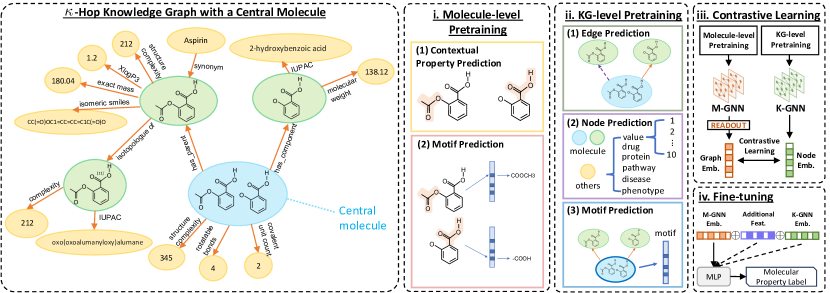
- Godeは、分子グラフ表現学習を目的としたM-GNNと、ターゲット分子を中心にした知識グラフサブ構造表現学習を目的としたK-GNNの2つの専用GNNを採用する。
- 本手法は二段階自己教師付き事前学習を実施する:M-GNNは分子グラフ上で、K-GNNはターゲット分子を中心にした知識グラフ(MolKG)のサブグラフ上で事前学習を行う。
- 同じ分子のM-GNNとK-GNNの埋め込み間に対照的学習を適用し、両者の表現を整列させることで、モダリティ間の知識伝達を確保する。
- 機能的官能基はRDKitを用いて抽出し、最終的な埋め込みと連結することで、分子表現を豊かにする。
- 微調整段階では、2つの推論モードをサポートする:M-GNNの埋め込みのみを使用するか、M-GNNとK-GNNの出力を連結する。
- MolKG知識グラフは、PubChemRDF、UMLS、PrimeKGといったマルチドメインの生化学的データから構築され、包括的な分子知識統合を支援する。
実験結果
リサーチクエスチョン
- RQ1分子グラフと知識グラフサブ構造の共同事前学習が、特性予測のための分子表現学習を向上させ得るか?
- RQ2分子グラフと知識グラフ表現間の二段階対照的学習が、埋め込みの頑健性と一般化性能をどのように向上させるか?
- RQ3機能的官能基の特徴の統合が、下流の分子特性予測性能に与える影響は何か?
- RQ4GodeはGROVER、MolCLR、KANOといった最先端モデルと比較して、多様な分子特性予測ベンチマークでどのように差をつけるか?
- RQ5分子グラフと知識グラフ構造の両方で事前学習を実施することで、分布外の分子データセットにおける性能低下はどの程度軽減されるか?
主な発見
- Godeは11の分類タスク全体でベースライン比平均ROC-AUCを12.7%向上させ、顕著に優れた性能を示した。
- 回帰タスクでは、平均RMSE/MAEを34.4%低減し、連続的分子特性予測における優れた予測精度を示した。
- Godeは現在の最良モデルを、平均分類性能で2.1%、平均回帰性能で6.4%上回った。
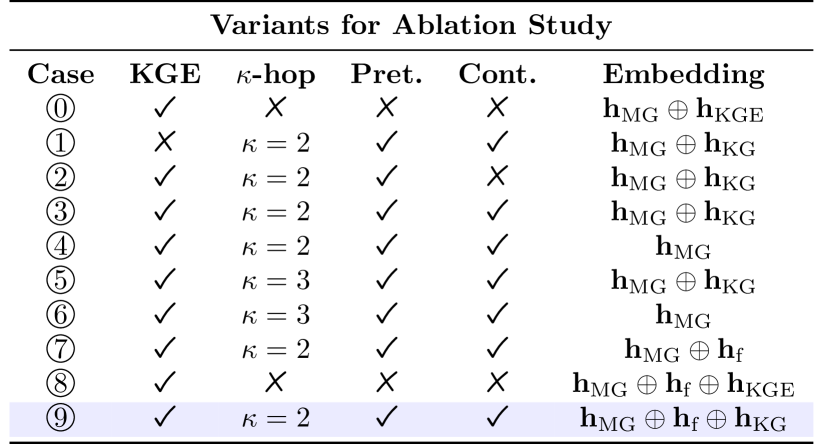
- アブレーションスタディの結果、M-GNNとK-GNNの両方を事前学習することで最も高い性能向上が得られ、両者がランダム初期化の場合にはROC-AUCが5.6%低下した。
- 機能的官能基の特徴の統合とM-GNN・K-GNN埋め込み間の対照的整列が、特に回帰タスクにおいて性能向上に顕著な寄与を示した。
- 微調整段階でM-GNN埋め込みのみを用いてもモデルは強固な性能を維持しており、学習済み表現の頑健性と柔軟性を示している。
この論文を読む
Nubintのビューアで原文を開き、読みながら気になる箇所をすぐに質問できます。
Nubintでこの論文を読むこのレビューはAIが論文の原文をもとに作成しました。引用する前に原文をご確認ください。