
[論文レビュー] Boosting Adversarial Attacks by Leveraging Decision Boundary Information
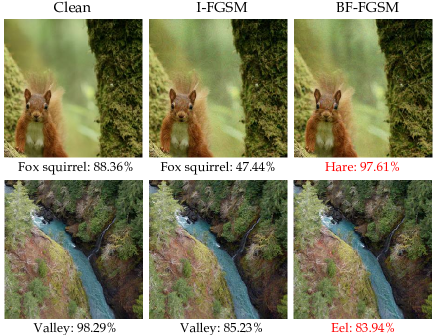
本稿では、代替モデルの意思決定境界に近い境界点からの勾配情報を活用することで、転送性を向上させる新しい転送ベースの adversarial 攻撃、Boundary Fitting Attack (BFA) を提案する。複数の境界点からの勾配を平均化することで、被害者モデルの意思決定境界をより効率的に超える、より効果的な adversarial 方向を生成する。これにより、最先端の攻撃成功率を達成し、通常の CNN では 5.6%、防御用 CNN では 14.9% 高い成功率を達成。CNN を代替モデルとして使用した場合、トランスフォーマーに対する攻撃成功率は 58.2% に達する。
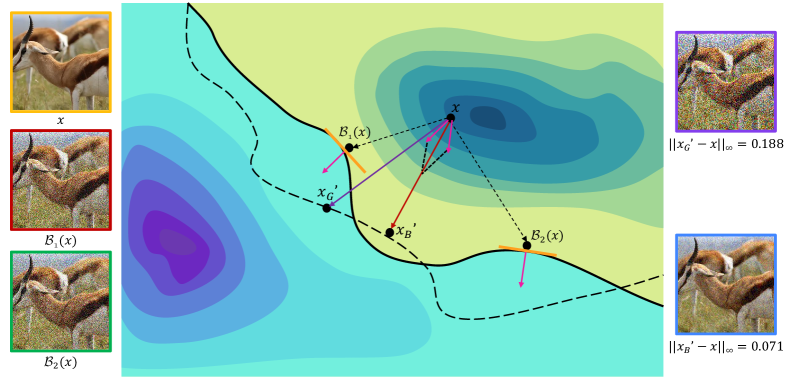
Due to the gap between a substitute model and a victim model, the gradient-based noise generated from a substitute model may have low transferability for a victim model since their gradients are different. Inspired by the fact that the decision boundaries of different models do not differ much, we conduct experiments and discover that the gradients of different models are more similar on the decision boundary than in the original position. Moreover, since the decision boundary in the vicinity of an input image is flat along most directions, we conjecture that the boundary gradients can help find an effective direction to cross the decision boundary of the victim models. Based on it, we propose a Boundary Fitting Attack to improve transferability. Specifically, we introduce a method to obtain a set of boundary points and leverage the gradient information of these points to update the adversarial examples. Notably, our method can be combined with existing gradient-based methods. Extensive experiments prove the effectiveness of our method, i.e., improving the success rate by 5.6% against normally trained CNNs and 14.9% against defense CNNs on average compared to state-of-the-art transfer-based attacks. Further we compare transformers with CNNs, the results indicate that transformers are more robust than CNNs. However, our method still outperforms existing methods when attacking transformers. Specifically, when using CNNs as substitute models, our method obtains an average attack success rate of 58.2%, which is 10.8% higher than other state-of-the-art transfer-based attacks.
研究の動機と目的
- 代替モデルから生成された adversarial 例の転送性が、モデルの勾配の違いにより制限されることを解決すること。
- 元の入力位置における勾配と比較して、意思決定境界における勾配がモデル間でより類似しているかどうかを調査すること。
- 意思決定境界の平坦性と幾何的性質を活用することで、adversarial 攻撃の成功率を向上させる手法を開発すること。
- 転送ベースの攻撃におけるトランスフォーマーと CNN の耐性を評価し、両アーキテクチャにおける攻撃効果性を向上させること。
- 境界勾配の平均化を、より転送性の高い adversarial 方向を見つける戦略として、理論的および実験的根拠を提供すること。
提案手法
- 入力画像をランダムな方向に摂動させることで、モデルの予測が変化するまで繰り返し、意思決定境界に近い境界点を複数サンプリングする。
- 得られた境界点で勾配を計算し、それらを平均化することで、被害者モデルの意思決定境界にさらに整合性の高い、洗練された adversarial 更新方向を生成する。
- 既存の勾配ベースの攻撃(例:FGSM、MI-FGSM)と互換性があり、標準的な攻撃パイプラインへの統合が可能である。
- 境界探索中のステップサイズを制御するためのスリムファクター γ が導入され、境界に近い位置と計算効率の両立を図る。
- 転送性を最適化するために、サンプリングされた境界点の数 N が調整され、N=20 が性能とコストの最良のトレードオフを示した。
- モデルの耐性の代理指標として「意思決定境界距離」を導入し、自然な方向に沿って距離が大きいほど耐性が高いことを示す。
実験結果
リサーチクエスチョン
- RQ1異なるモデルの勾配は、元の入力位置と比較して、意思決定境界ではより類似しているか?
- RQ2境界勾配の情報を活用することで、モデル間での adversarial 例の転送性が向上するか?
- RQ3意思決定境界の平坦性が、境界勾配から導かれる adversarial 方向の有効性を高めるか?
- RQ4CNN とトランスフォーマー間での転送ベース攻撃の性能はどのように異なり、本手法は両者で攻撃成功率を向上できるか?
- RQ5転送性を最大化するために、最適なハイパーパrameter設定(例:スリムファクター γ、境界点数 N)は何か?
主な発見
- 提案された Boundary Fitting Attack は、通常の CNN では最先端の転送ベース攻撃と比較して平均攻撃成功率が 5.6% 向上し、防御用 CNN では 14.9% 向上した。
- CNN を代替モデルとして使用した場合、本手法はトランスフォーマーに対する平均攻撃成功率を 58.2% に達成し、他の最先端手法と比較して 10.8% 高かった。
- トランスフォーマーから CNN への転送では、平均 78.1% の攻撃成功率を達成し、他の手法より 13.6% 高かった。
- SIM を追加することで、トランスフォーマーから CNN への攻撃で平均 82.6% の成功率を達成し、強力な転送性を示した。
- 実験により、境界勾配は元の勾配と比較してモデル間でより類似していることが確認され、本手法の核心仮説を支持した。
- アブレーションスタディの結果、γ=0.6 かつ N=20 が性能と計算コストの最良のバランスを提供することが判明した。
この論文を読む
Nubintのビューアで原文を開き、読みながら気になる箇所をすぐに質問できます。
Nubintでこの論文を読むこのレビューはAIが論文の原文をもとに作成しました。引用する前に原文をご確認ください。