
[論文レビュー] Boosting Consistency in Story Visualization with Rich-Contextual Conditional Diffusion Models
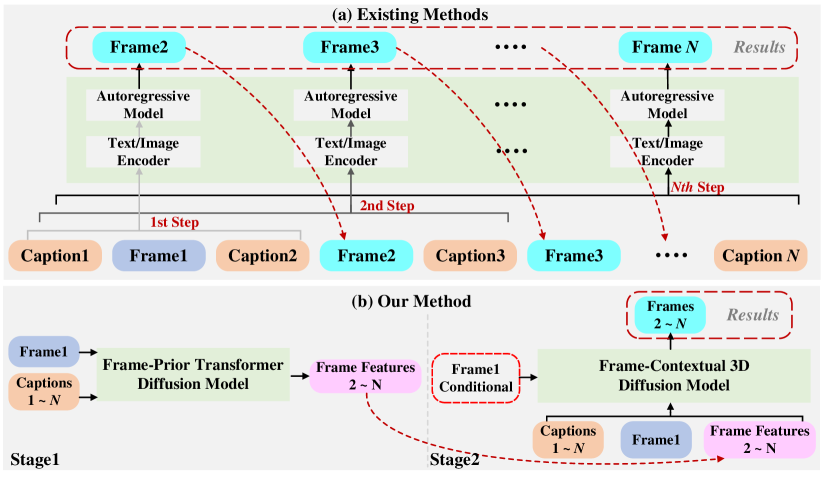
RCDMs は frame-prior トランスフォーマー拡散モデルと frame-contextual 3D 拡散モデルを組み合わせた二段階フレームワークを導入し、物語の視覚化における意味的一貫性と時間的一貫性を実現し、単一前向き推論生成を可能にします。
Recent research showcases the considerable potential of conditional diffusion models for generating consistent stories. However, current methods, which predominantly generate stories in an autoregressive and excessively caption-dependent manner, often underrate the contextual consistency and relevance of frames during sequential generation. To address this, we propose a novel Rich-contextual Conditional Diffusion Models (RCDMs), a two-stage approach designed to enhance story generation's semantic consistency and temporal consistency. Specifically, in the first stage, the frame-prior transformer diffusion model is presented to predict the frame semantic embedding of the unknown clip by aligning the semantic correlations between the captions and frames of the known clip. The second stage establishes a robust model with rich contextual conditions, including reference images of the known clip, the predicted frame semantic embedding of the unknown clip, and text embeddings of all captions. By jointly injecting these rich contextual conditions at the image and feature levels, RCDMs can generate semantic and temporal consistency stories. Moreover, RCDMs can generate consistent stories with a single forward inference compared to autoregressive models. Our qualitative and quantitative results demonstrate that our proposed RCDMs outperform in challenging scenarios. The code and model will be available at https://github.com/muzishen/RCDMs.
研究の動機と目的
- 自動回帰型ストーリービジュアル化手法における文脈的および時間的一貫性の弱点に対処する。
- 未知のクリップフレーム埋め込みを既知のフレームとキャプションから予測するフレーム-prior トランスフォーマー拡散モデルを提案する。
- フレーム埋め込みと画像レベルの豊富な文脈条件を共同で用いて整合性のあるストーリーを生成するフレーム文脈的3D拡散モデルを開発する。
- FlintstonesSV および PororoSV データセットで最先端と比較して定量的・定性的に改善を示す。
提案手法
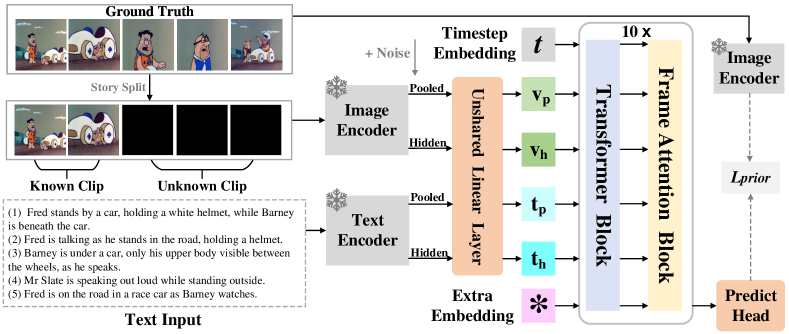
- Stage 1: Frame-prior トランスフォーマー拡散モデルは、既知のクリップフレームとすべてのキャプションを用いて未知のフレーム Semantic 埋め込みを予測する。
- Stage 2: Frame-contextual 3D 拡散モデルは、画像レベル(既知のクリップ画像)および特徴レベル(フレーム埋め込み、すべてのキャプション)の条件を用いてフレームを生成する。
- 凍結された CLIP ベースの画像エンコーダと凍結されたテキストエンコーダを使用し、フレームアテンションブロックを用いて時間的ダイナミクスを捉える。
- 画像レベルおよび特徴レベルの条件を、マルチモーダル相互作用モジュールとセマンティックスタッキングモジュールを介して注入する。
- 訓練は二段階の目的で行い、サンプリング時には分類子なしガイダンスを適用する。
実験結果
リサーチクエスチョン
- RQ1 frame-level semantic priors はストーリービジュアル化におけるフレーム間の一貫性をどのように向上させるか?
- RQ2画像レベルと特徴レベルの豊かな文脈条件付けは、キャプションのみや自己回帰法よりも意味的・時間的整合性を向上させるのか?
- RQ3二段階の RCDM は自己回帰拡散法と比べて推論の高速化または同等性を実現するか?
- RQ4各モジュール(IC, MIM, SSM, stage1 prior)が全体性能にどの程度寄与するか?
主な発見
- RCDMs は FlintstonesSV および PororoSV において他の SOTA 手法と比較して最良の FID、Char-Acc、Char-F1 を達成する。
- フレーム-prior ステージはフレーム意味的一貧性を改善し、 downstream のキャラクターおよびシーンの一貫性を高める。
- 画像レベルの条件付けとマルチモーダル相互作用モジュールは、キャプションのみのアプローチよりも結果を大幅に改善する。
- RCDMs は単一の前向き推論で一貫したストーリーを生成し、自己回帰ベースより推論速度で優れる。
- ユーザ調査により、RCDMs の視覚的質、テキスト−画像の関連性、時間的一貫性が高く評価された。
この論文を読む
Nubintのビューアで原文を開き、読みながら気になる箇所をすぐに質問できます。
Nubintでこの論文を読むこのレビューはAIが論文の原文をもとに作成しました。引用する前に原文をご確認ください。