
[論文レビュー] Building Accurate Translation-Tailored LLMs with Language Aware Instruction Tuning
本論文は、翻訳特化型LLMにおける言語指向の指示従いを向上させるための2段階微調整手法を提案する。指示と矛盾するサンプルに不確実性損失を適用することで、不要な翻訳を低減する。ゼロショット翻訳ベンチマークにおいて、不要な翻訳比率を平均53.3%削減し、SacreBLEUスコアを+5.7向上させる。
Translation-tailored Large language models (LLMs) exhibit remarkable translation capabilities, even competing with supervised-trained commercial translation systems. However, off-target translation remains an unsolved problem, especially for low-resource languages, hindering us from developing accurate LLMs-based translation models. To mitigate the off-target translation problem and enhance the performance of LLMs on translation, recent works have either designed advanced prompting strategies to highlight the functionality of translation instructions or exploited the in-context learning ability of LLMs by feeding few-shot demonstrations. However, these methods essentially do not improve LLM's ability to follow translation instructions, especially the language direction information. In this work, we design a two-stage fine-tuning algorithm to improve the instruction-following ability (especially the translation direction) of LLMs. Specifically, we first tune LLMs with the maximum likelihood estimation loss on the translation dataset to elicit the basic translation capabilities. In the second stage, we construct instruction-conflicting samples by randomly replacing the translation directions with a wrong one within the instruction, and then introduce an extra unlikelihood loss to learn those samples. Experiments on IWSLT and WMT benchmarks upon the LLaMA model spanning 16 zero-shot directions show that, compared to the competitive baseline -- translation-finetuned LLama, our method could effectively reduce the off-target translation ratio (averagely -53.3\%), thus improving translation quality with average +5.7 SacreBLEU and +16.4 BLEURT. Analysis shows that our method could preserve the model's general task performance on AlpacaEval. Code and models will be released at \url{https://github.com/alphadl/LanguageAware_Tuning}.
研究の動機と目的
- 低リソース言語を含め、ゼロショット翻訳設定における継続的な不要な翻訳問題に対処すること。
- 標準的なLLM事前学習が、指示のエンコーディングが弱いため、翻訳方向の指示を適切に従えないことの特定。
- 一般翻訳や教師あり翻訳性能を損なうことなく、LLMの指示従い能力、特に言語方向に関する能力を向上させること。
- 特に矛盾する翻訳方向に対して、モデルの指示内容への感受性を高めること。
- 不要な出力のような幻覚を低減させつつ、ゼロショットおよび教師あり翻訳方向の両方で高い性能を維持すること。
提案手法
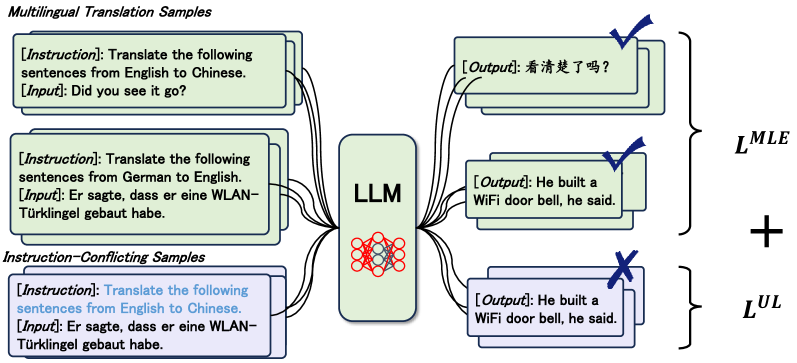
- 1段階目の微調整では、多言語翻訳データ上で最大尤度推定(MLE)を用い、LLaMAに基本的な翻訳能力を付与する。
- 2段階目の学習では、指示内の正しい翻訳方向をランダムに誤ったものに置き換えることで、指示と矛盾するサンプルを導入する。
- これらの矛盾するサンプルに対して、不確実性損失を適用し、指示と反対するシーケンスの生成を抑制する。
- 正しいサンプルにはMLE損失、矛盾するサンプルには不確実性損失を適用し、バランス調整ハイパーパrameter α を用いて同時に学習する。
- 生成時に指示トークンに重点を置くことで、モデルが言語方向の手がかりにより敏感になるようにする。
- 本手法はLLaMAに適用され、IWSLTおよびWMTベンチマークを用い、16のゼロショット翻訳方向で評価された。
実験結果
リサーチクエスチョン
- RQ1標準的な指示微調整は、ゼロショット設定においてLLMが翻訳方向の指示を正しく従うのをどの程度失敗するのか?
- RQ2指示と矛盾するサンプルに対して不確実性学習を導入することで、モデルの不要な翻訳回避能力が向上するか?
- RQ3提案手法は、教師あり翻訳方向または一般の指示従いタスクの性能を低下させるのか?
- RQ4本手法は、多様な低リソース言語およびゼロショット言語対において、不要な翻訳比率の低減にどの程度有効か?
- RQ5不確実性損失機構は、多言語翻訳タスクにおける指示従いの向上に効果的に適応可能か?
主な発見
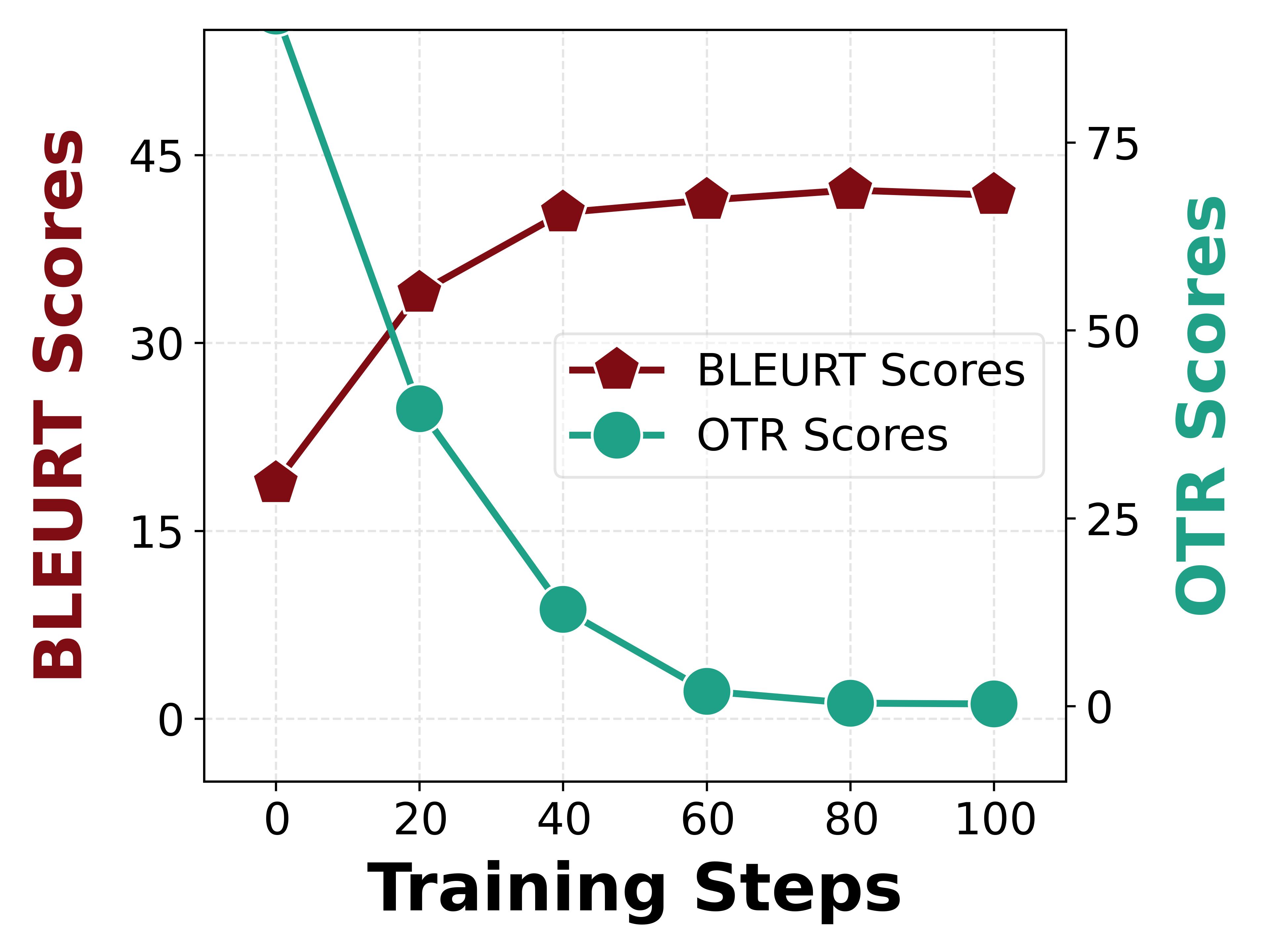
- 16のゼロショット翻訳方向全体で、平均して不要な翻訳比率が53.3%削減され、IWSLTでは-92.2%、WMTでは-29.9%の削減を達成した。
- ベンチマーク全体で、SacreBLEUスコアが平均+5.7、BLEURTスコアが+16.4向上した。IWSLTではBLEURTが+23.0、WMTでは+12.4向上し、SacreBLEUではIWSLTで+5.2、WMTで+6.1向上した。
- 教師あり翻訳方向でも高い性能を維持しており、ドメイン内能力に劣化がないことが示された。
- 安定したAlpacaEvalスコアから、一般の指示従い能力が保持されており、広範なタスクに悪影響を与えないことが示された。
- 低リソース言語を含む多様な言語対においてもロバストで、特にDe→Frのような困難なケースでも一貫した改善が得られた。
- 不確実性損失は、誤った翻訳方向を指定する指示に対して、その矛盾するシーケンスの生成を効果的に抑制した。
この論文を読む
Nubintのビューアで原文を開き、読みながら気になる箇所をすぐに質問できます。
Nubintでこの論文を読むこのレビューはAIが論文の原文をもとに作成しました。引用する前に原文をご確認ください。