
[論文レビュー] Can neutrino-assisted early dark energy models ameliorate the $H_0$ tension in a natural way?
本稿は、ハッブル緊張を解消するためのニュートリノ支援型初期ダークエネルギー(νEDE)モデルを調査し、スカラー場とニュートリノの結合が物質-放射均衡時に自然にEDEを誘発する可能性を提案する。ニュートリノの遷移に起因するEDEエネルギー密度の特徴を生成したが、検討されたパラメータ範囲ではEDE割合が十分に大きくならず($f_{\text{EDE}} \approx 10\%$)、この実装における自然性の限界が示された。
The idea of neutrino-assisted early dark energy ($ν$EDE), where a coupling between neutrinos and the scalar field that models early dark energy (EDE) is considered, was introduced with the aim of reducing some of the fine-tuning and coincidence problems that appear in usual EDE models. In order to be relevant in ameliorating the $H_0$ tension, the contribution of EDE to the total energy density ($f_ ext{EDE}$) should be around 10\% near the redshift of matter-radiation equality. We verify under which conditions $ν$EDE models can fulfill these requirements for a model with a quartic self-coupling of the EDE field and an exponential coupling to neutrinos. We find that in the situation where the EDE field is frozen initially, the contribution to $f_ ext{EDE}$ can be significant but it is not sensitive to the neutrino-EDE coupling and does not address the EDE coincidence problem. On the other hand, if the EDE field starts already dynamical at the minimum of the effective potential, it tracks this time-dependent minimum that presents a feature triggered by the neutrino transition from relativistic to nonrelativistic particles. This feature generates $f_ ext{EDE}$ in a natural way at around this transition epoch, that roughly coincides with the matter-radiation equality redshift. For the set of parameters that we considered we did not find values that satisfy the requirements on the background cosmological evolution to mitigate the Hubble tension in a natural way in this particular $ν$EDE model.
研究の動機と目的
- ニュートリノ支援型初期ダークエネルギー(νEDE)モデルが、初期条件の微調整なしにハッブル緊張を自然に緩和できるかを評価すること。
- ニュートリノが相対論的から非相対論的状態に遷移する過程が、物質-放射均衡赤方偏移($z \sim 3.5$)で自然にEDEを誘発できるかを調査すること。
- EDEスカラー場とニュートリノの結合が、ハッブル緊張を緩和するために必要な大きさでかつ適切なタイミングでのエネルギー密度寄与($f_{\text{EDE}} \approx 10\%$)をもたらすかを特定すること。
- EDE場が初期に凍結されている場合と、有効ポテンシャルの最小値から始まる場合の2つの初期条件シナリオを比較すること。
- CAMBを用いて背景レベルでのモデルの妥当性を評価し、$f_{\text{EDE}}$の時間発展とニュートリノ-EDE結合の役割に注目すること。
提案手法
- CAMBを用いて背景レベルでνEDEモデルを実装し、四次自己結合ポテンシャル($V \propto \phi^4$)と指数関数的ニュートリノ結合($A(\phi) = \exp(\beta\phi/M_{\text{Pl}})$)を用いた。
- アインシュタイン座標系におけるスカラー場の時間発展方程式を解き、有効ポテンシャルの時間依存最小値を追跡することで、場のダイナミクスをモデル化した。
- 2つの初期条件のレジームを分析した:(1) ヒューブル摩擦により任意の初期値で場が凍結されている状態、(2) 有効ポテンシャルの最小値から場が開始されている状態。
- $f_{\text{EDE}}$と偏差パラメータ$\Delta$を計算し、ニュートリノ-EDE結合の影響を定量化した。
- 解析的近似(式20)を用いて$f_{\text{EDE}}$を予測し、数値結果と比較した。
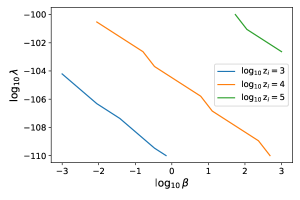
- パラメータスキャンを実施し、$\beta$(結合強度)と$\lambda$(自己結合)が$f_{\text{EDE}}$に与える感度を評価した。なお、他の宇宙論的パラメータは固定した。
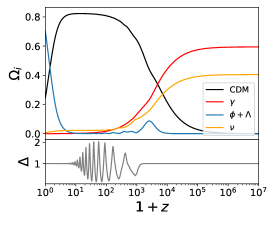
実験結果
リサーチクエスチョン
- RQ1ニュートリノが相対論的から非相対論的状態に遷移する過程が、物質-放射均衡期に自然にEDE場を誘発できるか?
- RQ2νEDEモデルが$z \sim 3.5$でハッブル緊張を緩和するために必要な$ f_{\text{EDE}} \approx 10\% $の大きさを十分に達成できるか?
- RQ3場が有効ポテンシャルの最小値から開始される場合、νEDEモデルはEDEの一致問題を解消できるか?
- RQ4場の最小値からの初期条件シナリオにおいて、ニュートリノ-EDE結合($\beta$)が$f_{\text{EDE}}$の時間発展に与える影響は?
- RQ5初期場の値やスカラー場パラメータの微調整なしに、モデルが顕著な$f_{\text{EDE}}$を達成できるか?
主な発見
- EDE場が初期に任意の値で凍結されている場合、$f_{\text{EDE}}$は宇宙論的に有意なレベルに達するが、これはニュートリノ-EDE結合に依存せず、EDEの一致問題を解消しない。
- 場が有効ポテンシャルの最小値から開始される場合、場は時間依存最小値に自然に従い、ニュートリノ遷移に起因して$z \sim 3.5$で$f_{\text{EDE}}$のピークが発生する。これは解析的に予測された通りである。
- ニュートリノ-EDE結合は、最小値からの初期条件シナリオにおいて非小な役割を果たしており、図7に示すように$f_{\text{EDE}}$は$\beta$に強く依存する。
- 結合の影響にもかかわらず、最小値からの初期条件シナリオで達成可能な最大$f_{\text{EDE}}$は、ハッブル緊張を緩和するための$ f_{\text{EDE}} \approx 10\% $の要件を満たさない。
- 自己結合$\lambda$を大きくして$f_{\text{EDE}}$を増加させても、場が長く凍結した状態に陥り、結果として第一の(自然でない)初期条件レジームに移行してしまう。
- 大きな結合($\beta = 1000$)でさえも、顕著な$f_{\text{EDE}}$を生成できないため、この特定のνEDE実装には根本的な制限があることが示された。
この論文を読む
Nubintのビューアで原文を開き、読みながら気になる箇所をすぐに質問できます。
Nubintでこの論文を読むこのレビューはAIが論文の原文をもとに作成しました。引用する前に原文をご確認ください。