
[論文レビュー] CDA: Contrastive-adversarial Domain Adaptation
本稿では、ドメインレベルの整合性を図る adversarial learning とクラスレベルの凝縮性・分離性を高める contrastive learning を組み合わせることで、自己教師ありドメイン適応を向上させる二段階型の対照的・敵対的ドメイン適応フレームワーク、CDA を提案する。CDA は、クラス内凝縮性と明確に分離された意思決定境界を向上させることで、Office-31 および Digits-5 で最先端の性能を達成し、DANN よりも最大で11%の精度向上を実現した。
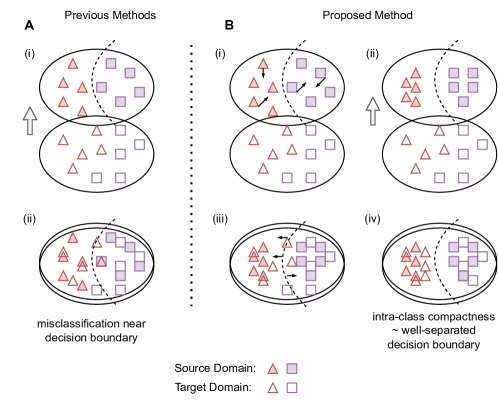
Recent advances in domain adaptation reveal that adversarial learning on deep neural networks can learn domain invariant features to reduce the shift between source and target domains. While such adversarial approaches achieve domain-level alignment, they ignore the class (label) shift. When class-conditional data distributions are significantly different between the source and target domain, it can generate ambiguous features near class boundaries that are more likely to be misclassified. In this work, we propose a two-stage model for domain adaptation called extbf{C}ontrastive-adversarial extbf{D}omain extbf{A}daptation extbf{(CDA)}. While the adversarial component facilitates domain-level alignment, two-stage contrastive learning exploits class information to achieve higher intra-class compactness across domains resulting in well-separated decision boundaries. Furthermore, the proposed contrastive framework is designed as a plug-and-play module that can be easily embedded with existing adversarial methods for domain adaptation. We conduct experiments on two widely used benchmark datasets for domain adaptation, namely, extit{Office-31} and extit{Digits-5}, and demonstrate that CDA achieves state-of-the-art results on both datasets.
研究の動機と目的
- 教師ありドメイン適応の限界である、ソースドメインとターゲットドメイン間のクラス条件付き分布シフトを扱うこと。
- ドメインレベルの整合性を超えてクラスレベルの整合性を達成することで、意思決定境界の明確さを向上させること。
- 既存の敵対的ドメイン適応手法に容易に統合可能な、プラグアンドプレイ型の対照的モジュールを設計すること。
- ドメインとクラスレベルの整合性を統合的に実現することで、Office-31 や Digits-5 といったベンチマークデータセットで最先端の性能を達成すること。
提案手法
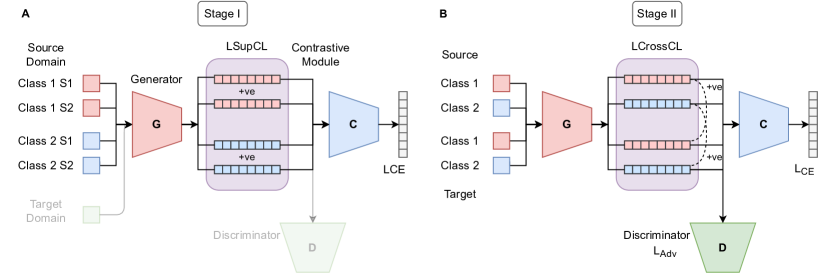
- CDA は二段階の訓練プロセスを採用する:最初の段階では、ラベル付きソースドメイン上で教師あり対照的学習を実施し、クラス内凝縮性とクラス間分離性を向上させる。
- 二段階目では、ドメイン識別器がソース特徴とターゲット特徴を区別できるようにすることで、全体的なドメイン分布の整合性を図る敵対的学習を実行する。
- クロスドメインの対照的損失を導入し、ソースドメインとターゲットドメインの同クラス特徴を近づけつつ、異クラス特徴を遠ざける。
- 教師あり対照的損失、敵対的損失、クロスドメイン対照的損失の複数の損失成分を統合的に最適化し、エンドツーエンドで学習を実行する。
- 対照的モジュールはプラグイン型に設計されており、アーキテクチャの大幅な見直しを伴わずに、既存の敵対的ドメイン適応モデルに統合可能である。
- 特徴生成器として、ImageNet で事前学習された ResNet-50 ベースを採用し、分類器とドメイン識別器のヘッドを別々に設ける。
実験結果
リサーチクエスチョン
- RQ1対照的学習は、ドメインレベルの整合性を超えて、自己教師ありドメイン適応におけるクラスレベルの整合性を向上させることができるか?
- RQ2対照的学習と敵対的学習の二段階訓練戦略が、ターゲットドメインにおける意思決定境界の品質と一般化性能に与える影響は何か?
- RQ3提案された対照的モジュールを既存の敵対的ドメイン適応フレームワークに追加した場合、性能向上はどの程度実現できるか?
- RQ4対照的学習と敵対的学習の組み合わせは、Office-31 や Digits-5 のような標準ベンチマークでより優れた一般化性能をもたらすか?
主な発見
- CDA は Office-31 データセットで平均89.9%の最先端精度を達成し、DANN や MADA、CDAN といった先行手法を上回った。
- Digits-5 ベンチマークでは、SVHN → MNIST で96.8%、MNIST → USPS で97.4%、MNIST → MNIST-M で96.6%の精度を達成し、すべてのベースラインを上回った。
- DANN と比較して、CDA は Office-31 で約9%、Digits-5 で11%の平均精度向上を達成し、対照的モジュールの有効性を示した。
- t-SNE ビジュアライゼーションの結果、CDA は特にクラス境界付近で、DANN よりもより明確に分離されたクラス判別性の高い埋め込みを生成した。
- アブレーションスタディの結果、対照的モジュールがクラス間分離性とクロスドメイン整合性を向上させることで、性能が顕著に向上することが確認された。
- 対照的モジュールのプラグアンドプレイ設計により、既存の敵対的手法に容易に統合可能であり、最小限の変更で性能向上が実現可能であることが示された。
この論文を読む
Nubintのビューアで原文を開き、読みながら気になる箇所をすぐに質問できます。
Nubintでこの論文を読むこのレビューはAIが論文の原文をもとに作成しました。引用する前に原文をご確認ください。