
[論文レビュー] CFR-ICL: Cascade-Forward Refinement with Iterative Click Loss for Interactive Image Segmentation
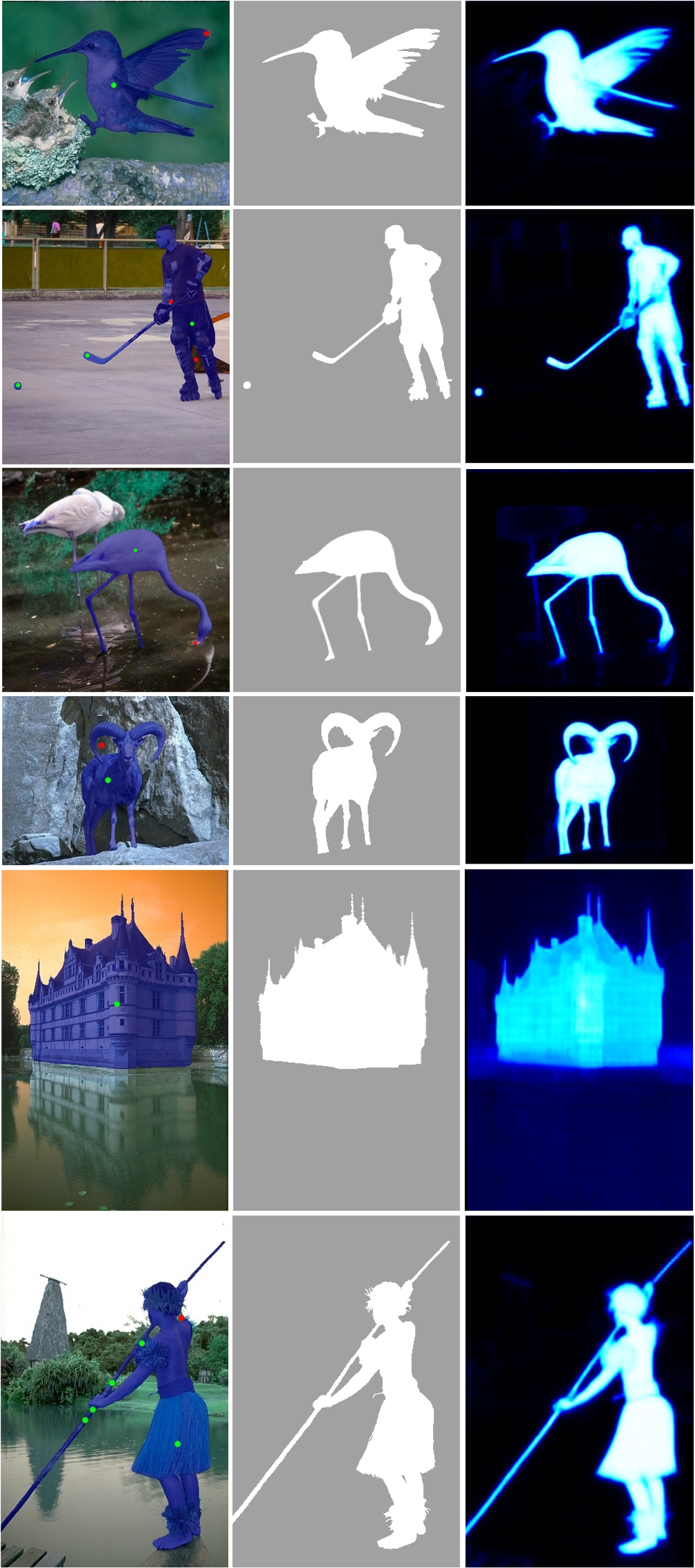
本稿では、統合的推論のためのカスケードフォワードリファインメント(CFR)、少ないユーザークリックで訓練するためのイテレーティブクリック損失(ICL)、およびトレーニングの多様性を高めるためのSUEMコピーピースト補強を統合した、新しいインタラクティブ画像セグメンテーションフレームワーク CFR-ICL を提案する。本手法は、最先端の性能を達成し、Berkeley では平均クリック数を 33.2% 減少(95% IoU 時)、DAVIS では 15.5% 減少(95% IoU 時)した。
The click-based interactive segmentation aims to extract the object of interest from an image with the guidance of user clicks. Recent work has achieved great overall performance by employing feedback from the output. However, in most state-of-the-art approaches, 1) the inference stage involves inflexible heuristic rules and requires a separate refinement model, and 2) the number of user clicks and model performance cannot be balanced. To address the challenges, we propose a click-based and mask-guided interactive image segmentation framework containing three novel components: Cascade-Forward Refinement (CFR), Iterative Click Loss (ICL), and SUEM image augmentation. The CFR offers a unified inference framework to generate segmentation results in a coarse-to-fine manner. The proposed ICL allows model training to improve segmentation and reduce user interactions simultaneously. The proposed SUEM augmentation is a comprehensive way to create large and diverse training sets for interactive image segmentation. Extensive experiments demonstrate the state-of-the-art performance of the proposed approach on five public datasets. Remarkably, our model reduces by 33.2\%, and 15.5\% the number of clicks required to surpass an IoU of 0.95 in the previous state-of-the-art approach on the Berkeley and DAVIS sets, respectively.
研究の動機と目的
- クリックベースのインタラクティブセグメンテーションにおける、セグメンテーション品質とユーザーインタラクションコストのバランスを改善すること。
- ヒューリスティックルールや分離されたリファインメントモデルに依存せずに、リファインメントプロセスを統合すること。
- インタラクティブセグメンテーションに特化した新しいデータ補強戦略を通じて、トレーニング効率とモデル一般化性能を向上させること。
- トレーニング中に必要なユーザークリック数を明示的に最小化するエンドツーエンド学習を可能とすること。
- 段階的なセグメンテーション詳細の向上を可能にする柔軟で統合的な推論フレームワークの開発
提案手法
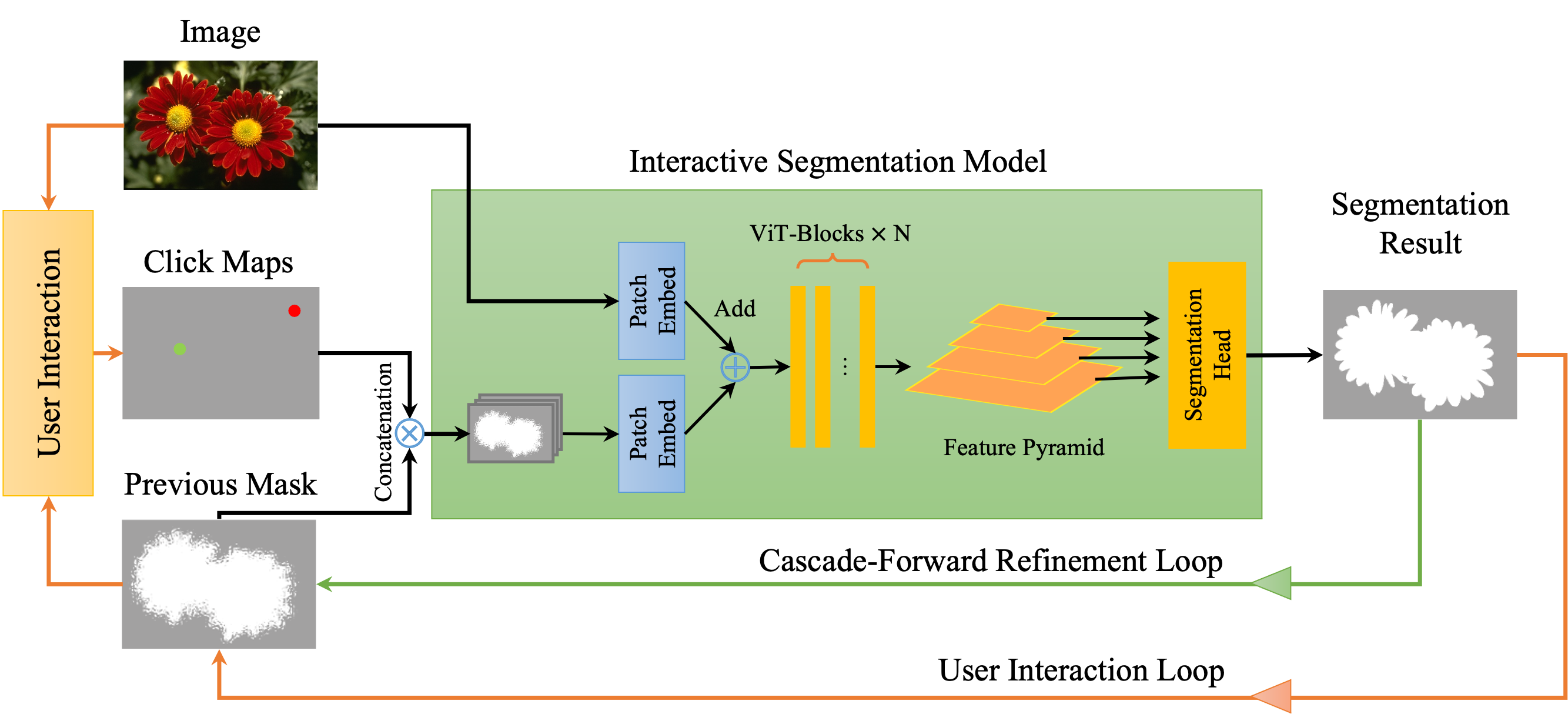
- 以前の出力を用いて粗くから細かくまで段階的にマスクをリファインする二重ループのイテレーティブ推論機構であるカスケードフォワードリファインメント(CFR)を導入。
- クリック回数と順序をトレーニング中に符号化する新しい損失関数であるイテレーティブクリック損失(ICL)を提案。
- SUEMコピーピースト補強を設計。トレーニングセットの多様性とサイズを高めるために4つのバリエーションを備えた包括的なデータ補強戦略。
- SBD および C+L データセットで ICL と SUEM を用いて微調整した ViT-Huge バックボーンを採用し、最適なパフォーマンスを実現。
- 計算効率と高い性能を兼ね備えるため、実際の応用では CFR-1 推論(1ステップリファインメント)を採用。
- A-CFR では、改善量が 20 ピxls 未満に下がった際に動的にリファインメントを停止するしきい値ベースの適応的終了機構を適用。
実験結果
リサーチクエスチョン
- RQ1統合的推論フレームワークは、ヒューリスティックルールや別個のリファインメントモデルに依存せずに、セグメンテーション品質を向上させることができるか?
- RQ2トレーニング中にクリック回数と順序を符号化する損失関数は、高精度なセグメンテーションに必要なユーザークリック数を削減できるか?
- RQ3SUEMコピーピーストのような包括的なデータ補強戦略は、インタラクティブセグメンテーションにおけるモデル一般化性能を顕著に向上させるか?
- RQ4ICL、CFR、SUEM の組み合わせが、多様なベンチマークで最先端のパフォーマンスを達成できるか?
- RQ5本手法は、既存のイテレーティブマスクガイドドおよび推論時最適化アプローチと比較して、効率性と正確性の両面で優れているか?
主な発見
- 提案された CFR-1 推論方式は、Berkeley データセットで 95% IoU 時に平均 2.9 クリックで優れた性能を達成し、前回の最先端手法比で 33.2% の改善を示した。
- DAVIS データセットでは、95% IoU 時に平均クリック数を 7.5 回に削減し、前回の最良結果比で 15.5% の改善を達成した。
- イテレーティブクリック損失(ICL)により、ユーザークリック数を明示的に最小化するトレーニングが可能となり、低インタラクション環境でのモデルの好ましさが向上した。
- SUEM コピーピースト補強は、GrabCut、Berkeley、DAVIS データセットで顕著な性能向上をもたらし、データ多様性とモデル一般化性能への有効性を示した。
- A-CFR-4 は、変化が微小になると動的にリファインメントを停止するため、CFR-4 よりも優れた性能を示し、動的停止の利点を実証した。
- CFR-ICL フレームワーク全体は、SBD、DAVIS、PascalVOC、Berkeley、GrabCut の5つの公開データセットで、すべてにおいて最先端のパフォーマンスを達成した。
この論文を読む
Nubintのビューアで原文を開き、読みながら気になる箇所をすぐに質問できます。
Nubintでこの論文を読むこのレビューはAIが論文の原文をもとに作成しました。引用する前に原文をご確認ください。