
[論文レビュー] Chain-of-Note: Enhancing Robustness in Retrieval-Augmented Language Models
Chain-of-Note (CoN) は retrieved documents の逐次読み取りノートを追加し、retrieval-augmented language models のノイズと未知のクエリに対する堅牢性を向上させ、オープンドメインベンチマーク全体で QA 性能を向上させる。
Retrieval-augmented language models (RALMs) represent a substantial advancement in the capabilities of large language models, notably in reducing factual hallucination by leveraging external knowledge sources. However, the reliability of the retrieved information is not always guaranteed. The retrieval of irrelevant data can lead to misguided responses, and potentially causing the model to overlook its inherent knowledge, even when it possesses adequate information to address the query. Moreover, standard RALMs often struggle to assess whether they possess adequate knowledge, both intrinsic and retrieved, to provide an accurate answer. In situations where knowledge is lacking, these systems should ideally respond with "unknown" when the answer is unattainable. In response to these challenges, we introduces Chain-of-Noting (CoN), a novel approach aimed at improving the robustness of RALMs in facing noisy, irrelevant documents and in handling unknown scenarios. The core idea of CoN is to generate sequential reading notes for retrieved documents, enabling a thorough evaluation of their relevance to the given question and integrating this information to formulate the final answer. We employed ChatGPT to create training data for CoN, which was subsequently trained on an LLaMa-2 7B model. Our experiments across four open-domain QA benchmarks show that RALMs equipped with CoN significantly outperform standard RALMs. Notably, CoN achieves an average improvement of +7.9 in EM score given entirely noisy retrieved documents and +10.5 in rejection rates for real-time questions that fall outside the pre-training knowledge scope.
研究の動機と目的
- Motivate robustness issues in retrieval-augmented language models (RALMs) due to noisy or irrelevant retrieved documents and unknown information.
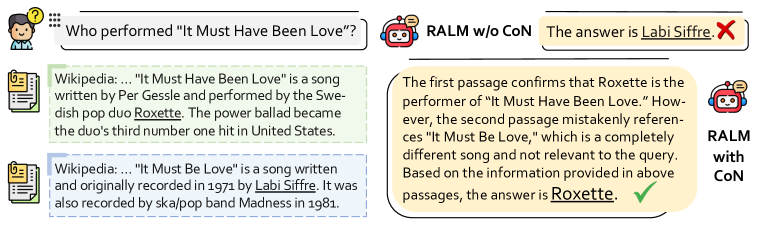
- Propose Chain-of-Note (CoN) to generate sequential reading notes for each retrieved document to assess relevance and filter content.
- Demonstrate through experiments that CoN improves QA performance and robustness on open-domain benchmarks (NQ, TriviaQA, WebQ, RealTimeQA).
- Showcase data collection via ChatGPT-generated notes and training of a LLaMa-2 7B model with weighted loss on notes and final answers.
提案手法
- Introduce Chain-of-Note (CoN) framework that generates sequential reading notes for each retrieved document.
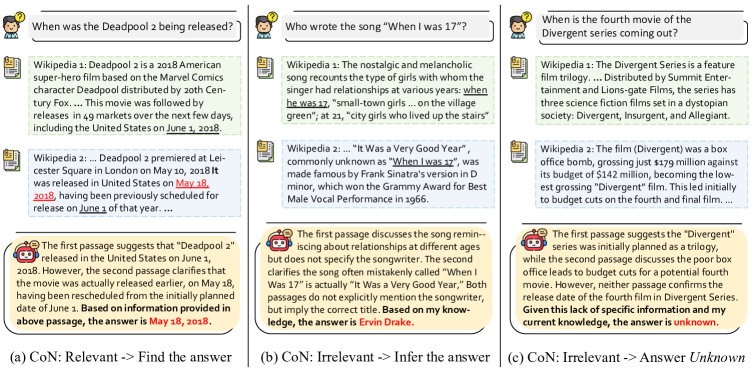
- Design three note types: direct-answer notes, contextual notes, and unknown notes (leading to 'unknown' responses when appropriate).
- Create training data by prompting ChatGPT on 10k NQ-derived questions and fine-tune a LLaMa-2 7B model to generate notes and final answers.
- Train with a weighted loss strategy that alternates focus between notes and final answers to balance information richness and answer accuracy.
実験結果
リサーチクエスチョン
- RQ1Can CoN improve overall QA performance of DPR-retrieved RALMs on open-domain benchmarks?
- RQ2Does CoN enhance robustness to noise by filtering irrelevant or misleading retrieved content?
- RQ3Does CoN improve the model’s ability to reject questions outside its knowledge scope (unknown robustness)?
- RQ4How does CoN perform across in-domain and out-of-domain datasets (NQ, TriviaQA, WebQ, RealTimeQA)?
主な発見
- CoN outperforms standard RALMs across three open-domain QA datasets, with an average EM improvement of +1.97 over baseline DPR+LLaMa-2.
- CoN yields a +7.9 average EM improvement under fully noisy retrieved documents across NQ, TriviaQA, and WebQ.
- CoN substantially increases reject rate (RR) by +10.5 on RealTimeQA, indicating stronger unknown robustness.
- In ablations, CoN shows greater gains when DPR retrieves irrelevant or noisy documents (e.g., +2.3 EM on NQ when relevant docs are missing).
- Case studies illustrate CoN’s ability to synthesize cross-document evidence, improving correctness in questions where surface cues mislead standard RALMs
この論文を読む
Nubintのビューアで原文を開き、読みながら気になる箇所をすぐに質問できます。
Nubintでこの論文を読むこのレビューはAIが論文の原文をもとに作成しました。引用する前に原文をご確認ください。