
[論文レビュー] Circumstellar interaction signatures in the low luminosity type II SN 2021gmj
本研究では、低光度Type II超新星SN 2021gmjの多波長観測を通じて、初期光曲線のずれと高イオン化状態の発光線から、周囲星間物質との相互作用を明らかにした。流体力学的モデリングと分光解析により、CSM質量は0.025 M☉、前身星質量は約10 M☉、中程度の爆発エネルギーであることが示され、このような相互作用の痕跡が低光度SNe IIにおいて一般的である可能性が示唆された。
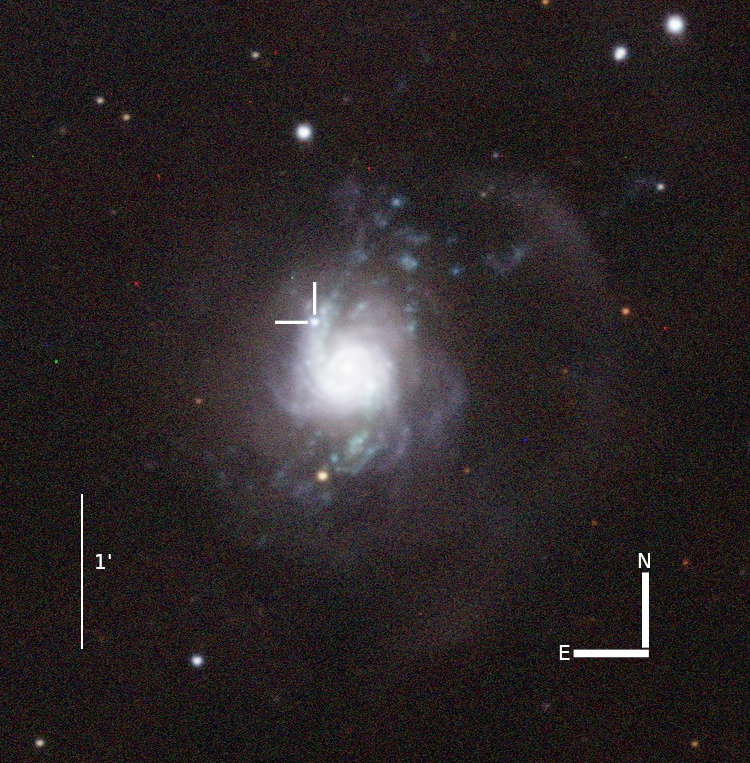
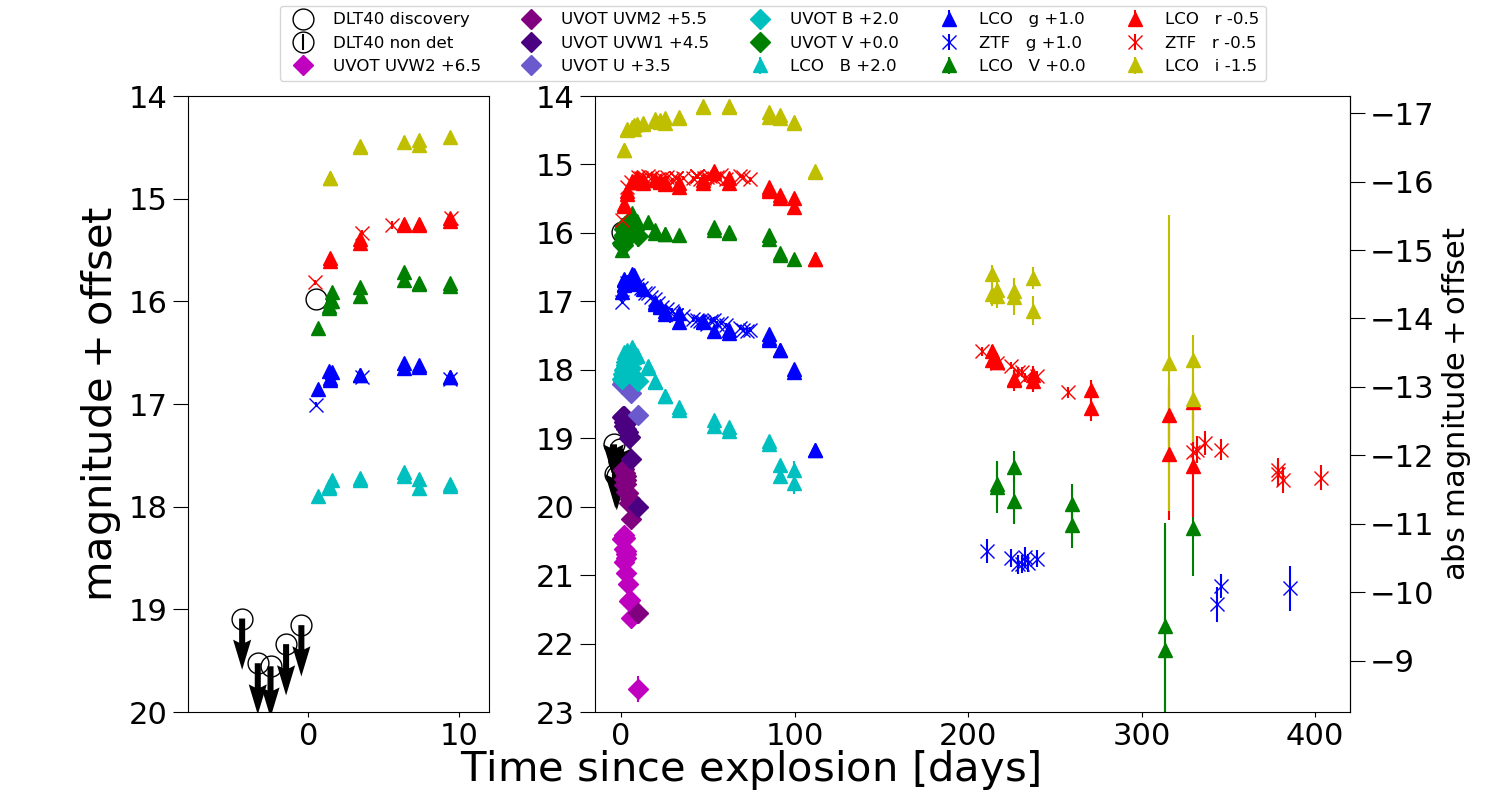
We present comprehensive optical observations of SN~2021gmj, a Type II supernova (SN~II) discovered within a day of explosion by the Distance Less Than 40~Mpc (DLT40) survey. Follow-up observations show that SN~2021gmj is a low-luminosity SN~II (LL~SN~II), with a peak magnitude $M_V = -15.45$ and Fe~II velocity of $\sim 1800 \ \mathrm{km} \ \mathrm{s}^{-1}$ at 50 days past explosion. Using the expanding photosphere method, we derive a distance of $17.8^{+0.6}_{-0.4}$~Mpc. From the tail of the light curve we obtain a radioactive nickel mass of $0.014 \pm 0.001$ M$_{\odot}$. The presence of circumstellar material (CSM) is suggested by the early-time light curve, early spectra, and high-velocity H$α$ in absorption. Analytical shock-cooling models of the light curve cannot reproduce the fast rise, supporting the idea that the early-time emission is partially powered by the interaction of the SN ejecta and CSM. The inferred low CSM mass of 0.025 M$_{\odot}$ in our hydrodynamic-modeling light curve analysis is also consistent with our spectroscopy. We observe a broad feature near 4600 Å, which may be high-ionization lines of C, N, or/and He~II. This feature is reproduced by radiation-hydrodynamic simulations of red supergiants with extended atmospheres. Several LL~SNe~II show similar spectral features, implying that high-density material around the progenitor may be common among them.
研究の動機と目的
- 低光度Type II超新星SN 2021gmjの光度的および分光的進化を特徴づけること。
- 光曲線および分光的解析を通じて、前身星の周囲に存在する周囲星間物質(CSM)の存在と性質を調査すること。
- 流体力学的モデリングおよび拡張光球面法を用いて、前身星質量、爆発エネルギー、⁵⁶Ni質量を特定すること。
- スペクトルに見られる高イオン化状態の発光特徴が、低光度SNe IIにおいて広範なCSM相互作用を示唆するものかどうかを検討すること。
提案手法
- 初期衝撃冷却およびプラトー期をモデリングするため、DLT40、Keck、MMT、Las Cumbres Observatoryを含む複数の観測所からの光度曲線を収集した。
- LRIS、DEIMOS、Binospec、FLOYDS機器からの分光データを用いて、高イオン化線を特定し、ドップラー速度のずれを測定した。
- Vバンドの明るさと光球面温度を用いて、拡張光球面法を適用し、距離を17.8⁺⁰.⁶₋₀.⁴ Mpcと導出した。
- 光曲線の尾部から⁵⁶Ni質量を推定し、M₅₆Ni = 0.014 ± 0.001 M☉の結果を得た。
- SNECを用いた流体力学的モデリングにより、定常状態の風によるCSMを仮定して光曲線にフィットさせ、CSM質量および爆発エネルギーを推定した。
- 拡張大気を持つ赤超巨星の放射流体力学的シミュレーションを、4600 Å付近の広帯域特徴の起源を解釈するために比較した。
実験結果
リサーチクエスチョン
- RQ1SN 2021gmjの前身星を取り巻く周囲星間物質(CSM)の性質と質量は何か?
- RQ2SN 2021gmjの初期光曲線は、標準的な衝撃冷却モデルからどのようにずれているか? これはエネルギー源に何を示唆するか?
- RQ34600 Å付近の広帯域発光特徴の原因は何か? これはC、N、またはHe IIの高イオン化線と整合的か?
- RQ4低光度Type II超新星において、CSM相互作用の痕跡が一般的に見られるか?
- RQ5SN 2021gmjの前身星質量および爆発エネルギーは何か? そして、標準モデルと比較してどう異なるか?
主な発見
- SN 2021gmjのピークVバンド明るさはMV = -15.45であり、これは低光度Type II超新星に分類される。
- 爆発中に生成された⁵⁶Ni質量は0.014 ± 0.001 M☉であり、低エネルギー・中程度質量の前身星モデルと整合的である。
- SN 2021gmjまでの距離は、拡張光球面法を用いて17.8⁺⁰.⁶₋₀.⁴ Mpcと導出された。
- 初期光曲線モデリングにより、標準的な衝撃冷却とは一致しない急激な上昇が示され、CSM相互作用によるエネルギー供給を支持する。
- 流体力学的モデリングにより、CSM質量は0.025 M☉、爆発エネルギーは0.294 foe(10 M☉の前身星を想定)と得られた。
- 4600 Å付近の広帯域特徴は、C、N、He IIの高イオン化線の可能性の高い混合物であると特定され、拡張赤超巨星とCSMを伴う放射流体力学的シミュレーションと整合的であった。
この論文を読む
Nubintのビューアで原文を開き、読みながら気になる箇所をすぐに質問できます。
Nubintでこの論文を読むこのレビューはAIが論文の原文をもとに作成しました。引用する前に原文をご確認ください。