
[論文レビュー] Citation-Enhanced Generation for LLM-based Chatbots
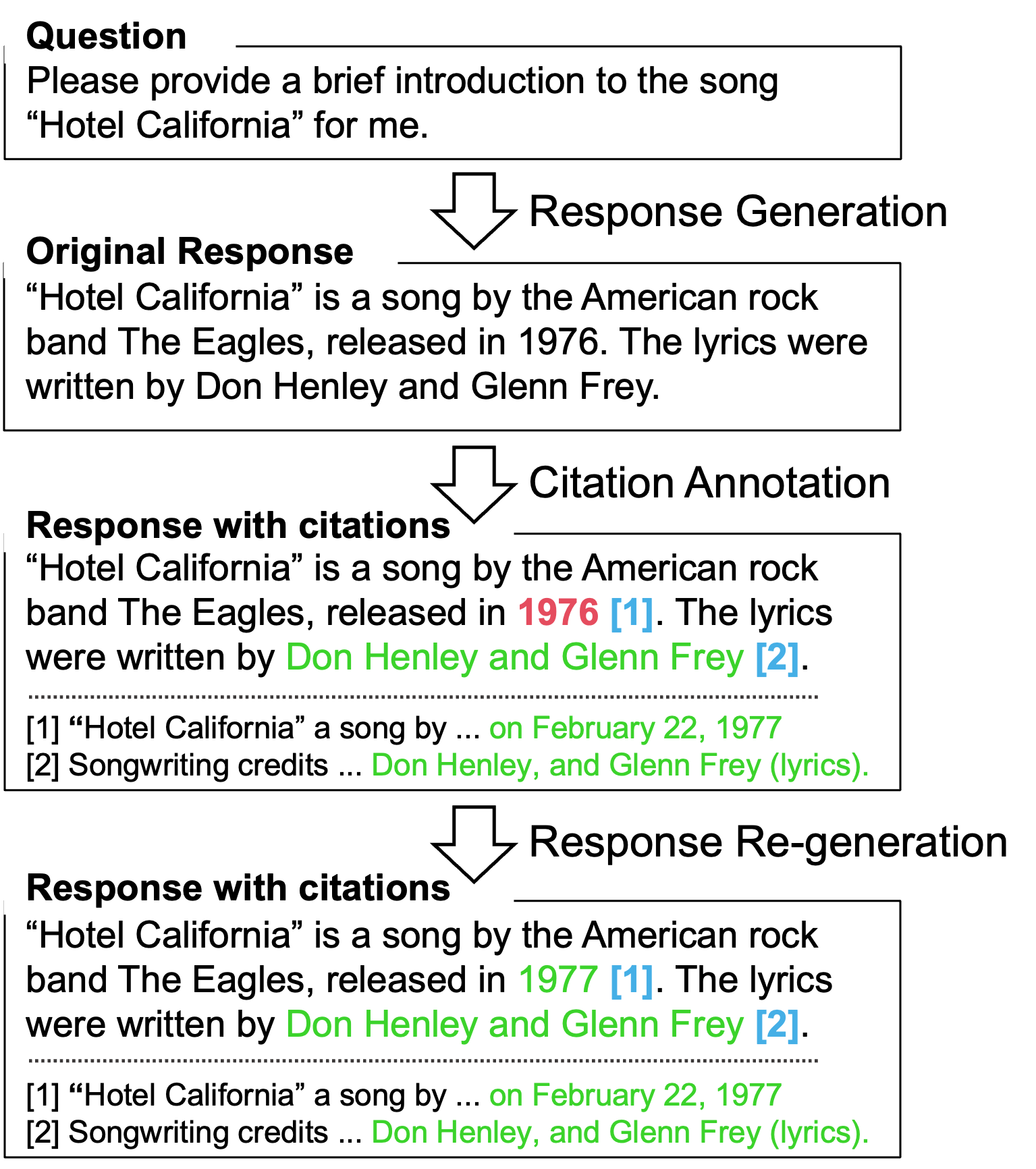
本稿では、訓練不要で後処理型のフレームワークである Citation-Enhanced Generation (CEG) を提案する。この手法は、関連文書を検索し、自然言語推論 (NLI) を用いて引用を生成することで、大規模言語モデル(LLM)ベースのチャットボットにおける幻覚を低減する。主張に引用がない場合、再生成を行うことで、微調整やデータアノテーションを必要とせず、3つの幻覚ベンチマークで最先端の性能を達成する。
Large language models (LLMs) exhibit powerful general intelligence across diverse scenarios, including their integration into chatbots. However, a vital challenge of LLM-based chatbots is that they may produce hallucinated content in responses, which significantly limits their applicability. Various efforts have been made to alleviate hallucination, such as retrieval augmented generation and reinforcement learning with human feedback, but most of them require additional training and data annotation. In this paper, we propose a novel post-hoc Citation-Enhanced Generation (CEG) approach combined with retrieval argumentation. Unlike previous studies that focus on preventing hallucinations during generation, our method addresses this issue in a post-hoc way. It incorporates a retrieval module to search for supporting documents relevant to the generated content, and employs a natural language inference-based citation generation module. Once the statements in the generated content lack of reference, our model can regenerate responses until all statements are supported by citations. Note that our method is a training-free plug-and-play plugin that is capable of various LLMs. Experiments on various hallucination-related datasets show our framework outperforms state-of-the-art methods in both hallucination detection and response regeneration on three benchmarks. Our codes and dataset will be publicly available.
研究の動機と目的
- 微調整や追加のデータアノテーションを必要とせずに、LLMベースのチャットボットにおける幻覚を軽減すること。
- さまざまな事前学習済みLLMと互換性がある柔軟で即挿し可能なソリューションを開発すること。
- 未支持の主張を検出し、引用を含む再生成により、事実の整合性を向上させること。
- 後処理検証パイプラインにおける検索モジュールとNLIモジュールの有効性を評価すること。
提案手法
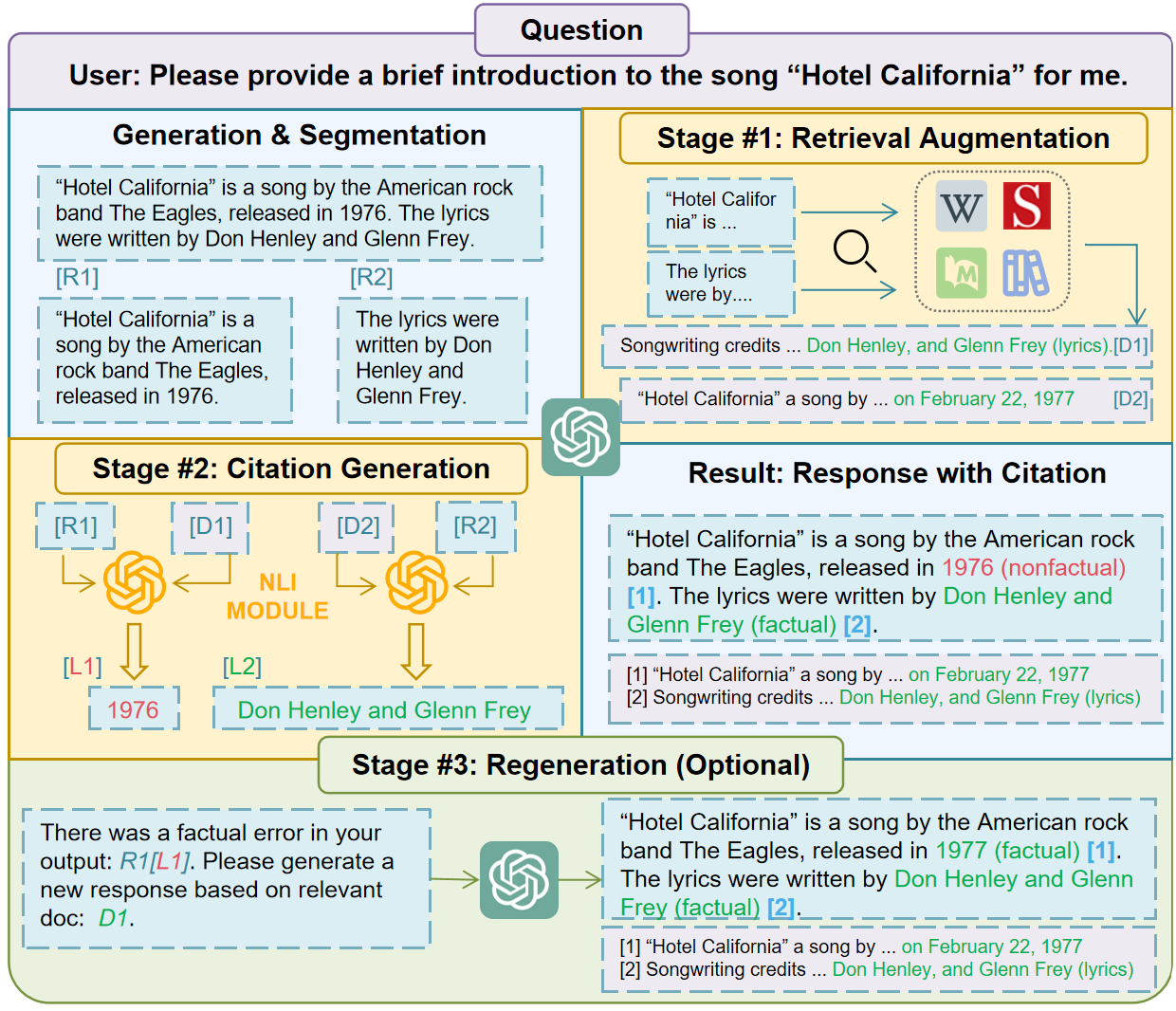
- 後処理型の検索モジュールは、密な検索モデル(例:SimCSE-BERT)を用いて、生成されたコンテンツをサポートする関連文書を検索する。
- NLIに基づく引用生成モジュールは、LLMの出力内の主張が検索された文書によって支持されているかどうかを検証する。
- 支持されていない主張が検出された場合、モデルはLLMに引用フィードバックを提示して出力を再生成するようプロンプトする。
- フレームワークはプラグインとして動作し、モデルの微調整やアーキテクチャの変更を一切必要としない。
- 効率性と有効性のバランスを考慮し、上位k件のドキュメント(k ≈ 5–6)を用いる。
- 主張と検索された証拠の間の含意関係を評価するために、GPT-4 や GPT-3.5-Turbo-Instruct などのNLIモデルが使用される。
実験結果
リサーチクエスチョン
- RQ1再訓練を必要とせずに、後処理型の引用生成フレームワークがLLMベースのチャットボットにおける幻覚を効果的に低減できるか?
- RQ2検索拡張型NLIは、LLMが出力する未支持の主張を特定するのにどの程度効果的か?
- RQ3性能と効率性のバランスを考慮した場合、最適な検索ドキュメント数(k)は何か?
- RQ4異なるLLMが引用検証においてどの程度の性能を示すか?
- RQ5このフレームワークは、多様なLLMやベンチマークに普遍的に適用可能か?
主な発見
- CEGフレームワークは、3つの幻覚関連ベンチマークで最先端の性能を達成し、幻覚検出および出力再生成の両面で既存手法を上回った。
- 検索器としてSimCSE-BERTを使用した場合、WikiRetrデータセットで上位10件のドキュメントを用いて76.8%の検索精度を達成した。
- GPT-4とGPT-3.5-Turbo-Instructは、それぞれ人間のアノテーターとの一致率が96%および91%を示した。
- 最適なk値は約5–6であった。k値が高くなると、注意の分散と相関性の低下により性能が低下した。
- 引用生成モジュールは、WikiRetr-GPT3データセットで78.2%の精度、WikiRetr-GPT4データセットで75.7%の精度を達成し、主張と証拠の整合性が高く保たれていることが示された。
- フレームワークは、微調整や追加のデータアノテーションを必要とせず、さまざまなLLMに対して高い頑健性を示した。
この論文を読む
Nubintのビューアで原文を開き、読みながら気になる箇所をすぐに質問できます。
Nubintでこの論文を読むこのレビューはAIが論文の原文をもとに作成しました。引用する前に原文をご確認ください。