
[論文レビュー] Cloth-Changing Person Re-identification from A Single Image with Gait Prediction and Regularization
本論文は、衣装の変更がある状況下でも人物再識別(ReID)の性能を向上させるために、単一画像から歩行予測を活用する新しい二ストリームフレームワーク、GI-ReIDを提案する。訓練中は補助的な歩行ストリームをReIDストリームの正則化に用い、推論時にはそのストリームを破棄することで、PRCCで37.55%のランク-1精度、VC-Clothesで93.76%の精度を達成し、最先端の性能を発揮。動画シーケンスを必要とせず、衣装変化に対して高い耐性を示す。
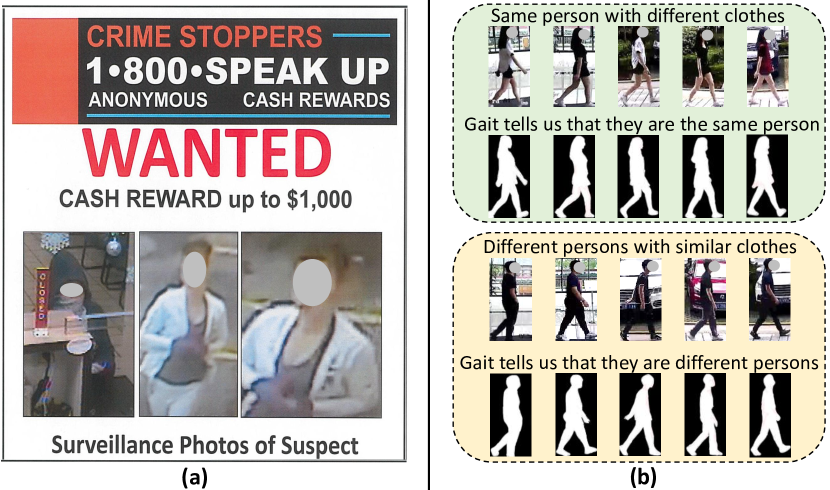
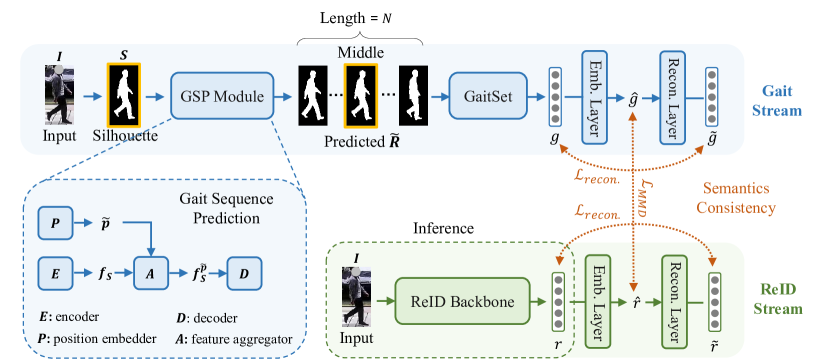
Cloth-Changing person re-identification (CC-ReID) aims at matching the same person across different locations over a long-duration, e.g., over days, and therefore inevitably meets challenge of changing clothing. In this paper, we focus on handling well the CC-ReID problem under a more challenging setting, i.e., just from a single image, which enables high-efficiency and latency-free pedestrian identify for real-time surveillance applications. Specifically, we introduce Gait recognition as an auxiliary task to drive the Image ReID model to learn cloth-agnostic representations by leveraging personal unique and cloth-independent gait information, we name this framework as GI-ReID. GI-ReID adopts a two-stream architecture that consists of a image ReID-Stream and an auxiliary gait recognition stream (Gait-Stream). The Gait-Stream, that is discarded in the inference for high computational efficiency, acts as a regulator to encourage the ReID-Stream to capture cloth-invariant biometric motion features during the training. To get temporal continuous motion cues from a single image, we design a Gait Sequence Prediction (GSP) module for Gait-Stream to enrich gait information. Finally, a high-level semantics consistency over two streams is enforced for effective knowledge regularization. Experiments on multiple image-based Cloth-Changing ReID benchmarks, e.g., LTCC, PRCC, Real28, and VC-Clothes, demonstrate that GI-ReID performs favorably against the state-of-the-arts. Codes are available at https://github.com/jinx-USTC/GI-ReID.
研究の動機と目的
- 監視システムにおいて長時間にわたり衣装が変化する状況下での人物再識別の課題に対処すること。
- 歩行を安定的かつ衣装に依存しないバイオメトリック特徴として活用することで、衣装変化に強い一般化性能を向上させること。
- 動画シーケンスや複雑なデータ収集を必要とせず、単一画像からの低遅延なアイデンティティマッチングを可能にすること。
- 訓練中に歩行特徴を正則化として用いることで、衣装変化に不変で、判別力のある特徴を学習するためのフレームワークを設計すること。
- 最先端のReIDモデルと実世界の展開とのギャップを埋め、推論速度を犠牲にせずに衣装変化に強いモデルを実現すること。
提案手法
- GI-ReIDは二ストリームアーキテクチャを採用:主なReIDストリームはアイデンティティマッチングを担当し、補助的なGait-Streamは推論時に破棄され、効率性が確保される。
- Gait-StreamはGait Sequence Prediction (GSP)モジュールを用い、単一のRGB画像から妥当な歩行シーケンスを生成することで、動きの特徴を強化する。
- GSPモジュールは学習された運動の事前分布を用いて、単一画像入力でも動的歩行特徴にアクセス可能にする。
- ReIDストリームとGaitストリーム間の意味的整合性制約を課し、知識蒸留の正則化を強化し、特徴学習を改善する。
- End-to-endで訓練され、ReID損失(アイデンティティマッチング用)と歩行認識損失(動きに基づく正則化用)の両方を統合的に最適化する。
- 補助的な歩行ストリームは訓練中に正則化器として機能し、歩行に基づく判別性を強調することで、ReIDストリームが衣装変化に不変な特徴を学習するよう促進する。
実験結果
リサーチクエスチョン
- RQ1単一画像から抽出した歩行特徴は、顕著な衣装変化がある状況下でも人物再識別性能を向上させることができるか?
- RQ2どのようにすれば歩行特徴を効果的に正則化器として活用し、画像ベースのReIDにおける衣装に依存しない表現学習を促進できるか?
- RQ3動画入力なしで、単一画像から意味的な歩行シーケンスを生成し、動きの特徴を豊かにできるか?
- RQ4ReIDストリームと歩行ストリーム間の知識蒸留は、衣装変化に強い性能を維持しながら、推論効率を損なわないか?
- RQ5本手法であるGI-ReIDは、長期的な衣装変化を含むベンチマークにおいて、最先端の手法と比較してどのように性能を発揮するか?
主な発見
- PRCCデータセットにおいて、GI-ReIDは衣装変化下で37.55%のランク-1精度を達成し、手作業特徴やディープラーニングモデルを含むすべてのベースライン手法を大きく上回った。
- VC-Clothesベンチマークでは93.76%のランク-1精度を達成し、困難な実世界の衣装変化シナリオにおいても優れた性能を示した。
- 衣装変化がない状況下でも、PRCCで85.97%のランク-1精度を達成し、多数の既存手法を上回った。これは、一般化能力の高さを示している。
- アブレーションスタディの結果、Gait-StreamおよびGSPモジュールが性能向上に不可欠であることが確認され、GSPの除去によりランク-1精度が6.5ポイント低下した。
- ストリーム間の意味的整合性制約により、ランク-1精度が3.5ポイント向上し、効果的な知識正則化の役割が裏付けられた。
- 遮蔽や多人数シナリオにおける歩行予測の失敗ケースであっても、二ストリーム正則化機構のおかげで性能が著しく低下しなかった。
より良い研究を、今すぐ始めましょう
論文の読解から最終レビューまで、研究時間を劇的に削減しましょう。
クレジットカード登録不要
このレビューはAIが作成し、人間の編集者が確認しました。