
[論文レビュー] Complex Mixer for MedMNIST Classification Decathlon
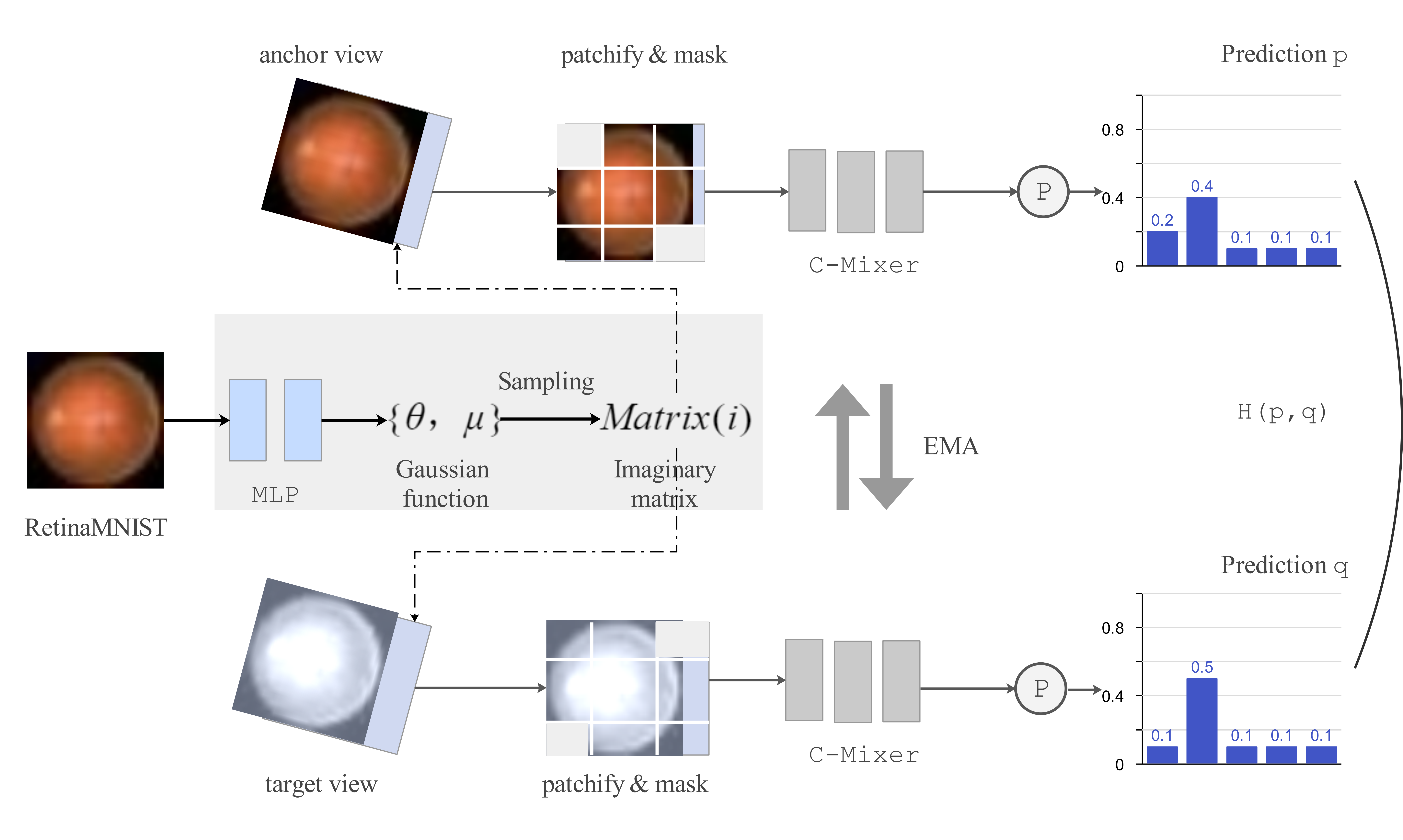
本稿では、ランダムマスキングを用いたインcentive学習および自己教師あり事前学習により、MedMNIST (v2)における情報損失およびラベル不確実性を軽減するため、複素数値特徴空間と頑健な表現学習を活用して、教師あり、弱教師あり、画像強化の各タスクで最先端の性能を達成する複素数 Mixer(C-Mixer)を提案する。
With the development of the medical image field, researchers seek to develop a class of datasets to block the need for medical knowledge, such as ext{MedMNIST} (v2). MedMNIST (v2) includes a large number of small-sized (28 $ imes$ 28 or 28 $ imes$ 28 $ imes$ 28) medical samples and the corresponding expert annotations (class label). The existing baseline model (Google AutoML Vision, ResNet-50+3D) can reach an average accuracy of over 70\% on MedMNIST (v2) datasets, which is comparable to the performance of expert decision-making. Nevertheless, we note that there are two insurmountable obstacles to modeling on MedMNIST (v2): 1) the raw images are cropped to low scales may cause effective recognition information to be dropped and the classifier to have difficulty in tracing accurate decision boundaries; 2) the labelers' subjective insight may cause many uncertainties in the label space. To address these issues, we develop a Complex Mixer (C-Mixer) with a pre-training framework to alleviate the problem of insufficient information and uncertainty in the label space by introducing an incentive imaginary matrix and a self-supervised scheme with random masking. Our method (incentive learning and self-supervised learning with masking) shows surprising potential on both the standard MedMNIST (v2) dataset, the customized weakly supervised datasets, and other image enhancement tasks.
研究の動機と目的
- MedMNIST (v2) における医療画像の極端な縮小(224×224 から 28×28 に)に起因する情報損失の課題に対処し、診断に不可欠な病変の詳細を保持する。
- MedMNIST (v2) における主観的な専門家によるラベル付与に起因するラベル不確実性を軽減し、分類器の汎化性能と性能を向上させる。
- 虚数部を用いて特徴表現の豊かさと意思決定境界の頑健性を向上させる、新たな機械学習パラダイム「複素数値表現学習」を提案する。
- ランダムマスキングを用いた自己教師あり事前学習フレームワークを設計し、モデルの正則化を図り、ラベルノイズ下での汎化性能を向上させる。
- 標準分類、弱教師あり学習、画像強化の多様な医療画像タスクにおいて、本手法の有効性を実証する。
提案手法
- 入力特徴に可学習なガウスノイズ(平均と分散をパラメータとして有する)を注入することでインcentive学習を導入し、認識に適した信号を豊かにし、モデリングコストを低減する。
- 実部と虚数部の特徴表現を組み合わせて複素数空間を構築し、回転不変性および位相に敏感なパターンを学習可能にすることで、意思決定境界の学習を向上させる。
- 画像パッチにランダムマスキングを適用した自己教師あり事前学習スキームを実装し、潜在的正則化を強制し、ラベル不確実性への頑健性を向上させる。
- 複素数値畳み込み層を備えたVision Transformer(ViT)バックボーンを用い、高次元空間における特徴表現を強化する複素数ドメインでの画像処理を実現する。
- 512×512解像度の画像を用い、バッチサイズ8、基本学習率0.001で、L1損失とAdamW最適化手法を用いてC-Mixerを訓練する。
- 標準的な交差エントロピー損失とRandAugmentなどのデータオーグメンテーションを用いて、下流タスクにおける事前学習モデルのファインチューニングを実施する。
実験結果
リサーチクエスチョン
- RQ1可学習なノイズを用いたインcentive学習は、細部が失われる低解像度医療画像における分類性能を向上させることができるか?
- RQ2ランダムマスキングを用いた自己教師あり学習は、MedMNIST (v2) データセットにおけるラベル不確実性の悪影響をどの程度軽減できるか?
- RQ3複素数値特徴表現は、医療画像分類タスクにおける意思決定境界の学習と頑健性を向上させるか?
- RQ4本手法で提案されたC-Mixerは、MSNet や ViT などの既存モデルと比較して、標準的および弱教師あり医療画像ベンチマークにおける精度と汎化性能において優れているか?
- RQ5本手法は分類を越えて、画像強化などの密度予測タスクへも一般化可能か?
主な発見
- エンドツーエンドのファインチューニングにおいて、CIFAR-10 および CIFAR-100 でMSNetに対して2%の絶対的上昇を示し、限られた監視下での優れた汎化性能を実証した。
- 訓練データの10%しか使用しないMNISTデータセットにおいても、本手法はMSNetとほぼ同等の性能を示し、最小限のラベル付きデータ下でも強力な性能を発揮することを示した。
- U-Netベースのアーキテクチャに複素数畳み込み層を適用した場合、特にテクスチャおよび色の回復において顕著な向上を示した。
- ランダムマスキングを用いた自己教師あり事前学習は、モデルの正則化を効果的に実現し、ラベルノイズへの感受性を低減し、類似サンプル間の一貫性を向上させた。
- 広範な実験により、本手法が教師あり、弱教師あり、および密度予測タスクのすべてにおいて優れた性能を発揮することを確認し、その広範な適用可能性を裏付けた。
- 複素数値表現の使用により、低解像度入力下でも高次元空間におけるより頑健な意思決定平面を学習可能となり、汎化性能が向上した。
この論文を読む
Nubintのビューアで原文を開き、読みながら気になる箇所をすぐに質問できます。
Nubintでこの論文を読むこのレビューはAIが論文の原文をもとに作成しました。引用する前に原文をご確認ください。